


Predictive models for type 2 diabetes onset in middle-aged subjects with the metabolic syndrome
- PMID: 23856414
- PMCID: PMC3717122
- DOI: 10.1186/1758-5996-5-36
Predictive models for type 2 diabetes onset in middle-aged subjects with the metabolic syndrome
Abstract
Objective: To investigate the predictive value of different biomarkers for the incidence of type 2 diabetes mellitus (T2DM) in subjects with metabolic syndrome.
Methods: A prospective study of 525 non-diabetic, middle-aged Lithuanian men and women with metabolic syndrome but without overt atherosclerotic diseases during a follow-up period of two to four years. We used logistic regression to develop predictive models for incident cases and to investigate the association between various markers and the onset of T2DM.
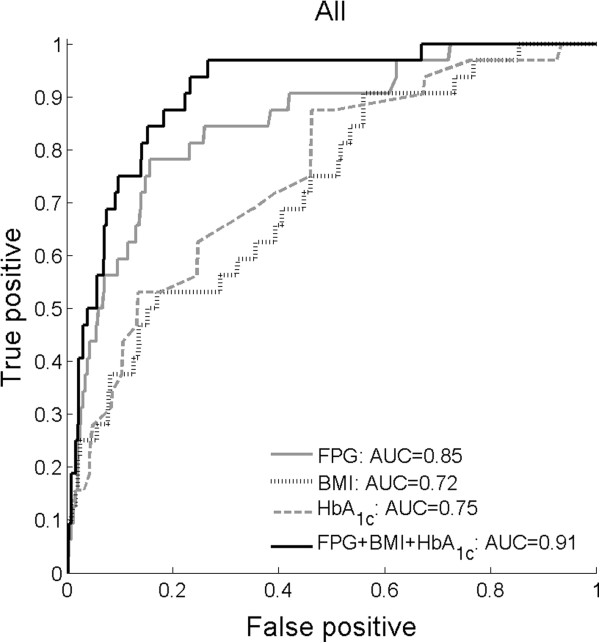
Results: Fasting plasma glucose (FPG), body mass index (BMI), and glycosylated haemoglobin can be used to predict diabetes onset with a high level of accuracy and each was shown to have a cumulative predictive value. The estimated area under the receiver-operating characteristic curve (AUC) for this combination was 0.92. The oral glucose tolerance test (OGTT) did not show cumulative predictive value. Additionally, progression to diabetes was associated with high values of aortic pulse-wave velocity (aPWV).
Conclusion: T2DM onset in middle-aged metabolic syndrome subjects can be predicted with remarkable accuracy using the combination of FPG, BMI, and HbA1c, and is related to elevated aPWV measurements.
Figures
References
-
- Grundy SM, Brewer HB Jr, Cleeman JI, Smith SC Jr, Lenfant C. Definition of metabolic syndrome: report of the National Heart, Lung, and Blood Institute/American Heart Association conference on scientific issues related to definition. Arterioscler Thromb Vasc Biol. 2004;24:e13–e18. - PubMed
-
- Sattar N, McConnachie A, Shaper AG, Blauw GJ, Buckley BM, De Craen AJ, Ford I, Forouhi NG, Freeman DJ, Jukema JW, Lennon L, Macfarlane PW, Murphy MB, Packard CJ, Stott DJ, Westendorp RG, Whincup PH, Shepherd J, Wannamethee SG. Can metabolic syndrome usefully predict cardiovascular disease and diabetes? Outcome data from two prospective studies. Lancet. 2008;371:1927–1935. doi: 10.1016/S0140-6736(08)60602-9. - DOI - PubMed
-
- Grundy SM, Cleeman JI, Daniels SR, Donato KA, Eckel RH, Franklin BA, Gordon DJ, Krauss RM, Savage PJ, Smith SC Jr, Spertus JA, Costa F. Diagnosis and management of the metabolic syndrome. An American Heart Association/National Heart, Lung, and Blood Institute Scientific Statement. Executive summary. Cardiol Rev. 2005;13:322–327. - PubMed
LinkOut - more resources
Full Text Sources
Other Literature Sources
