. 2013 Sep;43(9):867-78.
doi: 10.1016/j.ibmb.2013.07.002. Epub 2013 Jul 12.

Detection of the Wolbachia protein WPIP0282 in mosquito spermathecae: implications for cytoplasmic incompatibility

Affiliations

Detection of the Wolbachia protein WPIP0282 in mosquito spermathecae: implications for cytoplasmic incompatibility

John F Beckmann et al. Insect Biochem Mol Biol. 2013 Sep.

Abstract

Cytoplasmic incompatibility (CI) is a conditional sterility induced by the bacterium Wolbachia pipientis that infects reproductive tissues in many arthropods. Although CI provides a potential tool to control insect vectors of arthropod-borne diseases, the molecular basis for CI induction is unknown. We hypothesized that a Wolbachia-encoded, CI-inducing factor would be enriched in sperm recovered from spermathecae of female mosquitoes. Using SDS-PAGE and mass spectrometry, we detected peptides from the 56 kDa hypothetical protein, encoded by wPip_0282, associated with sperm transferred to females by Wolbachia infected males. We also detected peptides from the same protein in Wolbachia infected ovaries. Homologs of wPip_0282 and the co-transcribed downstream gene, wPip_0283, occur as multiple divergent copies in genomes of CI-inducing strains of Wolbachia. The operon is located in a genomic context that includes mobile genetic elements. The absence of wPip_0282 and wPip_0283 homologs from genomes of Wolbachia in filarial nematodes, as well as other members of the Rickettsiales, suggests a role as a candidate CI effector.

Keywords: 0282; Culex pipiens; Cytoplasmic incompatibility; Mass spectrometry; Mosquito; Wolbachia.


Figures

Figure 1
Figure 1
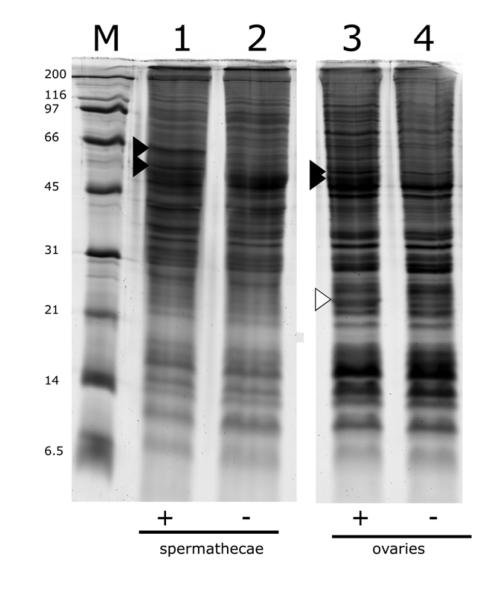
SDS-PAGE analysis of protein extracted from reproductive tissues from Wolbachia- infected and uninfected Culex pipiens mosquitoes. Lane M, molecular mass markers (kDa); lanes 1 and 2, 2400 dissected spermathecal lobes; lanes 3 and 4, 30 ovaries. Positive (+) and negative (−) symbols below the lanes indicate tissue derived from Wolbachia infected mosquitoes and tetracycline cured mosquitoes, respectively. Black arrows indicate bands containing at least three peptides from the WPIP0282 protein. The white arrow in lane 3 indicates the Wolbachia WSP protein band in infected ovaries (see Beckmann et al., 2013) which is absent from spermathecal extracts (lane 1). Microscopic examination of spermathecae was used to confirm that that the mosquitoes had mated and that Wolbachia were absent from the spermathecal tissues.
Figure 2
Figure 2
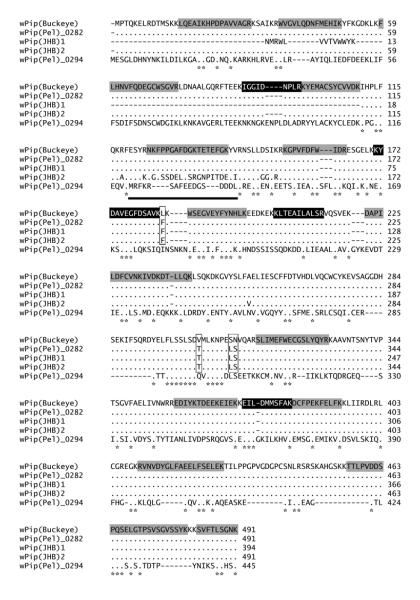
Total mass spectrometry detected peptide coverage of WPIP0282 and a sequence alignment of homologs from Culex pipiens strains of Wolbachia. Dots indicate amino acid identities with respect to wPip(Buckeye). Black shaded residues indicate peptides detected by mass spectrometry in both spermathecal and ovarian samples. Grey shaded residues indicate peptides detected only in ovarian samples. In wPip (Pel)_0282 homologs, vertical boxes indicate regions of divergence with respect to wPip(Buckeye). The bold black underline indicates a region of divergence in wPip(JHB)2. wPip (Pel)_0294 is a distant homolog of wPip (Pel)_0282. Asterisks indicate fully conserved residues.
Figure 3
Figure 3
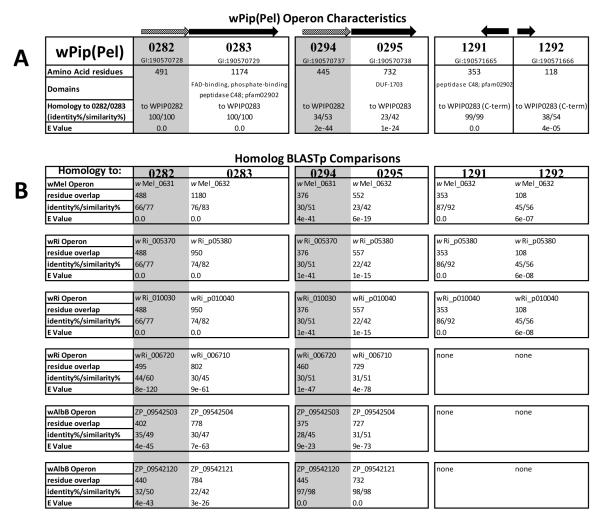
Tabled array of various protein homologs analyzed in this study. A. Organization, characteristics, and BlastP comparisons of all the proteins encoded by the genome of wPip (Pel): WPIP0282/0283, WPIP0294/0295, WPIP1291 and WPIP1292. Arrows at top indicate organization of genes and direction of transcription. Grey-shaded arrows and boxes indicate homologs of wPip_0282; black arrows and unshaded text indicate homologs of wPip_0283. Identity, similarity, and E values are based on amino acid residues. B. BlastP comparisons of homologs in various Wolbachia strains queried against homologs in wPip (Pel).
Figure 4
Figure 4
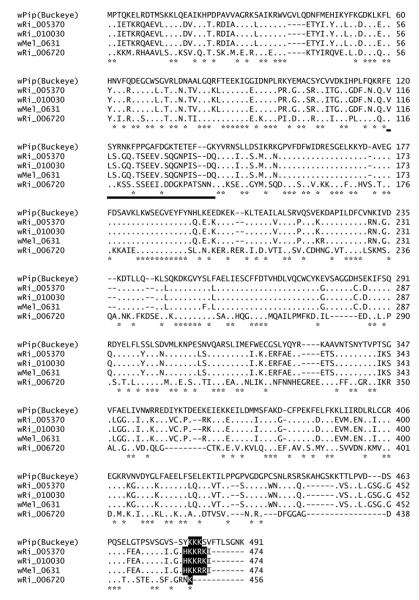
Protein alignments of other WPA0282 homologs within wMel and wRi. Dots indicate identities with respect to wPip(Buckeye) and asterisks indicate fully conserved residues. The bold black underline highlights the region of divergence corresponding to that shown for wPip(JHB)2 in Fig 2. Black shaded residues are conserved C-terminal positively charged residues.
Figure 5
Figure 5
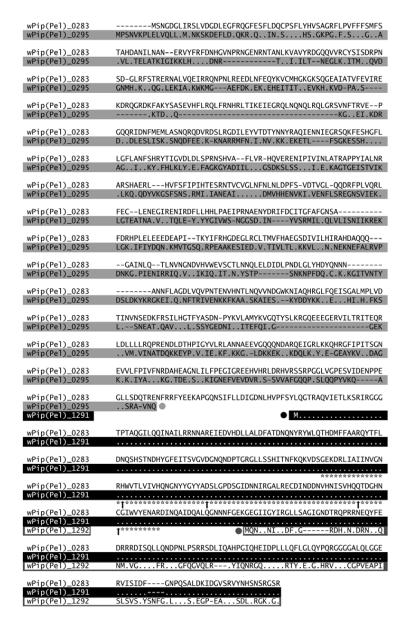
Protein alignments of the second gene in the operon, wPip0283, and its homologs in wPip(Pel). Dots indicate identities with respect to wPip (Pel)_0283. Grey shaded residues show the C-terminally truncated homolog, wPip0295; its terminus is indicated by a grey circle. Black shaded residues show N-terminally truncated homolog, wPip1291; its N-terminus is indicated by a black circle. At the bottom of the alignment dark grey boxed residues show the second N-terminally truncated homolog, wPip1292; its N-terminus is shown by the dark grey circle. Asterisks indicate the eukaryotic Ulp1 Ubiquitin-like C48 SUMO protease domain (pfam02902) with conserved catalytic residues identified by upward black arrows (Li and Hochstrasser, 1999; Mossessova and Lima, 2000). We note that the N-terminus of wPip_1291 begins downstream of the C-terminus of wPip_0295.
Figure 6
Figure 6
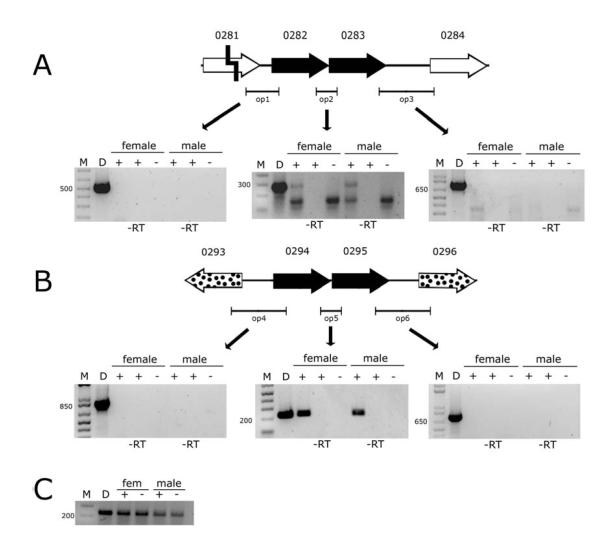
RT-PCR confirmation of operon structure and expression within Wolbachia infected female and male Culex pipiens mosquitoes. A. RT-PCR analysis of 0282-0283 operon. M is a DNA marker. D is a Wolbachia DNA positive PCR control. At the top of the gels, Plus (+) and minus (−) signify Wolbachia infection status. Negative controls were performed using uninfected (−) female and male mosquitoes; and lanes labeled –RT on bottom signify a reaction without reverse transcriptase as a control for DNA contamination of RNA samples. Positions of primers are indicated by horizontal bars labeled op1, op2, and op3. Bands were excised, sequenced, and determined to be the correct PCR/RT-PCR product. B. RT-PCR analysis of 0294-0295 operon. Symbols are as in A. Bands were excised, sequenced, and determined to be the correct PCR/RT-PCR product. C. Quality of RNA samples assayed by RT-PCR using primers for the mosquito ribosomal protein RpS3. Primer attributes are listed in table S1.
Figure 7
Figure 7
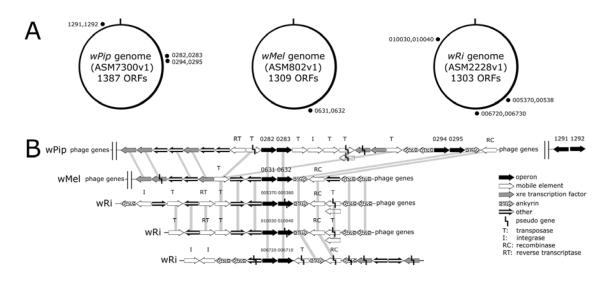
Operon structure and synteny within the three Wolbachia strains, wPip endosymbiont of Culex quinquefaciatus, wMel endosymbiont of Drosophila melanogaster, and wRi endosymbiont of Drosophila simulans. A. Genomes of the three strains with locations of the duplicated operon elements labeled as black dots. In wPip, the operon has been fully duplicated one time with parts of 0283 also being duplicated another two times to 1291 and 1292. In wMel the operon only occurs once. In wRi the operon has been duplicated three times throughout the genome. B. Expanded genome regions including the respective operon elements in the various species. Genes wRi_005380 and wRi_010040 are labeled as pseudo genes within the genome, but still encode a large open reading frame. Genes wPip_0283, wPip _1291, wMel_0632, wRi_p005380, and wRi_p010040 all have a conserved eukaryotic C48 sumo protease protein domain. Gene sizes are not to scale. Vertical shading indicates synteny among genome regions.

References

    1. Bazzocchi C, Comazzi S, Santoni R, Bandi C, Genchi C, Mortarino M. Wolbachia surface protein (WSP) inhibits apoptosis in human neutrophils. Parasite Immunol. 2007;29:73–79. - PubMed
    1. Beckmann JF, Fallon AM. Decapitation improves detection of Wolbachia pipientis (Rickettsiales: Anaplasmataceae) in Culex pipiens (Diptera: Culicidae) mosquitoes by the polymerase chain reaction. J. Med. Entomol. 2012;49:1103–1108. - PMC - PubMed
    1. Beckmann JF, Markowski TW, Witthuhn BA, Fallon AM. Detection of the Wolbachia-encoded DNA binding protein, HU beta, in mosquito gonads. Insect Biochem. Mol. Biol. 2013;43:272–279. http://www.ncbi.nlm.nih.gov/pubmed/23287400. - PMC - PubMed
    1. Benjamin B, Yves B, Corinne A. Assembly of the Tc1 and mariner transposition initiation complexes depends on the origins of their transposase DNA binding domains. Genetica. 2007;130:105–120. - PubMed
    1. Bordenstein SR, Reznikoff WS. Mobile DNA in obligate intracellular bacteria. Nature Rev. Microbiol. 2005;3:688–699. - PubMed

Publication types

Substances