. 2013 Aug 12;173(15):1397-404.
doi: 10.1001/jamainternmed.2013.7734.

Rapid bacterial whole-genome sequencing to enhance diagnostic and public health microbiology

Affiliations

Rapid bacterial whole-genome sequencing to enhance diagnostic and public health microbiology

Sandra Reuter et al. JAMA Intern Med. .

Abstract

Importance: The latest generation of benchtop DNA sequencing platforms can provide an accurate whole-genome sequence (WGS) for a broad range of bacteria in less than a day. These could be used to more effectively contain the spread of multidrug-resistant pathogens.

Objective: To compare WGS with standard clinical microbiology practice for the investigation of nosocomial outbreaks caused by multidrug-resistant bacteria, the identification of genetic determinants of antimicrobial resistance, and typing of other clinically important pathogens.

Design, setting, and participants: A laboratory-based study of hospital inpatients with a range of bacterial infections at Cambridge University Hospitals NHS Foundation Trust, a secondary and tertiary referral center in England, comparing WGS with standard diagnostic microbiology using stored bacterial isolates and clinical information.

Main outcomes and measures: Specimens were taken and processed as part of routine clinical care, and cultured isolates stored and referred for additional reference laboratory testing as necessary. Isolates underwent DNA extraction and library preparation prior to sequencing on the Illumina MiSeq platform. Bioinformatic analyses were performed by persons blinded to the clinical, epidemiologic, and antimicrobial susceptibility data.

Results: We investigated 2 putative nosocomial outbreaks, one caused by vancomycin-resistant Enterococcus faecium and the other by carbapenem-resistant Enterobacter cloacae; WGS accurately discriminated between outbreak and nonoutbreak isolates and was superior to conventional typing methods. We compared WGS with standard methods for the identification of the mechanism of carbapenem resistance in a range of gram-negative bacteria (Acinetobacter baumannii, E cloacae, Escherichia coli, and Klebsiella pneumoniae). This demonstrated concordance between phenotypic and genotypic results, and the ability to determine whether resistance was attributable to the presence of carbapenemases or other resistance mechanisms. Whole-genome sequencing was used to recapitulate reference laboratory typing of clinical isolates of Neisseria meningitidis and to provide extended phylogenetic analyses of these.

Conclusions and relevance: The speed, accuracy, and depth of information provided by WGS platforms to confirm or refute outbreaks in hospitals and the community, and to accurately define transmission of multidrug-resistant and other organisms, represents an important advance.


Figures
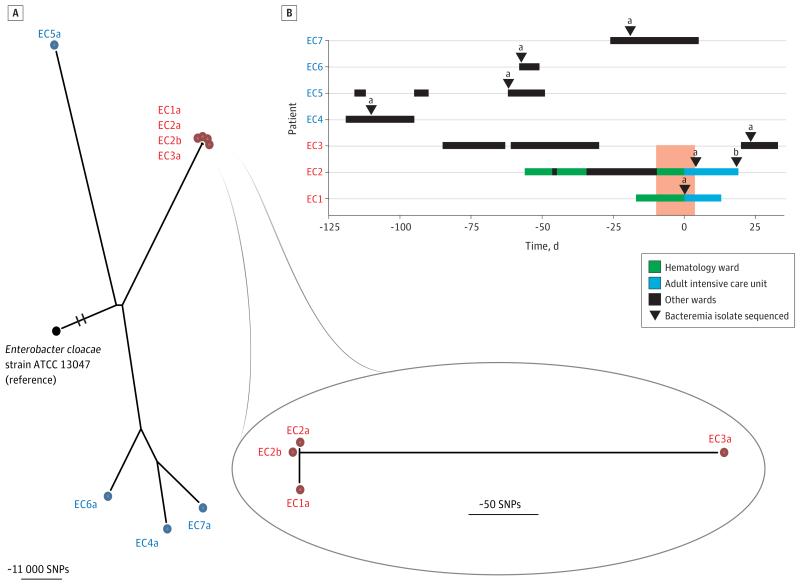
Figure 1
Figure 1. Enterobacter cloacae Outbreak Investigation
A, Phylogenetic tree based on whole-genome sequencing analysis. The whole genome sequence of E cloacae ATCC 13047 was used as the mapping reference. Putative outbreak isolate genomes are shown in red, controls in blue, and the reference isolate in black. The reference genome branch is truncated for clarity. The inset shows a close-up of the suspected outbreak isolates in which the EC1a genome was used as the mapping reference. We concluded that patients EC1 (the index case) and EC2 were involved in the outbreak, but that patient EC3 was unlikely to have been associated with a transmission event from patient EC1 or EC2. SNP indicates single-nucleotide polymorphism. B, Epidemiologic map of 7 patients with E cloacae bacteremia. EC1, EC2, and EC3 (in red) represent patients involved in an infection control investigation, and EC4 through EC7 (in blue) represent patients not linked to the putative outbreak. Day 0 denotes the day of bacteremia in the index case (EC1). One isolate from each patient was sequenced (denoted by the lowercase letter a), with the exception of patient EC2 who had 2 isolates sequenced, a and b (ie, EC2a and EC2b, from blood samples taken 14 days apart). The vertical dark pink block indicates when EC1 and EC2 were both on the same ward.
Figure 2
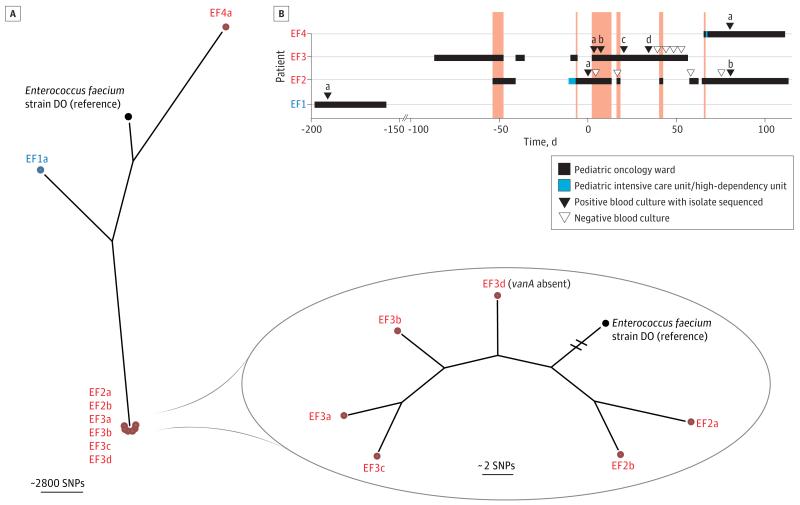
Figure 2. Enterococcus faecium Outbreak Investigation
A, Phylogenetic tree based on whole-genome sequencing analysis. The whole genome sequence of E faecium DO was used as the mapping reference. The genomes of putative outbreak isolates are shown in red, the control in blue, and reference isolate in black. The inset shows a close-up of the suspected outbreak isolates in which the reference genome branch is truncated for clarity. We concluded that patient EF4 was excluded from the outbreak involving patients EF2 and EF3. SNP indicates single-nucleotide polymorphism. B, Epidemiologic map of 4 patients with E faecium bacteremia. EF2, EF3, and EF4 (in red) represent patients involved in an infection control investigation, and EF1 (in blue) represents a patient with bacteremia on the same ward but not linked to the putative outbreak. Day 0 denotes the day of first bacteremia in EF2. The 8 sequenced isolates from 4 patients are labeled a, b, c, and d. The vertical dark pink blocks indicate when patients EF2, EF3, and/or EF4 were present on the same ward at the same time. With the exception of EF3d, all isolates were vancomycin resistant.
Figure 3
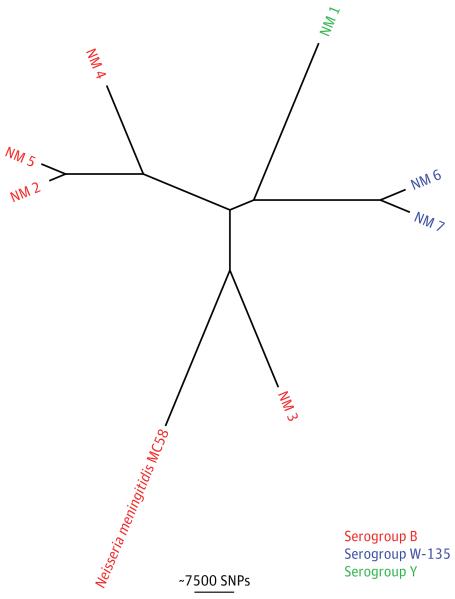
Figure 3. Neisseria meningitidis Phylogenetic Analysis
Phylogenetic tree based on whole-genome sequencing analysis. The whole genome sequence of N meningitidis MC58 was used as the mapping reference. Isolates are color-coded based on the serogroup, which was derived from the sequence data. Phylogenetic distances between isolates do not support a link between any of these cases, which is consistent with the findings of an epidemiologic investigation. SNP indicates single-nucleotide polymorphism.

Comment in

References

    1. Spellberg B, Bartlett JG, Gilbert DN. The future of antibiotics and resistance. N Engl J Med. 2013;368(4):299–302. - PMC - PubMed
    1. Hall BG, Ehrlich GD, Hu FZ. Pan-genome analysis provides much higher strain typing resolution than multilocus sequence typing. Microbiology. 2010;156(Pt 4):1060–1068. - PMC - PubMed
    1. Hiller NL, Ahmed A, Powell E, et al. Generation of genic diversity among Streptococcus pneumoniae strains via horizontal gene transfer during a chronic polyclonal pediatric infection. PLoS Pathog. 2010;6(9):e1001108. - PMC - PubMed
    1. Gardy JL, Johnston JC, Ho Sui SJ, et al. Whole-genome sequencing and social-network analysis of a tuberculosis outbreak. N Engl J Med. 2011;364(8):730–739. - PubMed
    1. Didelot X, Bowden R, Wilson DJ, Peto TE, Crook DW. Transforming clinical microbiology with bacterial genome sequencing. Nat Rev Genet. 2012;13(9):601–612. - PMC - PubMed

Publication types

MeSH terms