. 2013 Jul 22;202(2):211-9.
doi: 10.1083/jcb.201212060. Epub 2013 Jul 15.

CEP120 interacts with CPAP and positively regulates centriole elongation

Affiliations

CEP120 interacts with CPAP and positively regulates centriole elongation

Yi-Nan Lin et al. J Cell Biol. .

Abstract

Centriole duplication begins with the formation of a single procentriole next to a preexisting centriole. CPAP (centrosomal protein 4.1-associated protein) was previously reported to participate in centriole elongation. Here, we show that CEP120 is a cell cycle-regulated protein that directly interacts with CPAP and is required for centriole duplication. CEP120 levels increased gradually from early S to G2/M and decreased significantly after mitosis. Forced overexpression of either CEP120 or CPAP not only induced the assembly of overly long centrioles but also produced atypical supernumerary centrioles that grew from these long centrioles. Depletion of CEP120 inhibited CPAP-induced centriole elongation and vice versa, implying that these proteins work together to regulate centriole elongation. Furthermore, CEP120 was found to contain an N-terminal microtubule-binding domain, a C-terminal dimerization domain, and a centriolar localization domain. Overexpression of a microtubule binding-defective CEP120-K76A mutant significantly suppressed the formation of elongated centrioles. Together, our results indicate that CEP120 is a CPAP-interacting protein that positively regulates centriole elongation.


Figures
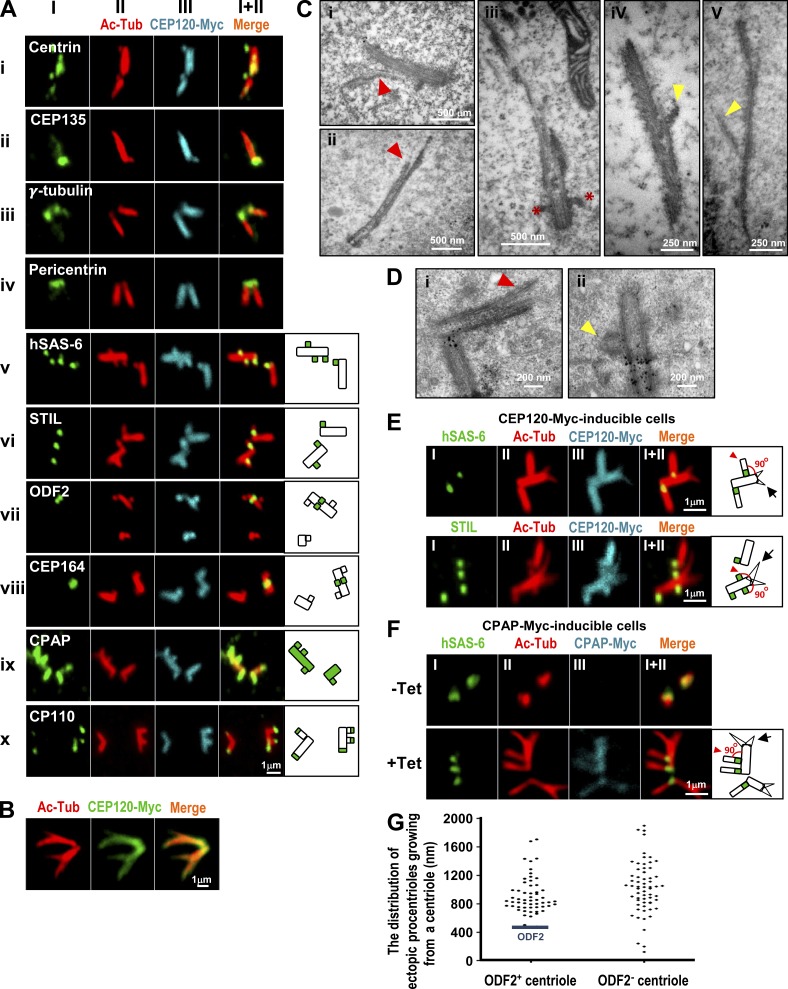
Figure 1.
Figure 1.
Overexpression of either CEP120 or CPAP induces atypical centriole amplification with extra long centrioles. (A–E) CEP120-Myc–inducible cells were treated with Tet for 48 h and analyzed by confocal fluorescence microscopy using the indicated antibodies (A, B, and E) or by EM (C and D). (C and D) The branched or vertically aligned MT-based filaments are marked by red or yellow arrowheads, respectively. Red asterisks in C (iii) represent appendage structures. (D) The small black dots are nonspecific precipitates that possibly formed during sample preparation. (C) The mean length and width of these CEP120-induced filaments were ∼1,000 and ∼195 nm, respectively (n = 40). (F) Excess CPAP induces the formation of atypical supernumerary centrioles from a preexisting centriole. CPAP-Myc–inducible cells were treated without (−Tet) or with (+Tet) Tet for 48 h and analyzed by confocal fluorescence microscopy. (G) The distribution of atypical ectopic procentrioles growing from ODF2-positive or -negative centrioles (n = 119 from a single experiment). CEP120-Myc–inducible cells were treated with Tet for 48 h and immunostained with antibodies against ODF2 and Ac-Tub.
Figure 2.
Figure 2.
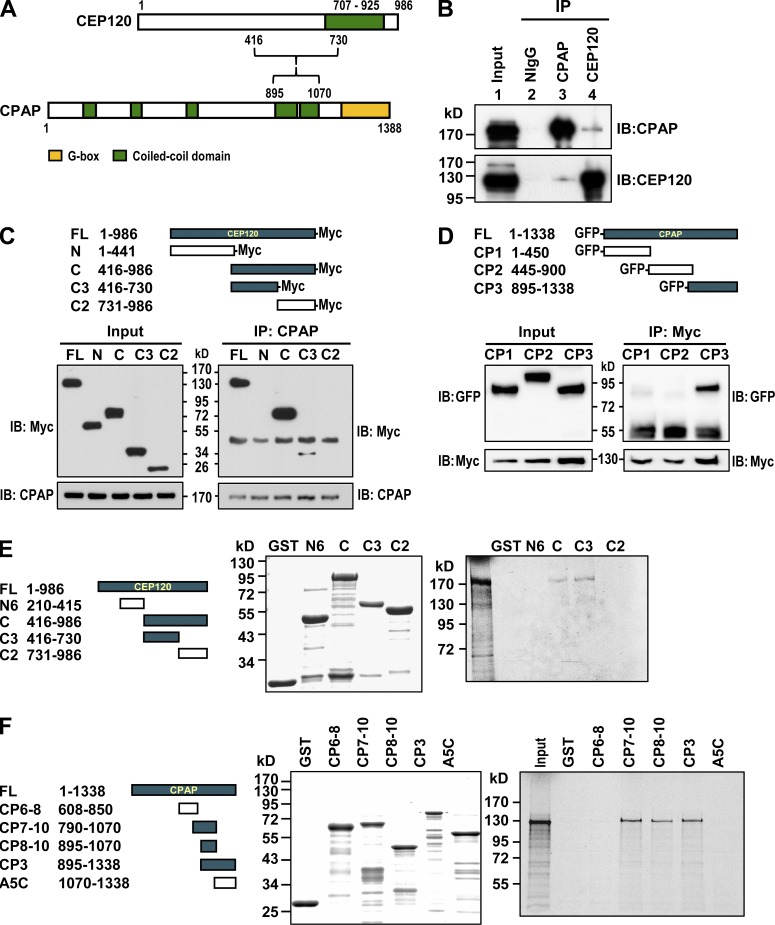
CEP120 interacts with CPAP. (A) A schematic representation of the interaction between CEP120 and CPAP. (B) Coimmunoprecipitation experiments showed that endogenous CEP120 and CPAP form a complex in vivo. (C) CPAP interacts with the C3 domain of CEP120. (D) CEP120 interacts with the CP3 domain of CPAP. (E) Mapping the CPAP-interacting domain in CEP120 by GST pull-down assays. Full-length [35S]methionine-labeled CPAP proteins were incubated with bead-bound GST or various GST-CEP120–truncated proteins and analyzed by SDS-PAGE and autoradiography. (F) Mapping the CEP120-interacting domain in CPAP.
Figure 3.
Figure 3.
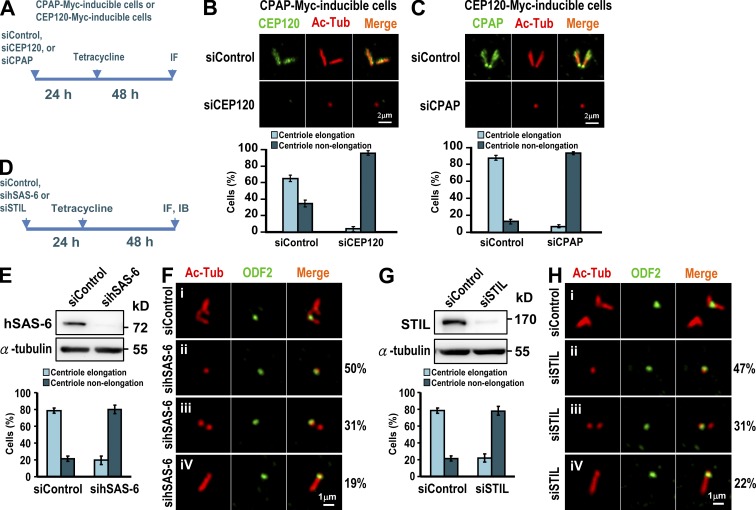
CEP120 cooperates with CPAP to promote centriole elongation and both hSAS-6 and STIL are required for CEP120-induced centriole elongation. (A–C) CPAP-Myc– (B) and CEP120-Myc (C)–inducible cells were treated as shown in A and analyzed by confocal fluorescence microscopy. The percentages of CPAP-Myc– or CEP120-Myc–induced elongated or nonelongated procentrioles formed after siCEP120 (B) or siCPAP (C) treatment are shown. (D–H) Depletion of hSAS-6 or STIL inhibits CEP120-induced centriole elongation. CEP120-Myc–inducible cells were transfected with siControl, sihSAS-6 (E and F), or siSTIL (G and H) as shown in D. Histograms illustrating the percentages of elongated or nonelongated centrioles induced by CEP120 overexpression in sihSAS-6– (E) or siSTIL-treated cells (G). Error bars represent means ± SD of 100 cells from three independent experiments.
Figure 4.
Figure 4.
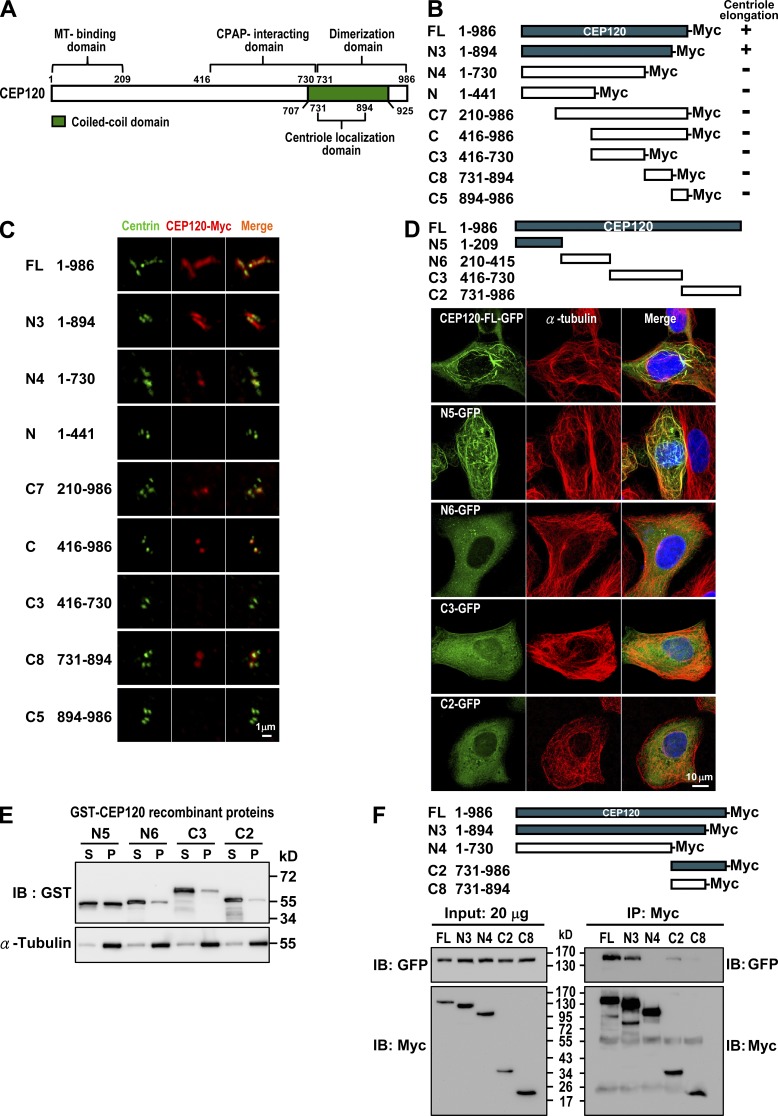
Mapping the functional domains of CEP120. (A) Summary of CEP120 functional domains. (B and C) Mapping the region required for CEP120-induced centriole elongation. U2OS cells were transiently transfected with various CEP120-Myc–truncated constructs (B) and analyzed by confocal fluorescence microscopy using antibodies against centrin and Myc (C). (D and E) Mapping the MT-binding domain in CEP120. Various GFP-tagged CEP120-truncated constructs (D) were transiently expressed in U2OS cells and analyzed by confocal fluorescence microscopy. (E) A MT cosedimentation assay was performed by incubating various recombinant GST-CEP120 proteins with purified tubulins and Taxol (20 µM). The supernatants (S) and pellets (P) were analyzed by immunoblotting. (F) Mapping the dimerization domain in CEP120. HEK 293T cells were cotransfected with various Myc-tagged CEP120-truncated constructs and a full-length CEP120-GFP. 24 h after transfection, cell lysates were analyzed by immunoprecipitation and immunoblotting using the indicated antibodies.
Figure 5.
Figure 5.
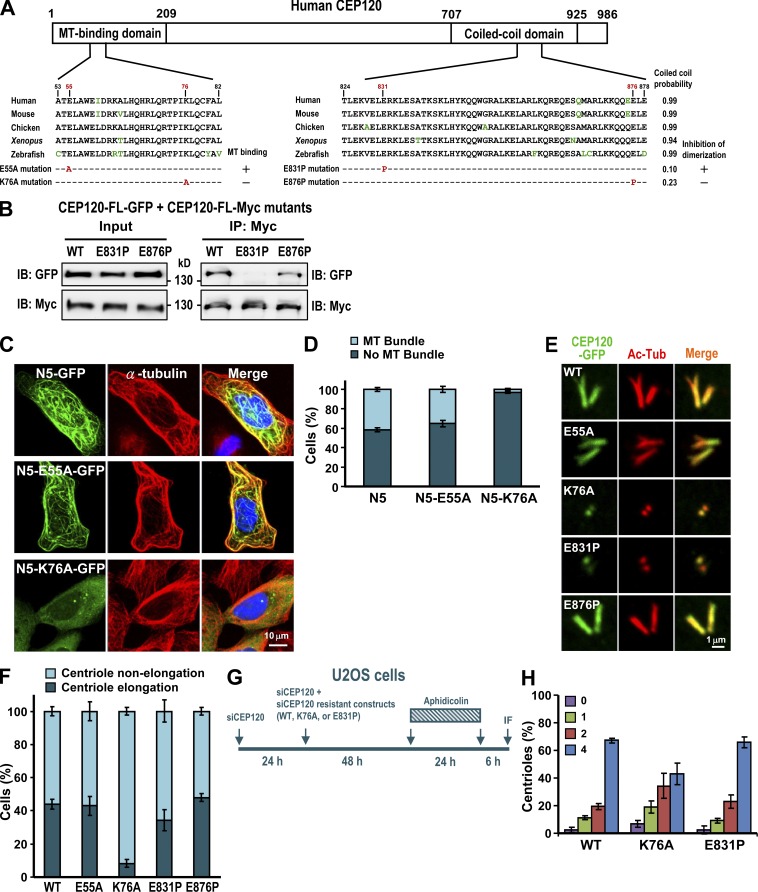
Functional characterization of the MT-binding and dimerization activities of CEP120. (A) Schematic representation of the CEP120 protein showing the mutations in the MT-binding and dimerization domains. (B) The E831P mutant showed decreased dimerization activity. HEK 293T cells were cotransfected with vectors encoding CEP120-FL-GFP and a CEP120-FL-Myc (E831P or E876P) mutant, and cell lysates were analyzed by immunoprecipitation and immunoblotting. (C and D) The N5-GFP-K76A mutant showed reduced MT-binding activity. U2OS cells were transfected with wild-type or mutant N5-GFP constructs. 48 h after transfection, cells were analyzed by confocal fluorescence microscopy (C). The percentages of transfected cDNA constructs that bound to MTs (MT bundle) are shown in D. (E and F) The effects of various CEP120 mutants on centriole elongation. U2OS cells were transfected with wild-type CEP120-FL-GFP or various CEP120-FL-GFP mutant constructs. 48 h after transfection, the cells were analyzed by confocal fluorescence microscopy (E) and the percentages of cells with elongated or nonelongated centrioles were calculated (F). (G and H) The effects of various CEP120 mutants on normal centriole duplication. U2OS cells were treated as described in G. (H) Histogram illustrating the percentages of cells showing various centriole numbers after treatment. Error bars represent means ± SD of 100 cells from three independent experiments.

References

    1. Arquint C., Sonnen K.F., Stierhof Y.D., Nigg E.A. 2012. Cell-cycle-regulated expression of STIL controls centriole number in human cells. J. Cell Sci. 125:1342–1352 10.1242/jcs.099887 - DOI - PubMed
    1. Azimzadeh J., Marshall W.F. 2010. Building the centriole. Curr. Biol. 20:R816–R825 10.1016/j.cub.2010.08.010 - DOI - PMC - PubMed
    1. Bond J., Roberts E., Springell K., Lizarraga S.B., Scott S., Higgins J., Hampshire D.J., Morrison E.E., Leal G.F., Silva E.O., et al. 2005. A centrosomal mechanism involving CDK5RAP2 and CENPJ controls brain size. Nat. Genet. 37:353–355 (published erratum appears in Nat. Genet. 2005. 37:555) 10.1038/ng1539 - DOI - PubMed
    1. Brito D.A., Gouveia S.M., Bettencourt-Dias M. 2012. Deconstructing the centriole: structure and number control. Curr. Opin. Cell Biol. 24:4–13 10.1016/j.ceb.2012.01.003 - DOI - PubMed
    1. Cizmecioglu O., Arnold M., Bahtz R., Settele F., Ehret L., Haselmann-Weiss U., Antony C., Hoffmann I. 2010. Cep152 acts as a scaffold for recruitment of Plk4 and CPAP to the centrosome. J. Cell Biol. 191:731–739 10.1083/jcb.201007107 - DOI - PMC - PubMed

Publication types

MeSH terms

Substances