


Review
doi: 10.1177/197140091302600119.
Epub 2013 Jan 19.
Progressive spinal cord compression due to epidural extramedullary hematopoiesis in thalassemia intermedia. A case report and literature review
Affiliations
- PMID: 23859178
- PMCID: PMC5278874
- DOI: 10.1177/197140091302600119
Item in Clipboard
Review
Progressive spinal cord compression due to epidural extramedullary hematopoiesis in thalassemia intermedia. A case report and literature review
Neuroradiol J.
2013 Feb.
Abstract
Extramedullary hematopoiesis (EMH) can occur in patients with thalassemia intermedia as a physiologic response to insufficient erythropoiesis to meet circulatory demands. Rarely, EMH involve the epidural space causing spinal cord compression. We describe a case of EMH in a 21-year-old man with β-thalassemia intermedia presenting with progressive low back pain, worsening paraparesis and sphincter disturbance. Magnetic resonance imaging (MRI) demonstrated spinal cord compression by EMH epidural mass lesions extending from T3 to T10 levels. An emergency multilevel decompressive laminectomy was performed with excision of the masses and complete rehabilitation of the patient.
Figures
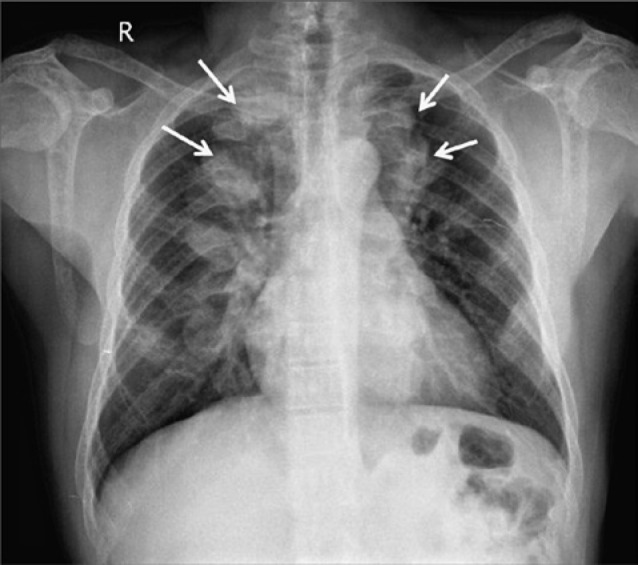
Plain chest X-ray revealed remarkable expansion of the anterior and posterior ends of the ribs (arrows).
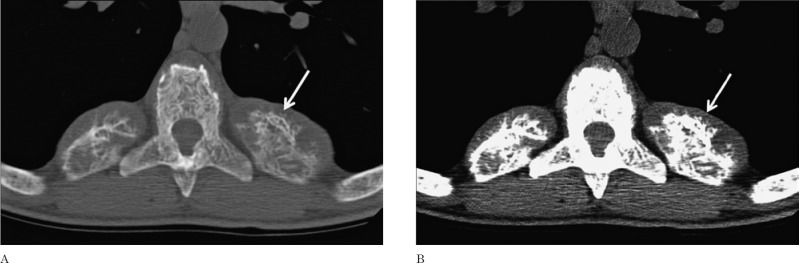
CT chest scan at bone (A) and soft tissue (B) window settings, confirmed remarkable marrow expansion and cortical breakthrough of the ribs with extrapleural soft tissue masses (arrows).
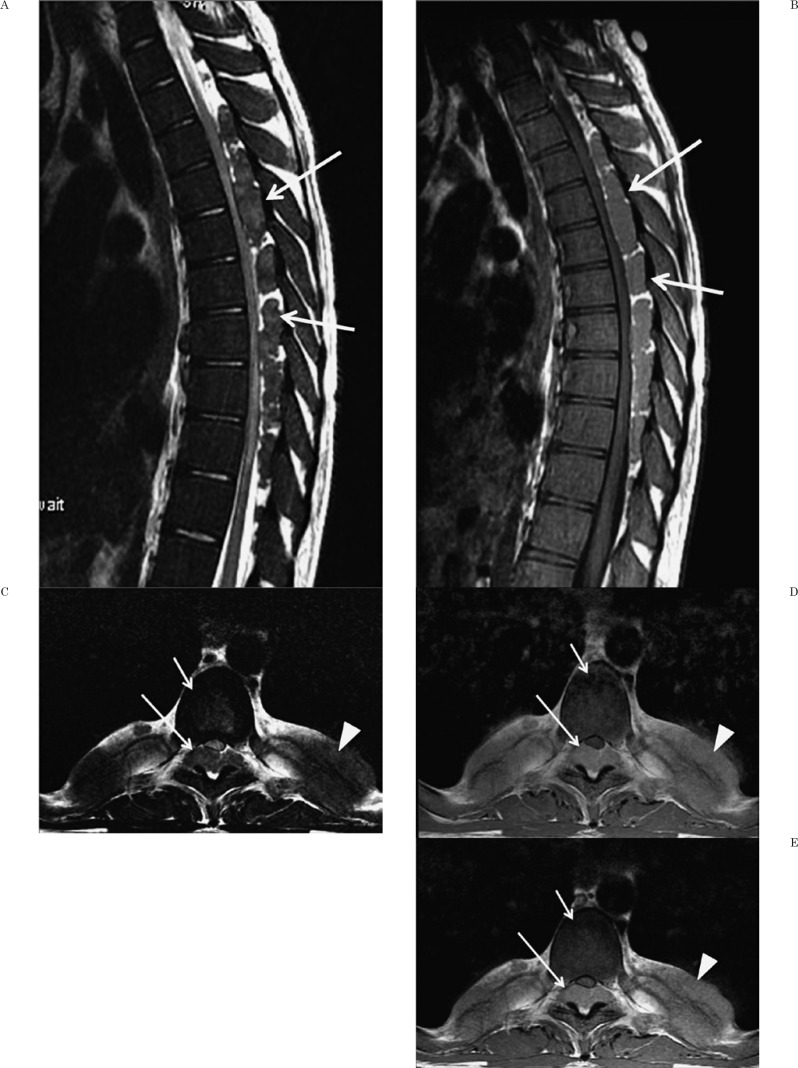
Sagittal MRI of thoracic and lumbar spine (A) T1 W, (B) T2 W fat sat and axial at mid dorsal spine level (C) T1 W (D) T2 W fat sat and (E) T1 W post i.v. Gd fat sat revealed multilevel lobulated posterior epidural extramedullary hemat-opoiesis (EMH) mass lesions extending from T3 to T10. The lesions displayed intermediate signal intensity on T1 and T2 weighted images with mild enhancement in post contrast images. They occupied more than 50% of the spinal canal, compressing the spinal cord anteriorly and thinning it out most at T4 and T5 levels denoting compression myelopathy (long arrows). A diffuse decrease in T1 and T2 bone marrow signal of scanned bones signifying red marrow conversion (short arrows), and bilateral paracostal extraosseous and extrapleural EMH masses were noted displaying a signal pattern similar to the posterior epidural mass lesions (arrowheads).
References
-
- Amirjamshidi A Abbassioun K Ketabchi SE. Spinal extradural hematopoiesis in adolescents with thalassemia. Report of two cases and a review of the literature. Childs Nerv Syst. 1991; 7: 223–225. - PubMed
-
- Aster J Kumar V. White cells, lymph nodes, spleen, and thymus. Pathologic basis of disease. 6th ed. Philadelphia: Saunders; 1997; 644–695.
-
- Ashkzaran H Delanote J Casselman J et al. Epidural extramedullar hematopoiesis. JBR-BTR. 2008; 91: 82–83. - PubMed
-
- Ileri T Azik F Ertem M et al. Extramedullary Hematopoiesis with Spinal Cord Compression in a Child with Thalassemia Intermedia. J Pediatr Hematol Oncol. 2009; 31: 681–683. - PubMed
Publication types
MeSH terms
LinkOut - more resources
Full Text Sources
Other Literature Sources
Research Materials
