


Co-polysomy of chromosome 1q and 19p predicts worse prognosis in 1p/19q codeleted oligodendroglial tumors: FISH analysis of 148 consecutive cases
- PMID: 23861470
- PMCID: PMC3748924
- DOI: 10.1093/neuonc/not092
Co-polysomy of chromosome 1q and 19p predicts worse prognosis in 1p/19q codeleted oligodendroglial tumors: FISH analysis of 148 consecutive cases
Abstract
Background: This study aimed to evaluate the prognostic significance of co-polsomy of chromosome 1q and 19p in 1p/19q codeleted oligodendroglial tumors (ODGs).
Methods: In a series of 148 ODGs with 1p/19q deletion, co-polysomy of 1q and 19p was detected by fluorescence in situ hybridization (FISH). Log-rank analysis and Cox regression methods were used to compare Kaplan-Meier plots and identify factors associated with worse prognosis.
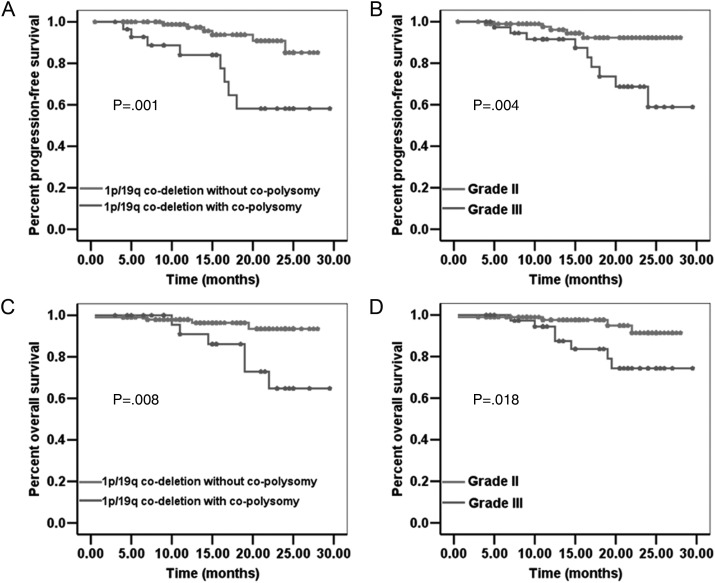
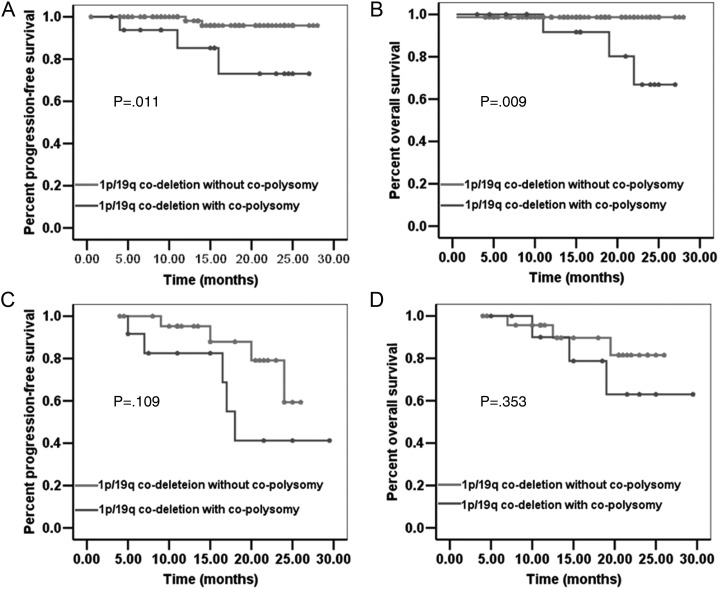
Results: There were 104 (70.3%) low-grade ODGs and 44 (29.7%) high-grade ODGs. Co-polysomy was independently associated with shorter progression-free survival and overall survival in 1p/19q codeleted ODGs, irrespective of tumor grades. The odds ratio of without and with co-polysomy was 0.263 (95% confidence interval [CI], 0.089-0.771; P = .015) for progression-free survival and 0.213 (95% CI, 0.060-0.756; P = .017) for overall survival. Subgroup analysis confirmed this trend in both low-grade and high-grade ODGs, although the P value for high-grade ODGs was marginally significant.
Conclusions: Co-polysomy of 1q and 19p could be used as a marker to independently predict worse prognoses and guide individual therapy in 1p/19q codeleted ODGs.
Keywords: 1p/19q co-deletion; co-polysomy; oligodendroglial tumors; prognosis; survival.
Figures
References
-
- Schwartzbaum JA, Fisher JL, Aldape KD, Wrensch M. Epidemiology and molecular pathology of glioma. Nat Clin Pract Neurol. 2006;2:494–503. 1–516. - PubMed
-
- Ohgaki H, Kleihues P. Epidemiology and etiology of gliomas. Acta Neuropathol. 2005;109:93–108. - PubMed
-
- Jenkins RB, Blair H, Ballman KV, et al. A t(1;19) (q10;p10) mediates the combined deletions of 1p and 19q and predicts a better prognosis of patients with oligodendroglioma. Cancer Res. 2006;66:9852–9861. - PubMed
-
- Wiens AL, Cheng L, Bertsch EC, Johnson KA, Zhang S, Hattab EM. Polysomy of chromosomes 1 and/or 19 is common and associated with less favorable clinical outcome in oligodendrogliomas: fluorescent in situ hybridization analysis of 84 consecutive cases. J Neuropathol Exp Neurol. 2012;71:618–624. - PubMed
Publication types
MeSH terms
Substances
LinkOut - more resources
Full Text Sources
Other Literature Sources
Medical
