


Evaluating potential spectral impacts of various artificial lights on melatonin suppression, photosynthesis, and star visibility
- PMID: 23861808
- PMCID: PMC3702543
- DOI: 10.1371/journal.pone.0067798
Evaluating potential spectral impacts of various artificial lights on melatonin suppression, photosynthesis, and star visibility
Abstract
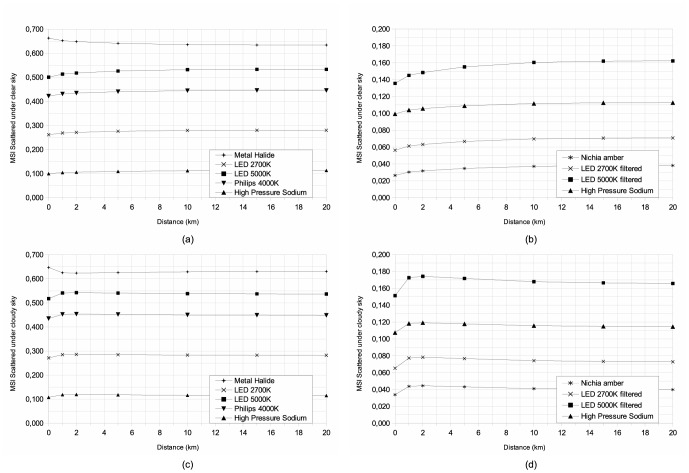
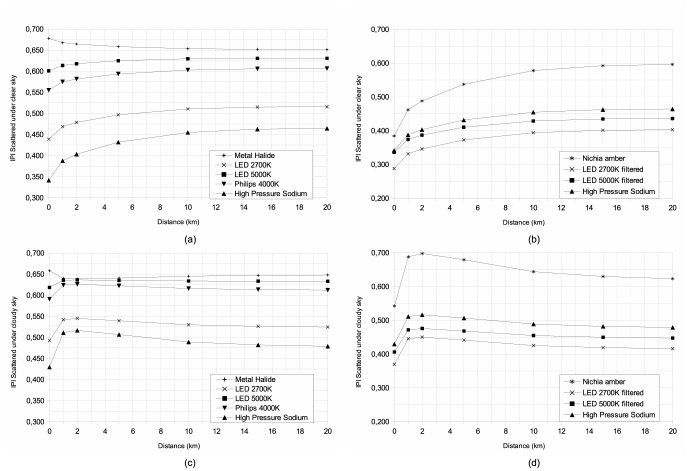
Artificial light at night can be harmful to the environment, and interferes with fauna and flora, star visibility, and human health. To estimate the relative impact of a lighting device, its radiant power, angular photometry and detailed spectral power distribution have to be considered. In this paper we focus on the spectral power distribution. While specific spectral characteristics can be considered harmful during the night, they can be considered advantageous during the day. As an example, while blue-rich Metal Halide lamps can be problematic for human health, star visibility and vegetation photosynthesis during the night, they can be highly appropriate during the day for plant growth and light therapy. In this paper we propose three new indices to characterize lamp spectra. These indices have been designed to allow a quick estimation of the potential impact of a lamp spectrum on melatonin suppression, photosynthesis, and star visibility. We used these new indices to compare various lighting technologies objectively. We also considered the transformation of such indices according to the propagation of light into the atmosphere as a function of distance to the observer. Among other results, we found that low pressure sodium, phosphor-converted amber light emitting diodes (LED) and LED 2700 K lamps filtered with the new Ledtech's Equilib filter showed a lower or equivalent potential impact on melatonin suppression and star visibility in comparison to high pressure sodium lamps. Low pressure sodium, LED 5000 K-filtered and LED 2700 K-filtered lamps had a lower impact on photosynthesis than did high pressure sodium lamps. Finally, we propose these indices as new standards for the lighting industry to be used in characterizing their lighting technologies. We hope that their use will favor the design of new environmentally and health-friendly lighting technologies.
Conflict of interest statement
Figures

References
-
- Cinzano P, Falchi PF, Elvidge CD (2001) The first world atlas of the artificial night sky brightness. Mon Not R Astron Soc 328: 689–707.
-
- Longcore T, Rich C (2004) Ecological light pollution. Front Ecol Environ 2(4): 191–198.
-
- Rich C, Longcore T (2006) Ecological consequences of artificial night lighting. Washington DC: Island Press. 478 p.
-
- Navara KJ, Nelson RJ (2007) The dark side of light at night: physiological, epidemiological, and ecological consequences. J Pineal Res 43: 215–224. - PubMed
-
- Bruce-White C, Shardlow M (2011) A review of the impact of artificial light on invertebrates: Putting the backbone into invertebrate conservation. Peterborough, UK: Buglife – The Invertebrate Conservation Trust. 32 p.
Publication types
MeSH terms
Substances
LinkOut - more resources
Full Text Sources
Other Literature Sources
Research Materials
