Targeting of low-dose CT screening according to the risk of lung-cancer death
- PMID: 23863051
- PMCID: PMC3783654
- DOI: 10.1056/NEJMoa1301851
Targeting of low-dose CT screening according to the risk of lung-cancer death
Abstract
Background: In the National Lung Screening Trial (NLST), screening with low-dose computed tomography (CT) resulted in a 20% reduction in lung-cancer mortality among participants between the ages of 55 and 74 years with a minimum of 30 pack-years of smoking and no more than 15 years since quitting. It is not known whether the benefits and potential harms of such screening vary according to lung-cancer risk.
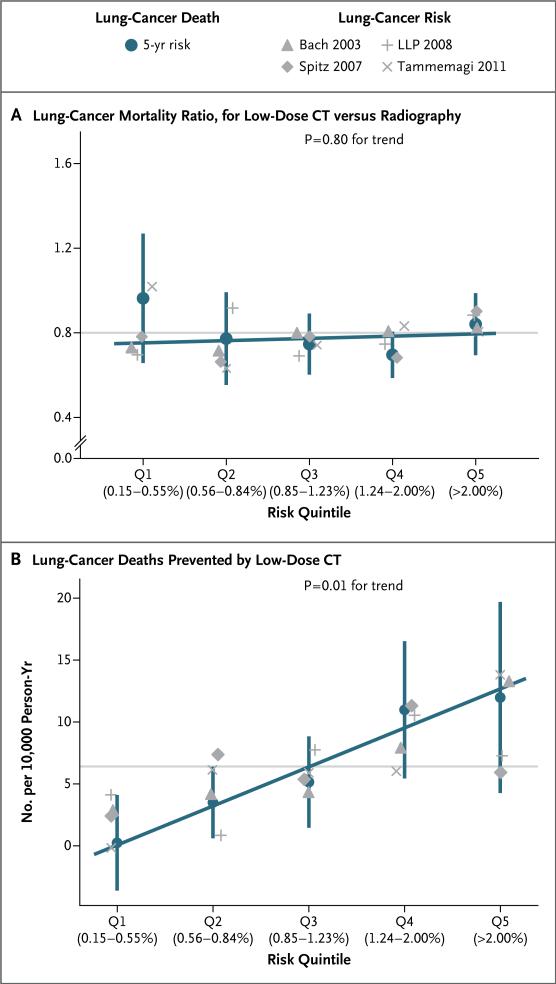
Methods: We assessed the variation in efficacy, the number of false positive results, and the number of lung-cancer deaths prevented among 26,604 participants in the NLST who underwent low-dose CT screening, as compared with the 26,554 participants who underwent chest radiography, according to the quintile of 5-year risk of lung-cancer death (ranging from 0.15 to 0.55% in the lowest-risk group [quintile 1] to more than 2.00% in the highest-risk group [quintile 5]).
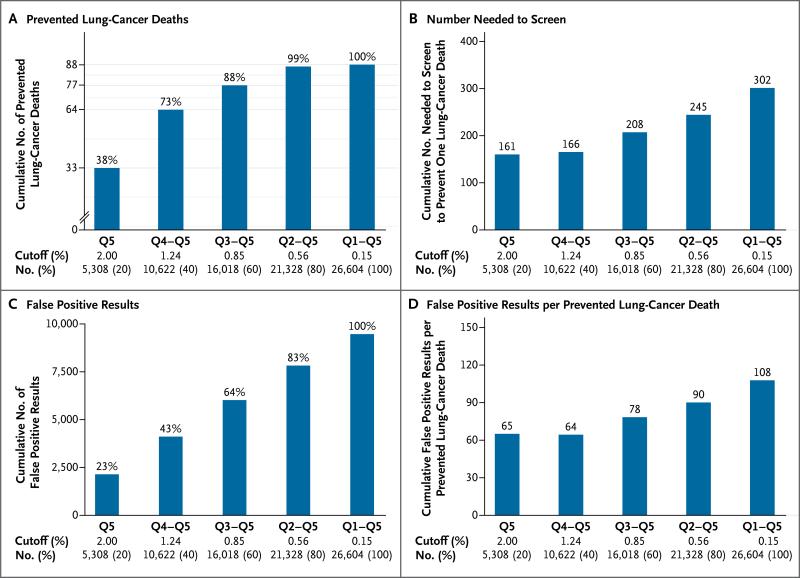
Results: The number of lung-cancer deaths per 10,000 person-years that were prevented in the CT-screening group, as compared with the radiography group, increased according to risk quintile (0.2 in quintile 1, 3.5 in quintile 2, 5.1 in quintile 3, 11.0 in quintile 4, and 12.0 in quintile 5; P=0.01 for trend). Across risk quintiles, there were significant decreasing trends in the number of participants with false positive results per screening-prevented lung-cancer death (1648 in quintile 1, 181 in quintile 2, 147 in quintile 3, 64 in quintile 4, and 65 in quintile 5). The 60% of participants at highest risk for lung-cancer death (quintiles 3 through 5) accounted for 88% of the screening-prevented lung-cancer deaths and for 64% of participants with false positive results. The 20% of participants at lowest risk (quintile 1) accounted for only 1% of prevented lung-cancer deaths.
Conclusions: Screening with low-dose CT prevented the greatest number of deaths from lung cancer among participants who were at highest risk and prevented very few deaths among those at lowest risk. These findings provide empirical support for risk-based targeting of smokers for such screening. (Funded by the National Cancer Institute.).
Figures
Comment in
-
[Targeting of low-dose CT screening in prevention of lung cancer?].Dtsch Med Wochenschr. 2013 Sep;138(36):1754. doi: 10.1055/s-0032-1329057. Epub 2013 Sep 3. Dtsch Med Wochenschr. 2013. PMID: 24002872 German. No abstract available.
-
[Lung cancer--selective use of low-dose CT in early detection?].Rofo. 2014 Jan;186(1):8. Rofo. 2014. PMID: 24511598 German. No abstract available.
References
Publication types
MeSH terms
Grants and funding
- N01 CN025512/CA/NCI NIH HHS/United States
- U01 CA080098/CA/NCI NIH HHS/United States
- N01 CN025511/CA/NCI NIH HHS/United States
- N01 CN025516/CA/NCI NIH HHS/United States
- N02 CN063300/CA/NCI NIH HHS/United States
- U01 CA079778/CA/NCI NIH HHS/United States
- N01 CN025518/CA/NCI NIH HHS/United States
- N01 CN025515/CA/NCI NIH HHS/United States
- Z99 CA999999/ImNIH/Intramural NIH HHS/United States
- N01 CN025514/CA/NCI NIH HHS/United States
- N01 CN025522/CA/NCI NIH HHS/United States
- N01 CN025513/CA/NCI NIH HHS/United States
- N01 CN025524/CA/NCI NIH HHS/United States
- N01 CN025476/CA/NCI NIH HHS/United States
- Y99 CA999999/CA/NCI NIH HHS/United States
- N01 CN075022/CA/NCI NIH HHS/United States
LinkOut - more resources
Full Text Sources
Other Literature Sources
Medical