Review
. 2013 Jul 16;5(7):1758-86.
doi: 10.3390/v5071758.

Chromatin dynamics during lytic infection with herpes simplex virus 1

Affiliations
Review

Chromatin dynamics during lytic infection with herpes simplex virus 1

Kristen L Conn et al. Viruses. .

Abstract

Latent HSV-1 genomes are chromatinized with silencing marks. Since 2004, however, there has been an apparent inconsistency in the studies of the chromatinization of the HSV-1 genomes in lytically infected cells. Nuclease protection and chromatin immunoprecipitation assays suggested that the genomes were not regularly chromatinized, having only low histone occupancy. However, the chromatin modifications associated with transcribed and non-transcribed HSV-1 genes were those associated with active or repressed transcription, respectively. Moreover, the three critical HSV-1 transcriptional activators all had the capability to induce chromatin remodelling, and interacted with critical chromatin modifying enzymes. Depletion or overexpression of some, but not all, chromatin modifying proteins affected HSV-1 transcription, but often in unexpected manners. Since 2010, it has become clear that both cellular and HSV-1 chromatins are highly dynamic in infected cells. These dynamics reconcile the weak interactions between HSV-1 genomes and chromatin proteins, detected by nuclease protection and chromatin immunoprecipitation, with the proposed regulation of HSV-1 gene expression by chromatin, supported by the marks in the chromatin in the viral genomes and the abilities of the HSV-1 transcription activators to modulate chromatin. It also explains the sometimes unexpected results of interventions to modulate chromatin remodelling activities in infected cells.


Figures
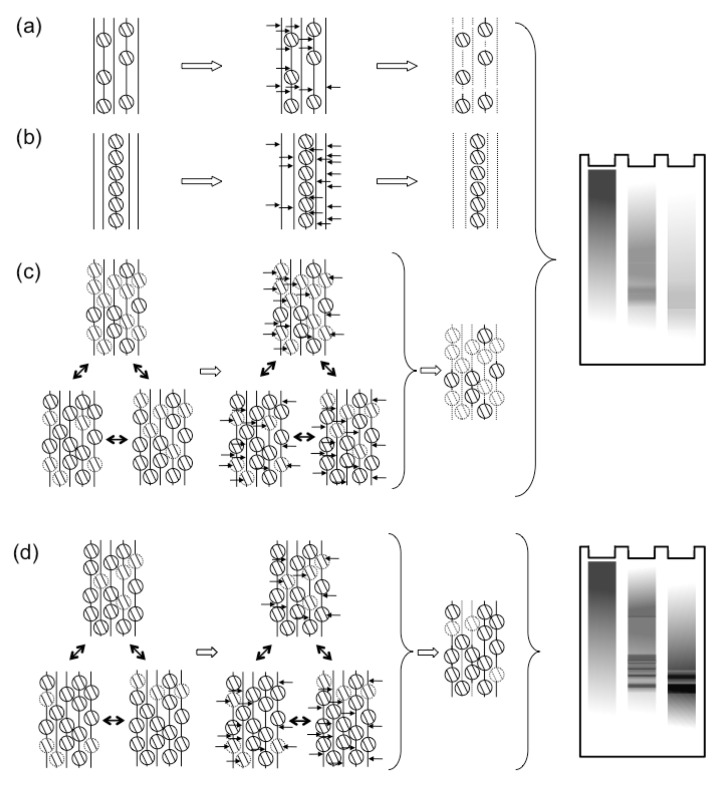
Figure 1
Figure 1
The dynamics of HSV-1 nucleosomes in lytic or latent infections. (a, b) Classic models proposed that most HSV-1 genomes were not properly chromatinized in lytic infections. Either all genomes were proposed to have only sporadic nucleosomes, or some genomes were proposed to be chromatinized, whereas most were proposed to not associate with nucleosomes. Both models would result in the observed protection from MCN digestion to mostly fragments of variable sizes, which show as a “smear” in Southern blots. In contrast, latent genomes were proposed to be normally chromatinized. In these classic models, the difference between lytic and latent viral genomes was qualitative (i.e., non‑chromatinized or chromatinized, respectively). (c) More recent evidence points to the HSV-1 genomes forming unstable nucleosomes, which unbind during the digestion, failing to protect the viral DNA. (d) In contrast, latent or quiescent HSV-1 genomes are in far more stable nucleosomes, which protect their DNA from MCN digestion, resulting in the typical “nucleosome ladder”. According to the more recent evidence, the difference between lytic and latent HSV-1 genomes is quantitative (i.e., different degree of nucleosome stability).
Figure 2
Figure 2
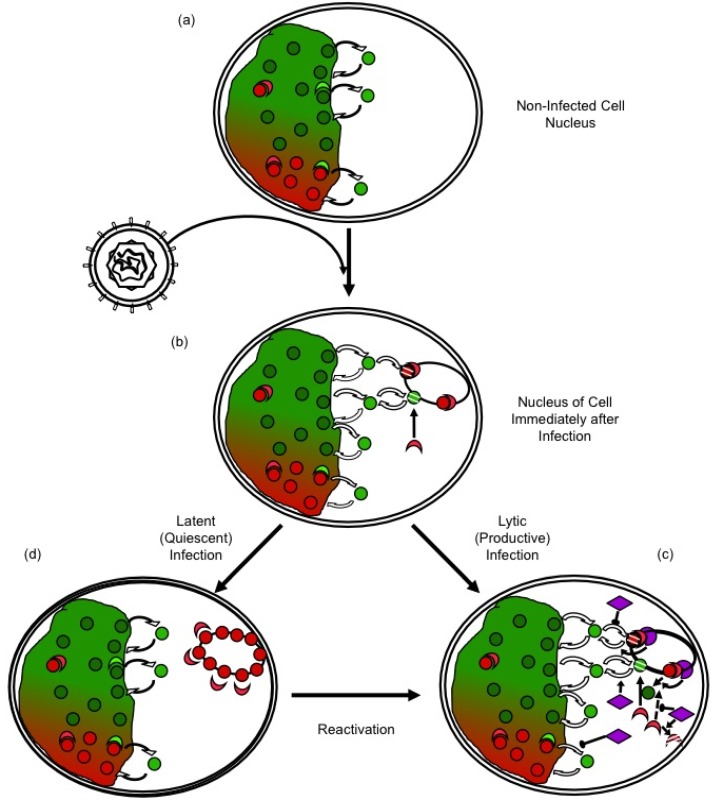
Regulation of HSV-1 gene expression by chromatin silencing and anti-silencing. (a) In the nuclei of non infected cells, histones (red and green circles) unbind from chromatin, diffuse through the nucleus and rebind to a different site. The diffusing histones are bound to histone chaperones in the “free pool”. Histones exchange in both transcribed (green) and silenced (red) chromatin, but at different rates. Chromatin modifying enzymes (crescent shapes) modulate histone dynamics by modulating affinity for chromatin, DNA, or other proteins. (b) Immediately after nuclear entry, HSV-1 genomes are complexed by the cell in silencing chromatin (red), to which further silencing chromatin modifying proteins are recruited (red crescent shapes). (c) In productive infections, HSV-1 proteins (purple) mobilize histones away from the viral genomes, by indirectly modulating their PTM, availability, localization, or interaction with other proteins, and recruiting activating chromatin modifying proteins (green crescents). (d) Viral genes are then transcribed and the genomes are replicated. In latent or quiescent infections, the initial silencing chromatin is not disrupted efficiently, leading to the formation of (almost) fully silenced chromatin, which must be disrupted for reactivation to occur.

References

    1. Wilson A.C., LaMarco K., Peterson M.G., Herr W. The vp16 accessory protein hcf is a family of polypeptides processed from a large precursor protein. Cell. 1993;74:115–125. doi: 10.1016/0092-8674(93)90299-6. - DOI - PubMed
    1. Kristie T.M., Roizman B. Host-cell proteins bind to the cis-acting site required for virion-mediated induction of herpes-simplex virus-1 alpha-genes. Proc. Natl. Acad. Sci. USA. 1987;84:71–75. doi: 10.1073/pnas.84.1.71. - DOI - PMC - PubMed
    1. Ohare P., Goding C.R., Haigh A. Direct combinatorial interaction between a herpes-simplex virus regulatory protein and a cellular octamer-binding factor mediates specific induction of virus immediate-early gene-expression. EMBO J. 1988;7:4231–4238. - PMC - PubMed
    1. Ohare P., Goding C.R. Herpes-simplex virus regulatory elements and the immunoglobulin octamer domain bind a common factor and are both targets for virion transactivation. Cell. 1988;52:435–445. doi: 10.1016/S0092-8674(88)80036-9. - DOI - PubMed
    1. Preston C.M., Frame M.C., Campbell M.E.M. A complex formed between cell components and an hsv structural polypeptide binds to a viral immediate early gene regulatory DNA-sequence. Cell. 1988;52:425–434. doi: 10.1016/S0092-8674(88)80035-7. - DOI - PubMed

Publication types

LinkOut - more resources