. 2013 Oct;110(8):1733-43.
doi: 10.1152/jn.00955.2012. Epub 2013 Jul 17.

Regulation of epileptiform discharges in rat neocortex by HCN channels

Affiliations

Regulation of epileptiform discharges in rat neocortex by HCN channels

Asher J Albertson et al. J Neurophysiol. 2013 Oct.

Abstract

Hyperpolarization-activated, cyclic nucleotide-gated, nonspecific cation (HCN) channels have a well-characterized role in regulation of cellular excitability and network activity. The role of these channels in control of epileptiform discharges is less thoroughly understood. This is especially pertinent given the altered HCN channel expression in epilepsy. We hypothesized that inhibition of HCN channels would enhance bicuculline-induced epileptiform discharges. Whole cell recordings were obtained from layer (L)2/3 and L5 pyramidal neurons and L1 and L5 GABAergic interneurons. In the presence of bicuculline (10 μM), HCN channel inhibition with ZD 7288 (20 μM) significantly increased the magnitude (defined as area) of evoked epileptiform events in both L2/3 and L5 neurons. We recorded activity associated with epileptiform discharges in L1 and L5 interneurons to test the hypothesis that HCN channels regulate excitatory synaptic inputs differently in interneurons versus pyramidal neurons. HCN channel inhibition increased the magnitude of epileptiform events in both L1 and L5 interneurons. The increased magnitude of epileptiform events in both pyramidal cells and interneurons was due to an increase in network activity, since holding cells at depolarized potentials under voltage-clamp conditions to minimize HCN channel opening did not prevent enhancement in the presence of ZD 7288. In neurons recorded with ZD 7288-containing pipettes, bath application of the noninactivating inward cationic current (Ih) antagonist still produced increases in epileptiform responses. These results show that epileptiform discharges in disinhibited rat neocortex are modulated by HCN channels.

Keywords: HCN channels; Ih; epilepsy; epileptiform discharges; inhibitory interneurons; neocortex.


Figures

Fig. 1.
Fig. 1.
Effects of noninactivating inward cationic current (Ih) inhibition on evoked epileptiform discharges in neocortical L5 pyramidal cells. A: specimen records showing epileptiform events evoked by L5 stimulation in a L5 pyramidal cell before (Control, black) and after (gray) ZD 7288. B: summary of effects of ZD 7288 on evoked paroxysmal discharges. Epileptiform discharges were quantified by determining the area under the membrane depolarization associated with epileptiform responses (left) and the number of superimposed action potentials (APs) (right). Responses from individual neurons and mean responses before and during bath application of the Ih antagonist ZD 7288 are shown. ZD 7288 significantly increased the area of epileptiform events in L5 pyramidal neurons, whereas the number of overlying APs was not significantly changed (ns). C: epileptiform events after L2/3 stimulation in a L5 pyramidal neuron before (black) and after (gray) ZD 7288. D: similar to B but after L2/3 stimulation. ZD 7288 significantly increases both the area of epileptiform events and the number of overlying spikes in L5 pyramidal neurons after L2/3 stimulation. *P < 0.05.
Fig. 2.
Fig. 2.
Evoked epileptiform discharges in neocortical L2/3 pyramidal cells before and after bath application of ZD 7288. A: specimen records showing epileptiform events evoked by L5 stimulation in a L2/3 pyramidal neuron before (black) and after (gray) ZD 7288. Responses occurred at a shorter latency and had a longer duration in the presence of the drug. B: summary plots of the area under the membrane depolarization associated with epileptiform events (left) and the number of superimposed APs (right) under control conditions and after bath application of ZD 7288. Responses from individual neurons and mean responses are shown. ZD 7288 significantly increases the area of epileptiform events in L2/3 pyramidal neurons but does not significantly affect the number of overlying APs after L5 stimulation. C: epileptiform event evoked by L2/3 stimulation in a L2/3 pyramidal neuron before (black) and after (gray) ZD 7288. D: similar to B but after L2/3 stimulation. ZD 7288 significantly increased the area of epileptiform events but not the number of overlying spikes in L5 pyramidal neurons after L2/3 stimulation. *P < 0.05.
Fig. 3.
Fig. 3.
Ih inhibition enhances epileptiform responses in L5 GABAergic interneurons. A, left: photomicrograph of biocytin-labeled cell showing morphology of a typical L5 interneuron. Scale bar, 20 μm. Right: specimen records showing repetitive firing properties of the recorded interneuron. Inset shows firing on an expanded timescale. Firing showed no accommodation, and each AP was followed by a prominent afterhyperpolarization (AHP). B: specimen records showing responses to a series of hyperpolarizing current steps. Small “sag” responses were seen with large hyperpolarizations. C: superimposed specimen records show responses to stimulation at low stimulus intensities before and after Ih inhibition. D: summary plots showing that ZD 7288 significantly increases the area of epileptiform events in L5 interneurons. E: typical responses evoked by a stronger stimulation before and during application of ZD 7288. F: bath application of ZD 7288 resulted in enhanced responses to strong stimulation. *P < 0.05.
Fig. 4.
Fig. 4.
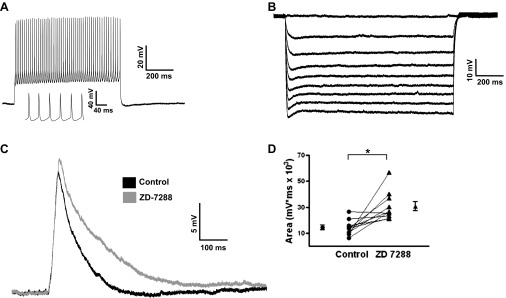
Epileptiform events in L1 interneurons are enhanced after Ih inhibition. A: specimen record of a response to a depolarizing current pulse in a L1 interneuron. No accommodation was observed, and each AP was followed by an AHP. B: examples of L1 interneuron responses to hyperpolarizing current pulses show small sag responses and no rebound depolarizations. C: synaptic responses in a L1 interneuron before (black) and after (gray) ZD 7288. D: ZD 7288 significantly enhances the area of evoked events in L1 interneurons. *P < 0.05.
Fig. 5.
Fig. 5.
Role of network activity in Ih modulation of epileptiform discharges. A: epileptiform events in a L5 pyramidal cell voltage-clamped at −60 mV before (black) and after (gray) ZD 7288. Responses were still prolonged under voltage-clamp conditions. B: summary plot showing that ZD 7288 significantly increases the area of epileptiform events in L5 pyramidal cells clamped at −60 mV to minimize Ih activation. C: specimen records of epileptiform discharges in an L1 interneuron voltage-clamped at −60 mV before (black) and after (gray) ZD 7288. D: summary plot illustrating that, under voltage-clamp conditions, ZD 7288 still significantly increases the area of epileptiform events. *P < 0.05.

References

    1. Agmon A, Wells JE. The role of the hyperpolarization-activated cationic current Ih in the timing of interictal bursts in the neonatal hippocampus. J Neurosci 23: 3658–3668, 2003 - PMC - PubMed
    1. Albertson AJ, Yang J, Hablitz JJ. Decreased hyperpolarization-activated currents in layer 5 pyramidal neurons enhance excitability in focal cortical dysplasia. J Neurophysiol 106: 2189–2200, 2011 - PMC - PubMed
    1. Alefeld M, Sutor B, Luhmann HJ. Pattern and pharmacology of propagating epileptiform discharges in mouse cerebral cortex. Exp Neurol 153: 113–122, 1998 - PubMed
    1. Ali AB, Deuchars J, Pawelzik H, Thomson AM. CA1 pyramidal to basket and bistratified cell EPSPs: dual intracellular recordings in rat hippocampal slices. J Physiol 507: 201–217, 1998 - PMC - PubMed
    1. Aponte Y, Lien CC, Reisinger E, Jonas P. Hyperpolarization-activated cation channels in fast-spiking interneurons of rat hippocampus. J Physiol 574: 229–243, 2006 - PMC - PubMed

Publication types

MeSH terms