


Remarkable anti-trichomonas vaginalis activity of plants traditionally used by the Mbyá-Guarani indigenous group in Brazil
- PMID: 23865068
- PMCID: PMC3705823
- DOI: 10.1155/2013/826370
Remarkable anti-trichomonas vaginalis activity of plants traditionally used by the Mbyá-Guarani indigenous group in Brazil
Abstract
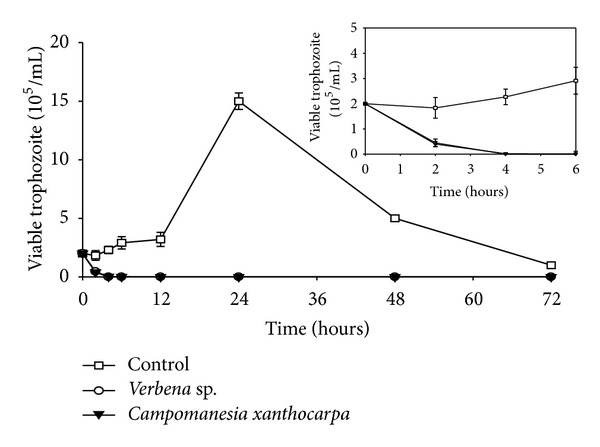
Trichomonas vaginalis, a flagellate protozoan, is the causative agent of trichomonosis, the most common nonviral sexually transmitted disease worldwide. Taking into account the increased prevalence of metronidazole-resistant isolates, alternative drugs are essential for the successful treatment. Natural products are the source of most new drugs, and popular wisdom about the use of medicinal plants is a powerful tool in this search. In this study, the activity of 10 medicinal plants extensively used in daily life by Mbyá-Guarani indigenous group was evaluated against seven different T. vaginalis isolates. Among the aqueous extracts tested, Verbena sp. (Guachu ka'a in Mbyá-Guarani language) and Campomanesia xanthocarpa (Guavira in Mbyá-Guarani language) showed the highest activity against T. vaginalis with MIC value of 4.0 mg/mL reaching 100% of efficacy against the parasite. The kinetic growth assays showed that the extracts promoted complete growth abolishment after 4 h of incubation. In addition, the extracts tested did not promote a significant hemolytic activity against human erythrocytes. Our results show for the first time the potential activity of Verbena sp. and C. xanthocarpa against T. vaginalis. In addition, this study demonstrates that indigenous knowledge is an important source of new prototype antiprotozoal agents.
Figures

References
-
- WHO. Global Incidence and Prevalence of Selected Curable Sexually Transmitted Infections-2008. Geneva, Switzerland: World Health Organization; 2012. http://apps.who.int/iris/bitstream/10665/75181/1/9789241503839_eng.pdf.
-
- Klebanoff MA, Carey JC, Hauth JC, et al. Failure of metronidazole to prevent preterm delivery among pregnant women with asymptomatic Trichomonas vaginalis infection. The New England Journal of Medicine. 2001;345(7):487–493. - PubMed
-
- Grodstein F, Goldman MB, Cramer DW. Relation of tubal infertility to history of sexually transmitted diseases. American Journal of Epidemiology. 1993;137(5):577–584. - PubMed
-
- Viikki M, Pukkala E, Nieminen P, Hakama M. Gynaecological infections as risk determinants of subsequent cervical neoplasia. Acta Oncologica. 2000;39(1):71–75. - PubMed
Publication types
MeSH terms
Substances
LinkOut - more resources
Full Text Sources
Other Literature Sources
