. 2013 Jul 16;44(1):54.
doi: 10.1186/1297-9716-44-54.

Vaccination with recombinant NetB toxin partially protects broiler chickens from necrotic enteritis

Affiliations

Vaccination with recombinant NetB toxin partially protects broiler chickens from necrotic enteritis

Anthony L Keyburn et al. Vet Res. .

Abstract

NetB toxin from Clostridium perfringens is a major virulence factor in necrotic enteritis in poultry. In this study the efficacy of NetB as a vaccine antigen to protect chickens from necrotic enteritis was examined. Broiler chickens were immunized subcutaneously with purified recombinant NetB (rNetB), formalin treated bacterin and cell free toxoid with or without rNetB supplementation. Intestinal lesion scores and NetB antibody levels were measured to determine protection after mild oral gavage, moderate in-feed and heavy in-feed challenges with virulent C. perfringens isolates. Birds immunized with rNetB were significantly protected against necrotic enteritis when challenged with a mild oral dose of virulent bacteria, but were not protected when a more robust challenge was used. Bacterin and cell free toxoid without rNetB supplementation did not protect birds from moderate and severe in-feed challenge. Only birds immunized with bacterin and cell free toxoid supplemented with rNetB showed significant protection against moderate and severe in-feed challenge, with the later giving the greatest protection. Higher NetB antibody titres were observed in birds immunized with rNetB compared to those vaccinated with bacterin or toxoid, suggesting that the in vitro levels of NetB produced by virulent C. perfringens isolates are too low to induce the development of a strong immune response. These results suggest that vaccination with NetB alone may not be sufficient to protect birds from necrotic enteritis in the field, but that in combination with other cellular or cell-free antigens it can significantly protect chickens from disease.


Figures
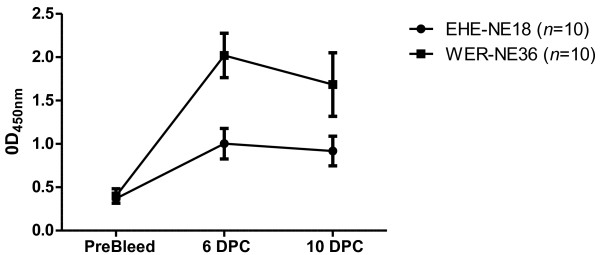
Figure 1
Figure 1
NetB specific IgY production in birds inoculated with two different C. perfringens strains. Two groups of 10 birds were challenged in-feed (days 26 and 27) either with EHE-NE18 (●) or WER-NE36 (■) and serum collected on days 26 (pre-bleed), 33 (6 days post-challenge, 6 DPC) and 37 (10 days post challenge, 10 DPC). The levels of serum IgY antibodies against NetB were measured by ELISA and expressed as the average optical density at 450nm. The error bars represent SEM.
Figure 2
Figure 2
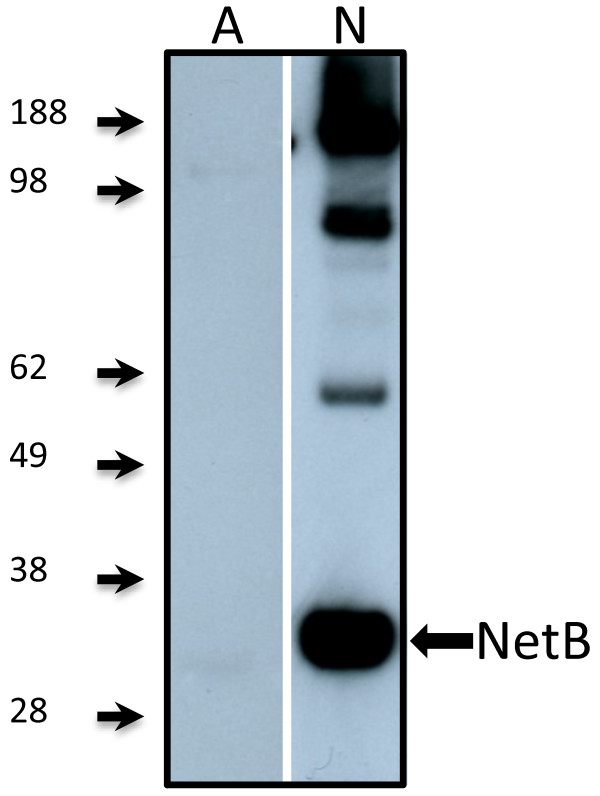
Western blot of serum from broiler chickens immunized with rNetB. Recombinant NetB was electrophoresied on a 4%-12% SDS-PAGE and transferred onto a PVDF membrane. The blot was developed with an ECL Western blotting kit and results recorded on autoradiographic film. SeeBlue Plus2 prestained marker (Invitrogen) was used as a size marker (kDa). Birds were immunized with 50 μg of rNetB with CSIRO Triple adjuvant (days 7 and 17) and serum collected on day 28. A, probed with sera from birds vaccinated with adjuvant only; N, probed with sera from birds vaccinated with rNetB in adjuvant.
Figure 3
Figure 3
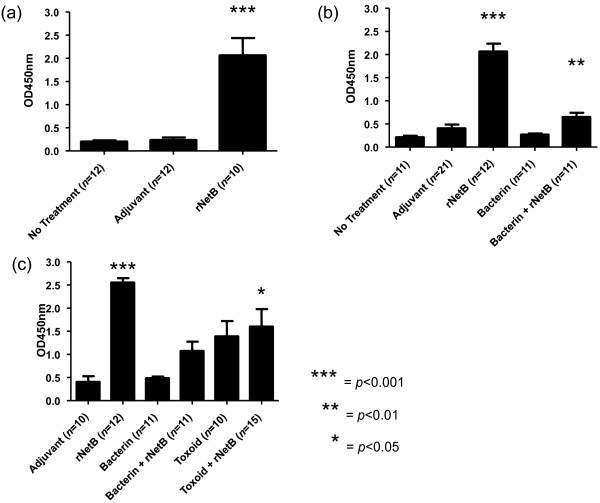
Serum IgY responses of broiler chickens immunized with clostridial proteins. Chickens were immunized subcutaneously with the indicated vaccines on days 7 and 17, challenged with C. perfringens, and the levels of serum IgY antibodies against NetB were measured by ELISA at day 28. Adjuvant only and no treatment groups were used as controls. (a) Birds were immunized and challenged orally with EHE-NE18 (days 24 and 25). (b) Birds were immunized and challenged in-feed with EHE-NE18 (days 26 and 27). (c) Birds were immunized and challenge in-feed with WER-NE36 (days 26 and 27). The error bars represent SEM.
Figure 4
Figure 4
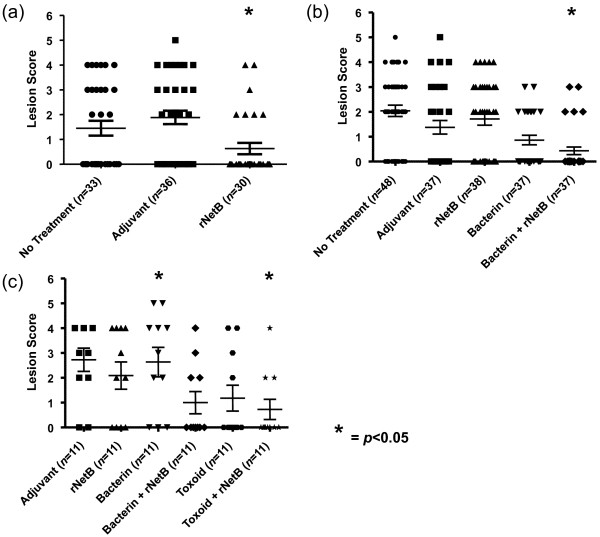
Lesion scores of broiler chickens immunized with clostridial proteins. Chickens were immunized subcutaneously with the indicated vaccines on days 7 and 17, challenged with C. perfringens, and the lesions scores assessed at day 28. The solid horizontal bars represent the average lesion score in each group. Intestinal lesions in the small intestine (duodenum to ileum) were scored as previously reported: 0, no gross lesions; 1, thin or friable walls; 2, focal necrosis or ulceration (1 to 5 foci); 3, focal necrosis or ulceration (6 to 15 foci); 4, focal necrosis or ulceration (16 or more foci); 5, patches of necrosis 2 to 3 cm long; 6, diffuse necrosis typical of field cases. (a) Birds were immunized and challenged orally with EHE-NE18 (days 24 and 25). (b) Birds were immunized and challenged in-feed with EHE-NE18 (days 26 and 27). (c) Birds were immunized and challenge in-feed with WER-NE36 (days 26 and 27). Error bars represent SEM.

References

    1. Van der Sluis W. Clostridial enteritis is an often underestimated problem. World Poultry. 2000;16:42–43.
    1. Van Immerseel F, De Buck J, Pasmans F, Huyghebaert G, Haesebrouck F, Ducatelle R. Clostridium perfringens in poultry: an emerging threat for animal and public health. Avian Pathol. 2004;33:537–549. doi: 10.1080/03079450400013162. - DOI - PubMed
    1. Dahiya JP, Wilkie DC, Van Kessel AG, Drew MD. Potential strategies for controlling necrotic enteritis in broiler chickens in post-antibiotic era. Anim Feed Sci Technol. 2006;129:60–88. doi: 10.1016/j.anifeedsci.2005.12.003. - DOI
    1. Grave K, Kaldhusdal MC, Kruse H, Harr LMF, Flatlandsmo K. What has happened in norway after the ban of avoparcin? Consumption of antimicrobials by poultry. Prev Vet Med. 2004;62:59–72. doi: 10.1016/j.prevetmed.2003.08.009. - DOI - PubMed
    1. Walker PD. Bacterial vaccines: old and new, veterinary and medical. Vaccine. 1992;10:977–990. doi: 10.1016/0264-410X(92)90106-T. - DOI - PubMed

Publication types

MeSH terms