


Serum ferritin contributes to racial or geographic disparities in metabolic syndrome in Taiwan
- PMID: 23866264
- PMCID: PMC10282300
- DOI: 10.1017/S1368980013001596
Serum ferritin contributes to racial or geographic disparities in metabolic syndrome in Taiwan
Abstract
Objectives: Asians and Pacific Islanders have higher circulating serum ferritin (SF) compared with Caucasians but the clinical significance of this is unclear. There is a higher prevalence of metabolic syndrome (MetS) in Taiwanese Indigenous than Han Chinese. Genetically, Indigenous are related to Austronesians and account for 2 % of Taiwan's population. We tested the hypothesis that accumulation of Fe in the body contributes to the ethnic/racial disparities in MetS in Taiwan.
Design: A population-based, cross-sectional study.
Setting: National Nutrition and Health Survey in Taiwan and Penghu Island.
Subjects: A total of 2638 healthy adults aged ≥19 years. Three ethnic groups were included.
Results: Han Chinese and Indigenous people had comparable levels of SF. Austronesia origin was independently associated with MetS (OR = 2·61, 95 % CI 2·02, 3·36). After multiple adjustments, the odds for MetS (OR = 2·49, 95 % CI 1·15, 5·28) was significantly higher among Indigenous people in the highest SF tertile compared with those in the lowest tertile. Hakka and Penghu Islanders yielded the lowest risks (OR = 1·08, 95 % CI 0·44, 2·65 and OR = 1·21, 95 % CI 0·52, 2·78, respectively). Indigenous people in the highest SF tertile had increased risk for abnormal levels of fasting glucose (OR = 2·34, 95 % CI 1·27, 4·29), TAG (OR = 1·94, 95 % CI 1·11, 3·39) and HDL-cholesterol (OR = 2·10, 95 % CI 1·18, 3·73) than those in the lowest SF tertile.
Conclusions: Our results raise the possibility that ethnic/racial differences in body Fe store susceptibility may contribute to racial and geographic disparities in MetS.
Figures

 (men),
  (women); Hakka:
  (men),
  (women); Indigenous:
  (men),
  (women); Penghu Islander:
  (men),
  (women))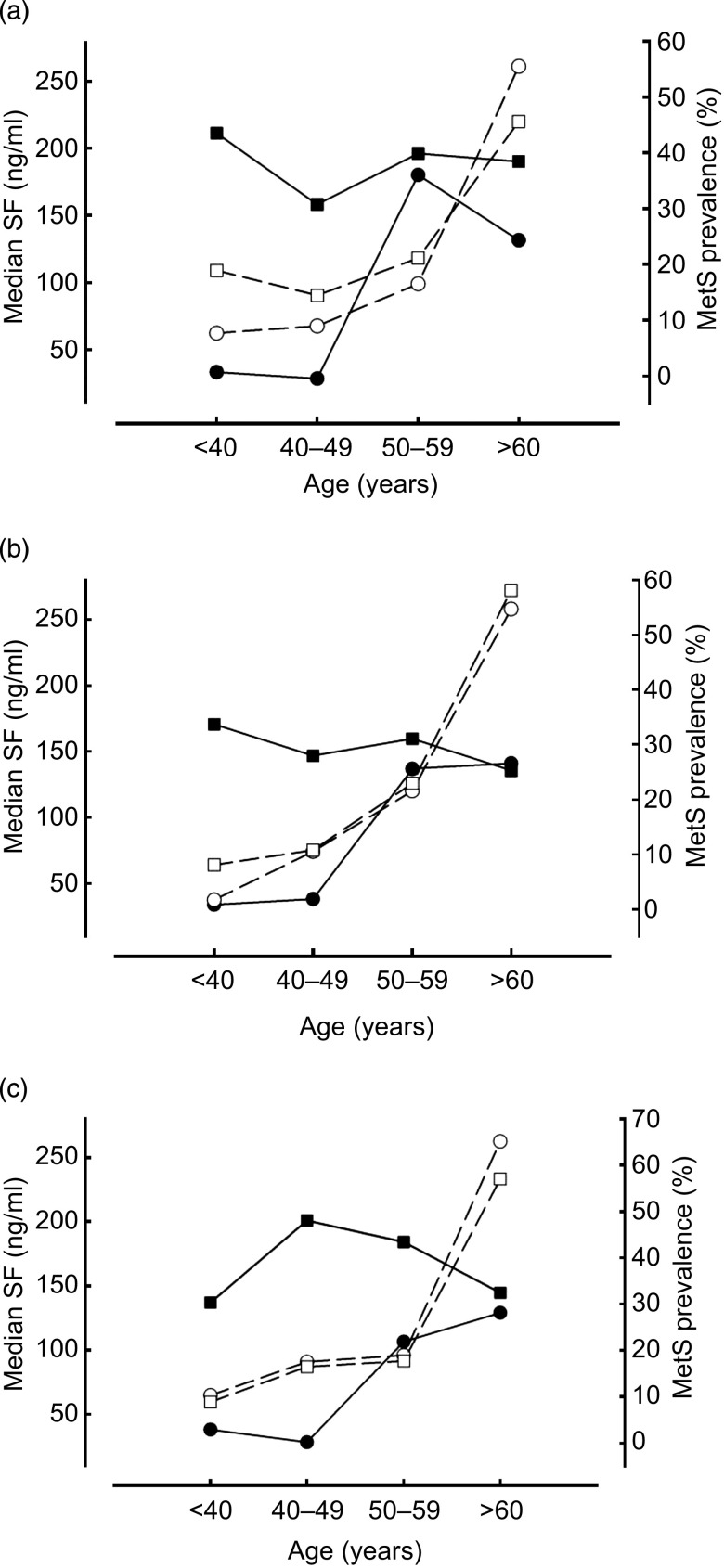
 , men;
  , women) and metabolic syndrome (MetS) prevalence (
 , men;
  , women) by decade of age for healthy Taiwanese men and women aged ≥19 years (n 2638) according to ethnic group: (a) Indigenous; (b) Hakka; (c) Penghu Islanders
References
-
- Adams PC, Reboussin DM, Barton JC et al. (2005) Hemochromatosis and iron-overload screening in a racially diverse population. N Engl J Med 352, 1769–1778. - PubMed
-
- Harris EL, McLaren CE, Reboussin DM et al. (2007) Serum ferritin and transferrin saturation in Asians and Pacific Islanders. Arch Intern Med 167, 722–726. - PubMed
-
- Sun L, Franco OH, Hu FB et al. (2008) Ferritin concentrations, metabolic syndrome, and type 2 diabetes in middle-aged and elderly chinese. J Clin Endocrinol Metab 93, 4690–4696. - PubMed
-
- Bozzini C, Girelli D, Olivieri O et al. (2005) Prevalence of body iron excess in the metabolic syndrome. Diabetes Care 28, 2061–2063. - PubMed
-
- Jehn M, Clark JM & Guallar E (2004) Serum ferritin and risk of the metabolic syndrome in US adults. Diabetes Care 27, 2422–2428. - PubMed
Publication types
MeSH terms
Substances
LinkOut - more resources
Full Text Sources
Other Literature Sources
Medical
