


Modification of the tumor microenvironment as a novel target of renal cell carcinoma therapeutics
- PMID: 23867518
- PMCID: PMC3879112
- DOI: 10.1097/PPO.0b013e31829da0ae
Modification of the tumor microenvironment as a novel target of renal cell carcinoma therapeutics
Abstract
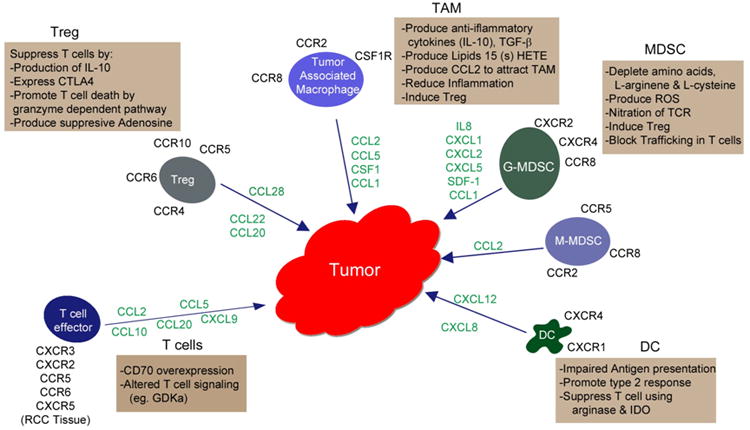
To move forward with immunotherapy, it is important to understand how the tumor microenvironment generates systemic immunosuppression in patients with renal cell carcinoma (RCC) as well as in patients with other types of solid tumors. Even though antigen discovery in RCC has lagged behind melanoma, recent clinical trials have finally authenticated that RCC is susceptible to vaccine-based therapy. Furthermore, judicious coadministration of cytokines and chemotherapy can potentiate therapeutic responses to vaccine in RCC and prolong survival, as has already proved possible for melanoma. Although high-dose interleukin 2 immunotherapy has been superseded as first-line therapy for RCC by promiscuous receptor tyrosine kinase inhibitors (rTKIs) such as sunitinib, sunitinib itself is a potent immunoadjunct in animal tumor models. A reasonable therapeutic goal is to unite antiangiogenic strategies with immunotherapy as first-line therapy for RCC. This strategy is equally appropriate for testing in all solid tumors in which the microenvironment generates immunosuppression. A common element of RCC and pancreatic, colon, breast, and other solid tumors is large numbers of circulating myeloid-derived suppressor cells (MDSCs), and because MDSCs elicit regulatory T cells rather than vice versa, gaining control over MDSCs is an important initial step in any immunotherapy. Although rTKIs like sunitinib have a remarkable capacity to deplete MDSCs and restore normal T-cell function in peripheral body compartments such as the bloodstream and the spleen, such rTKIs are effective only against MDSCs, which are engaged in phospho-STAT3-dependent programming (pSTAT3+). Unfortunately, rTKI-resistant pSTAT3- MDSCs are especially apt to arise within the tumor microenvironment itself, necessitating strategies that do not rely exclusively on STAT3 disruption. The most utilitarian strategy to gain control of both pSTAT3+ and pSTAT3- MDSCs may be to exploit the natural differentiation pathway, which permits MDSCs to mature into tumoricidal macrophages (TM1) via such stimuli as Toll-like receptor agonists, interferon γ, and CD40 ligation. Overall, this review highlights the mechanisms of immune suppression used by the different regulatory cell types operative in RCC as well as other tumors. It also describes the different therapeutic strategies to overcome the suppressive nature of the tumor microenvironment.
Conflict of interest statement
Declaration of interest: The authors report no conflicts of interest. The authors alone are responsible for the content and writing of the paper.
Figures

References
-
- Grosh WW. Renal cell carcinoma: treatment with interferon. Compr Ther. 1987;13(6):34–39. Epub 1987/06/01. - PubMed
-
- Gupta K, Miller JD, Li JZ, Russell MW, Charbonneau C. Epidemiologic and socioeconomic burden of metastatic renal cell carcinoma (mRCC): a literature review. Cancer Treat Rev. 2008;34(3):193–205. Epub 2008/03/04. - PubMed
-
- Rosenberg SA, Lotze MT, Muul LM, et al. A progress report on the treatment of 157 patients with advanced cancer using lymphokine-activated killer cells and interleukin-2 or high-dose interleukin-2 alone. N Engl J Med. 1987;316(15):889–897. Epub 1987/04/09. - PubMed
-
- Escudier B, Goupil MG, Massard C, Fizazi K. Sequential therapy in renal cell carcinoma. Cancer. 2009;115(10 Suppl):2321–2326. Epub 2009/04/30. - PubMed
-
- Kaelin WG., Jr The von Hippel-Lindau tumour suppressor protein: O2 sensing and cancer. Nat Rev Cancer. 2008;8(11):865–873. Epub 2008/10/17. - PubMed
Publication types
MeSH terms
Substances
Grants and funding
LinkOut - more resources
Full Text Sources
Other Literature Sources
Research Materials
Miscellaneous
