


Facial pain with localized and widespread manifestations: separate pathways of vulnerability
- PMID: 23867732
- PMCID: PMC3808468
- DOI: 10.1016/j.pain.2013.07.009
Facial pain with localized and widespread manifestations: separate pathways of vulnerability
Abstract
Human association studies of common genetic polymorphisms have identified many loci that are associated with risk of complex diseases, although individual loci typically have small effects. However, by envisaging genetic associations in terms of cellular pathways, rather than any specific polymorphism, combined effects of many biologically relevant alleles can be detected. The effects are likely to be most apparent in investigations of phenotypically homogenous subtypes of complex diseases. We report findings from a case-control, genetic association study of relationships between 2925 single nucleotide polymorphisms (SNPs) and 2 subtypes of a commonly occurring chronic facial pain condition, temporomandibular disorder (TMD): 1) localized TMD and 2) TMD with widespread pain. When compared to healthy controls, cases with localized TMD differed in allelic frequency of SNPs that mapped to a serotonergic receptor pathway (P=0.0012), while cases of TMD with widespread pain differed in allelic frequency of SNPs that mapped to a T-cell receptor pathway (P=0.0014). A risk index representing combined effects of 6 SNPs from the serotonergic pathway was associated with greater odds of localized TMD (odds ratio 2.7, P=1.3 E-09), and the result was reproduced in a replication case-control cohort study of 639 people (odds ratio 1.6, P=0.014). A risk index representing combined effects of 8 SNPs from the T-cell receptor pathway was associated with greater odds of TMD with widespread pain (P=1.9 E-08), although the result was not significant in the replication cohort. These findings illustrate potential for clinical classification of chronic pain based on distinct molecular profiles and genetic background.
Keywords: Case-control study; Human genetics; Serotonergic receptor; Temporomandibular disorder.
Copyright © 2013 International Association for the Study of Pain. All rights reserved.
Conflict of interest statement
Drs. Slade, Diatchenko, Fillingim and Maixner are consultants with equity interests in Algynomics Inc., a company providing research services in personalized pain medication and diagnostics. All other authors declare no financial relationships that might represent a possible conflict of interest.
Figures
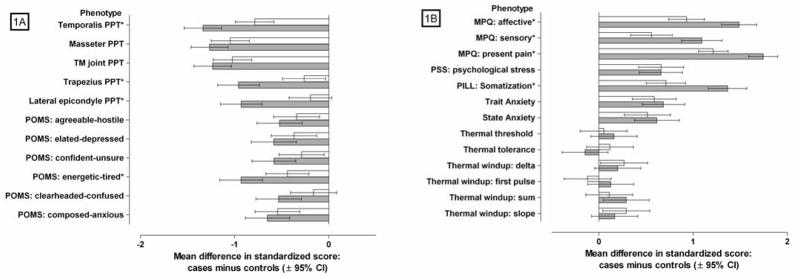
 TMD with widespread pain (n=105)]. Phenotypes in Fig 1A are measures of pressure pain thresholds (PPT) and mood, where lower means in TMD subtypes relative to controls signify greater pain sensitivity and more negative mood (respectively). Phenotypes in Fig 1B are measures of pain perceptions, psychological states, and numerical ratings of thermal pain, where higher means in TMD subtypes relative to controls signify more severe pain, greater psychological distress, and greater pain sensitivity (respectively). Mood was measured using the Profile of Mood States (POMS) questionnaire. Pain perceptions were measured using the McGill Pain Questionnaire (MPQ). Psychological stress was measured using the Perceived Stress Scale (PSS). Somatization was measure using the Pennebaker Index of Limbic Languidness (PILL). All phenotypic measures were transformed to standardized z-scores with a mean of zero and standard deviation of 1.0 for the full cohort of TMD cases and controls. * indicates phenotypes where the case-control difference varies significantly (P<0.002) according to TMD subtype.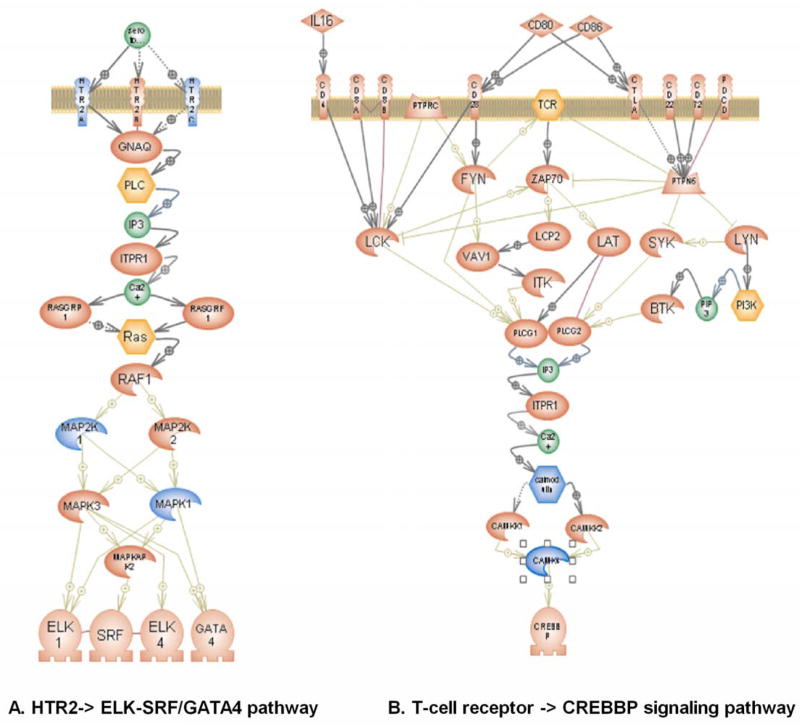
References
-
- Chen H, Slade G, Lim PF, Miller V, Maixner W, Diatchenko L. Relationship between temporomandibular disorders, widespread palpation tenderness, and multiple pain conditions: a case-control study. The journal of pain : official journal of the American Pain Society. 2012;13(10):1016–1027. - PMC - PubMed
-
- Cohen S, Kamarck T, Mermelstein R. A global measure of perceived stress. J Health Soc Behav. 1983;24(4):385–396. - PubMed
-
- Costigan M, Moss A, Latremoliere A, Johnston C, Verma-Gandhu M, Herbert TA, Barrett L, Brenner GJ, Vardeh D, Woolf CJ, Fitzgerald M. T-cell infiltration and signaling in the adult dorsal spinal cord is a major contributor to neuropathic pain-like hypersensitivity. J Neurosci. 2009;29(46):14415–14422. - PMC - PubMed
-
- Dao TT, Lavigne GJ, Charbonneau A, Feine JS, Lund JP. The efficacy of oral splints in the treatment of myofascial pain of the jaw muscles: a controlled clinical trial. Pain. 1994;56(1):85–94. - PubMed
-
- Diatchenko L, Nackley AG, Slade GD, Fillingim RB, Maixner W. Idiopathic pain disorders--pathways of vulnerability. Pain. 2006;123(3):226–230. - PubMed
Publication types
MeSH terms
Substances
Grants and funding
LinkOut - more resources
Full Text Sources
Other Literature Sources
Medical
Molecular Biology Databases
