The cumulative risk of false-positive fecal occult blood test after 10 years of colorectal cancer screening
- PMID: 23868091
- PMCID: PMC3770276
- DOI: 10.1158/1055-9965.EPI-13-0254
The cumulative risk of false-positive fecal occult blood test after 10 years of colorectal cancer screening
Abstract
Background: Annual colorectal cancer screening with fecal occult blood test (FOBT) is a noninvasive alternative to screening colonoscopy once every 10 years. If false-positive FOBT results are common, then many patients selecting an FOBT regimen will be exposed to the same invasive testing as those selecting a colonoscopy regimen. The objective of this study was to estimate the probability of experiencing a false-positive after receiving annual FOBT screening for 10 years.
Methods: Medical records for patients aged 50 to 79 years receiving FOBT screening with Hemoccult Sensa between 1997 and 2009 at Group Health of Washington State captured the date and results of each FOBT, along with subsequent colorectal cancer diagnoses. We used logistic regression to analyze associations between patient characteristics and odds of a positive FOBT with no invasive cancer diagnosis within 1 year (FOBT+, CRC-). We estimated the probability of receiving at least one FOBT+, CRC- result after 10 years of screening.
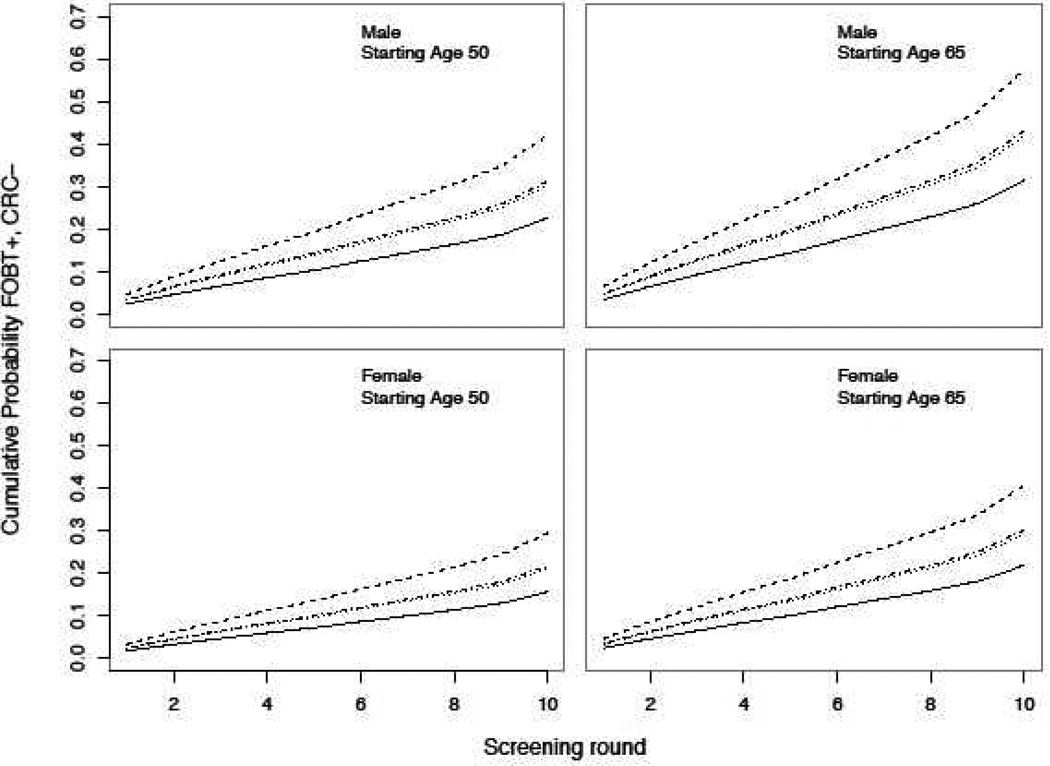
Results: We observed 181,950 FOBTs from 94,637 individuals. Older patients, males, and non-White patients were significantly more likely to receive FOBT+, CRC- results (P < 0.001 for all risk factors). After 10 years of annual FOBT, 23.0% [95% confidence interval (CI), 18.2-27.0] will receive at least one FOBT+, CRC- result.
Conclusions: Most patients participating in annual FOBT screening for 10 years will not have a positive result, reinforcing the potential value of this regimen as a noninvasive alternative to colonoscopy.
Impact: Annual stool-based screening is a screening alternative resulting in substantially fewer colonoscopies than once per decade colonoscopy.
©2013 AACR.
Conflict of interest statement
Figures
References
-
- U.S. Cancer Statistics Working Group. United States Cancer Statistics: 1999–2008 Incidence and Mortality Web-based Report. [Accessed June 13, 2012];2012 Available at: http://www.cdc.gov/uscs.
-
- Kronborg O, Fenger C, Olsen J, Jorgensen OD, Sondergaard O. Randomised study of screening for colorectal cancer with faecal-occult-blood test. Lancet. 1996;348:1467–1471. - PubMed
-
- Hardcastle JD, Chamberlain JO, Robinson MH, Moss SM, Amar SS, Balfour TW, et al. Randomised controlled trial of faecal-occult-blood screening for colorectal cancer. Lancet. 1996;348:1472–1477. - PubMed
-
- Mandel JS, Bond JH, Church TR, Snover DC, Bradley GM, Schuman LM, et al. Reducing mortality from colorectal cancer by screening for fecal occult blood. Minnesota Colon Cancer Control Study. N Engl J Med. 1993;328:1365–1371. - PubMed
Publication types
MeSH terms
Grants and funding
LinkOut - more resources
Full Text Sources
Other Literature Sources
Medical