


Loss of function of the melanocortin 2 receptor accessory protein 2 is associated with mammalian obesity
- PMID: 23869016
- PMCID: PMC3788688
- DOI: 10.1126/science.1233000
Loss of function of the melanocortin 2 receptor accessory protein 2 is associated with mammalian obesity
Erratum in
- Science. 2013 Aug 30;341(6149):959
Abstract
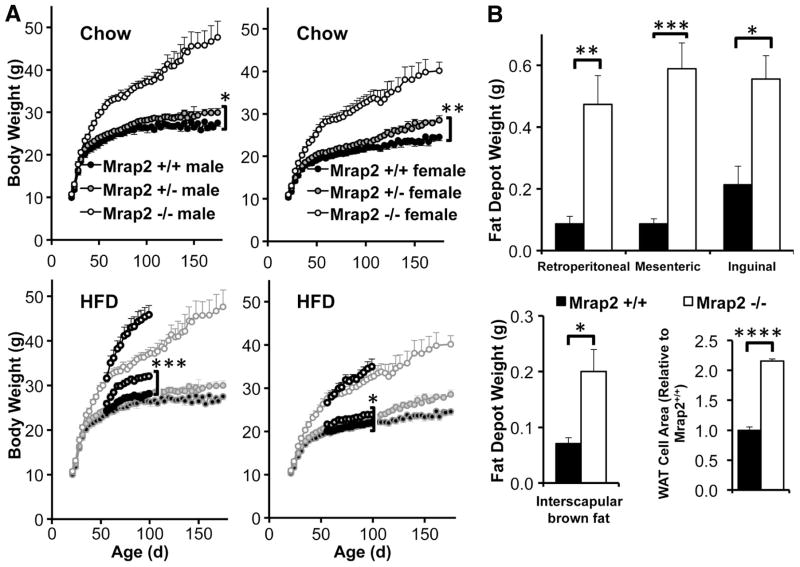
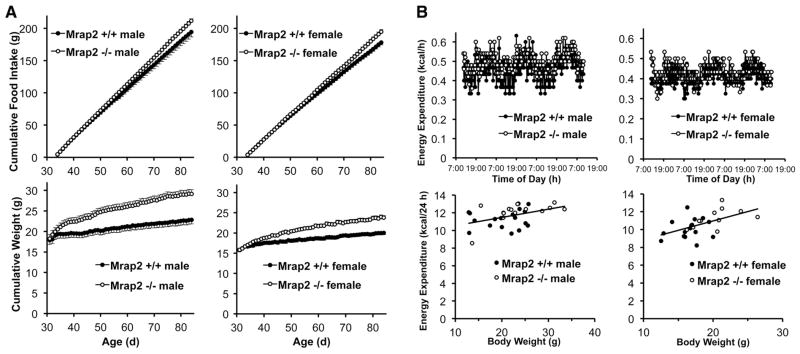
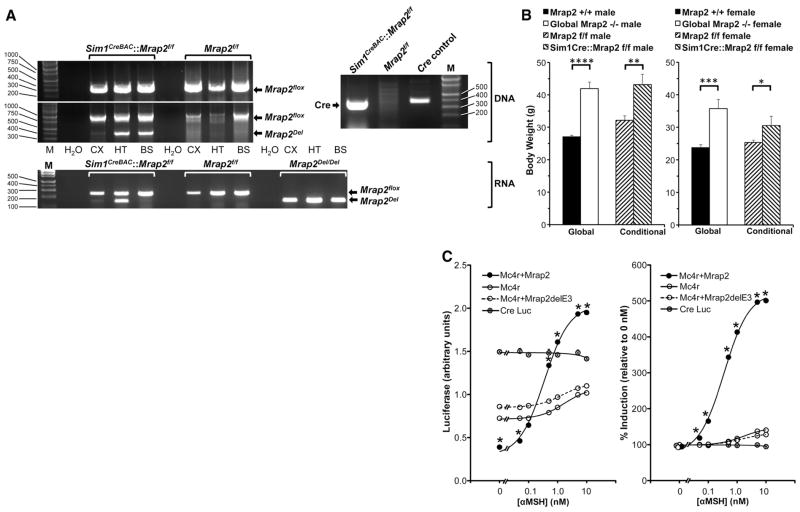
Melanocortin receptor accessory proteins (MRAPs) modulate signaling of melanocortin receptors in vitro. To investigate the physiological role of brain-expressed melanocortin 2 receptor accessory protein 2 (MRAP2), we characterized mice with whole-body and brain-specific targeted deletion of Mrap2, both of which develop severe obesity at a young age. Mrap2 interacts directly with melanocortin 4 receptor (Mc4r), a protein previously implicated in mammalian obesity, and it enhances Mc4r-mediated generation of the second messenger cyclic adenosine monophosphate, suggesting that alterations in Mc4r signaling may be one mechanism underlying the association between Mrap2 disruption and obesity. In a study of humans with severe, early-onset obesity, we found four rare, potentially pathogenic genetic variants in MRAP2, suggesting that the gene may also contribute to body weight regulation in humans.
Figures
Comment in
-
Mrap2: an accessory protein linked to obesity.Cell Metab. 2013 Sep 3;18(3):309-11. doi: 10.1016/j.cmet.2013.08.016. Cell Metab. 2013. PMID: 24011068 Free PMC article.
-
Controlling caloric intake and energy expenditure may not be enough to keep weight stable.Climacteric. 2013 Dec;16(6):727. Climacteric. 2013. PMID: 24383096 No abstract available.
References
-
- Cone RD. Studies on the physiological functions of the melanocortin system. Endocrine reviews. 2006 Dec;27:736. - PubMed
-
- Hay DL, Poyner DR, Sexton PM. GPCR modulation by RAMPs. Pharmacology & therapeutics. 2006 Jan;109:173. - PubMed
-
- Cooray SN, Clark AJ. Melanocortin receptors and their accessory proteins. Molecular and cellular endocrinology. 2011 Jan 15;331:215. - PubMed
-
- Metherell LA, et al. Mutations in MRAP, encoding a new interacting partner of the ACTH receptor, cause familial glucocorticoid deficiency type 2. Nature genetics. 2005 Feb;37:166. - PubMed
Publication types
MeSH terms
Substances
Grants and funding
- G0600408/MRC_/Medical Research Council/United Kingdom
- G0802796/MRC_/Medical Research Council/United Kingdom
- R01DK075787/DK/NIDDK NIH HHS/United States
- MC_UU_12012/5/MRC_/Medical Research Council/United Kingdom
- R01 DK075787/DK/NIDDK NIH HHS/United States
- G0600717/MRC_/Medical Research Council/United Kingdom
- T32 DK007699/DK/NIDDK NIH HHS/United States
- P30-HD18655/HD/NICHD NIH HHS/United States
- G0900554/MRC_/Medical Research Council/United Kingdom
- T32 MH020017/MH/NIMH NIH HHS/United States
- G9824984/MRC_/Medical Research Council/United Kingdom
- 098497/WT_/Wellcome Trust/United Kingdom
LinkOut - more resources
Full Text Sources
Other Literature Sources
Medical
Molecular Biology Databases
Research Materials
