. 2013 Jul 19;341(6143):278-81.
doi: 10.1126/science.1232995.

Developmental control of the melanocortin-4 receptor by MRAP2 proteins in zebrafish

Affiliations

Developmental control of the melanocortin-4 receptor by MRAP2 proteins in zebrafish

Julien A Sebag et al. Science. .

Abstract

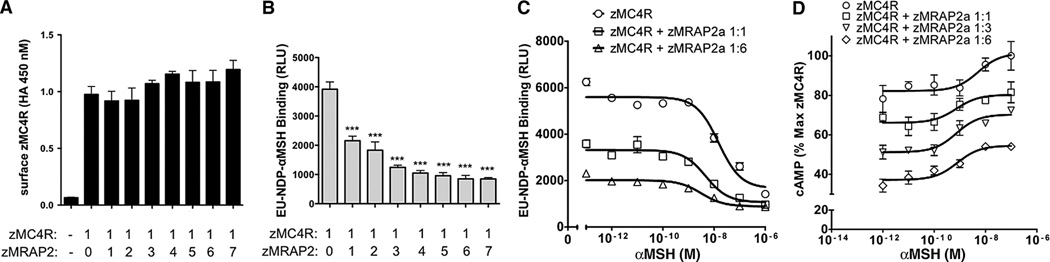
The melanocortin-4 receptor (MC4R) is essential for control of energy homeostasis in vertebrates. MC4R interacts with melanocortin receptor accessory protein 2 (MRAP2) in vitro, but its functions in vivo are unknown. We found that MRAP2a, a larval form, stimulates growth of zebrafish by specifically blocking the action of MC4R. In cell culture, this protein binds MC4R and reduces the ability of the receptor to bind its ligand, α-melanocyte-stimulating hormone (α-MSH). A paralog, MRAP2b, expressed later in development, also binds MC4R but increases ligand sensitivity. Thus, MRAP2 proteins allow for developmental control of MC4R activity, with MRAP2a blocking its function and stimulating growth during larval development, whereas MRAP2b enhances responsiveness to α-MSH once the zebrafish begins feeding, thus increasing the capacity for regulated feeding and growth.


Figures
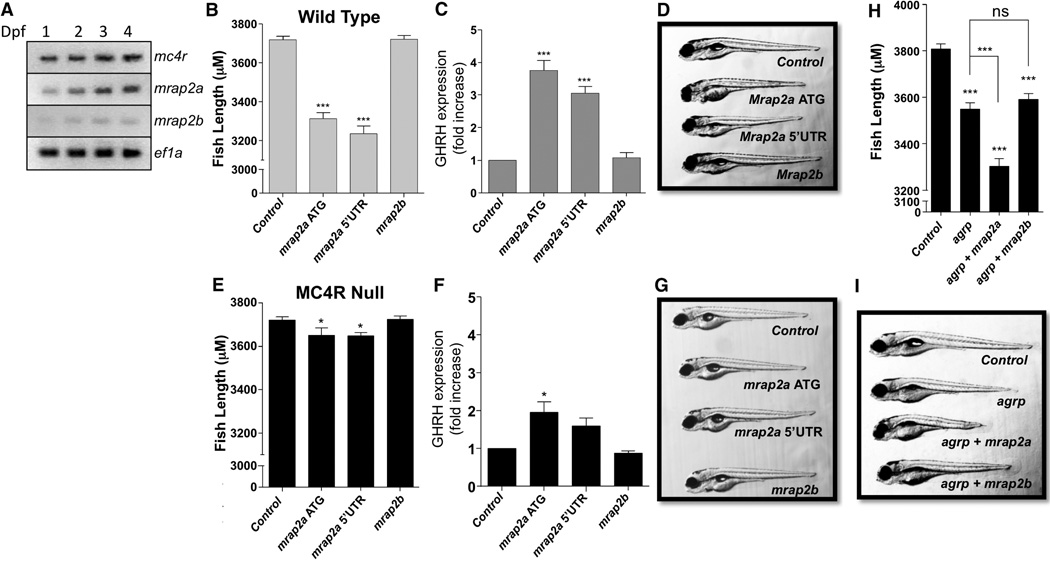
Fig. 1
Fig. 1. Regulation of MC4R by MRAP2a in the zebrafish embryo
(A) RT-PCR showing the level of mRNA expression for mc4r, mrap2a, and mrap2b in the first 4 days of zebrafish development. (B to G) Length [(B) and (E)], ghrh expression [(C) and (F)], and representative pictures [(D) and (G)] of 5 dpf wild-type or mc4r-null zebrafish injected with the indicated morpholinos. (H and I) Length (H) and representative picture (I) of zebrafish embryos injected with (top to bottom) control morpholino or morpholino targeting agrp, mrap2a, or both. *P < 0.05, ***P < 0.001; ns, not significant.
Fig. 2
Fig. 2. Regulation of MC4R byMRAP2a
(A) Surface expression of MC4R measured by whole-cell enzyme-linked immunosorbent assay (ELISA) in nonpermeabilized HEK293T cells transfected with mc4r and increasing amounts of mrap2a. (B) Europium-labeled NDP–α-MSH binding in HEK293T cells transfected with mc4r and increasing amounts of mrap2a. (C) Competition binding assay in HEK293T cells transfected with mc4r without or with mrap2a at mc4r/mrap2a ratios of 1:1 or 1:6. (D) Concentration-response curves of α-MSH–induced cAMP production in HEK293T cells expressing the CRE-luciferase reporter, mc4r, and different amounts of mrap2a. ***P < 0.001.
Fig. 3
Fig. 3. Regulation of MC4R by MRAP2b
(A) RT-PCR depicting the expression of mc4r, mrap2a, mrap2b, and the housekeeping gene ef1a in zebrafish adult brain. (B) qPCR measuring the change in expression of mc4r, mrap2a, and mrap2b in the adult brain relative to the 4 dpf embryo. (C) qPCR (top) and RT-PCR (bottom) depicting the expression of mouse MRAP2 at different embryonic and postnatal stages; E, embryonic day. (D) Surface expression of MC4R measured by whole-cell ELISA in nonpermeabilized HEK293T cells transfected with mc4r and different amounts of mrap2b. (E) Competition binding assay in HEK293T cells transfected with mc4r alone or with mrap2b at the indicated ratio. (F) Concentration-response curves of α-MSH–induced cAMP production in HEK293T cells transfected with mc4r and the indicated amount of mrap2b or mouse MRAP2. ***P < 0.001.

Comment in

References

    1. Farooqi IS, et al. N. Engl. J. Med. 2003;348:1085–1095. - PubMed
    1. Huszar D, et al. Cell. 1997;88:131–141. - PubMed
    1. Vaisse C, Clement K, Guy-Grand B, Froguel P. Nat. Genet. 1998;20:113–114. - PubMed
    1. Yeo GS, et al. Nat. Genet. 1998;20:111–112. - PubMed
    1. Lampert KP, et al. Curr. Biol. 2010;20:1729–1734. - PubMed

Publication types

MeSH terms