. 2013 Jul 18;20(8):438-45.
doi: 10.1101/lm.031666.113.

Potentiating mGluR5 function with a positive allosteric modulator enhances adaptive learning

Affiliations

Potentiating mGluR5 function with a positive allosteric modulator enhances adaptive learning

Jian Xu et al. Learn Mem. .

Abstract

Metabotropic glutamate receptor 5 (mGluR5) plays important roles in modulating neural activity and plasticity and has been associated with several neuropathological disorders. Previous work has shown that genetic ablation or pharmacological inhibition of mGluR5 disrupts fear extinction and spatial reversal learning, suggesting that mGluR5 signaling is required for different forms of adaptive learning. Here, we tested whether ADX47273, a selective positive allosteric modulator (PAM) of mGluR5, can enhance adaptive learning in mice. We found that systemic administration of the ADX47273 enhanced reversal learning in the Morris Water Maze, an adaptive task. In addition, we found that ADX47273 had no effect on single-session and multi-session extinction, but administration of ADX47273 after a single retrieval trial enhanced subsequent fear extinction learning. Together these results demonstrate a role for mGluR5 signaling in adaptive learning, and suggest that mGluR5 PAMs represent a viable strategy for treatment of maladaptive learning and for improving behavioral flexibility.


Figures
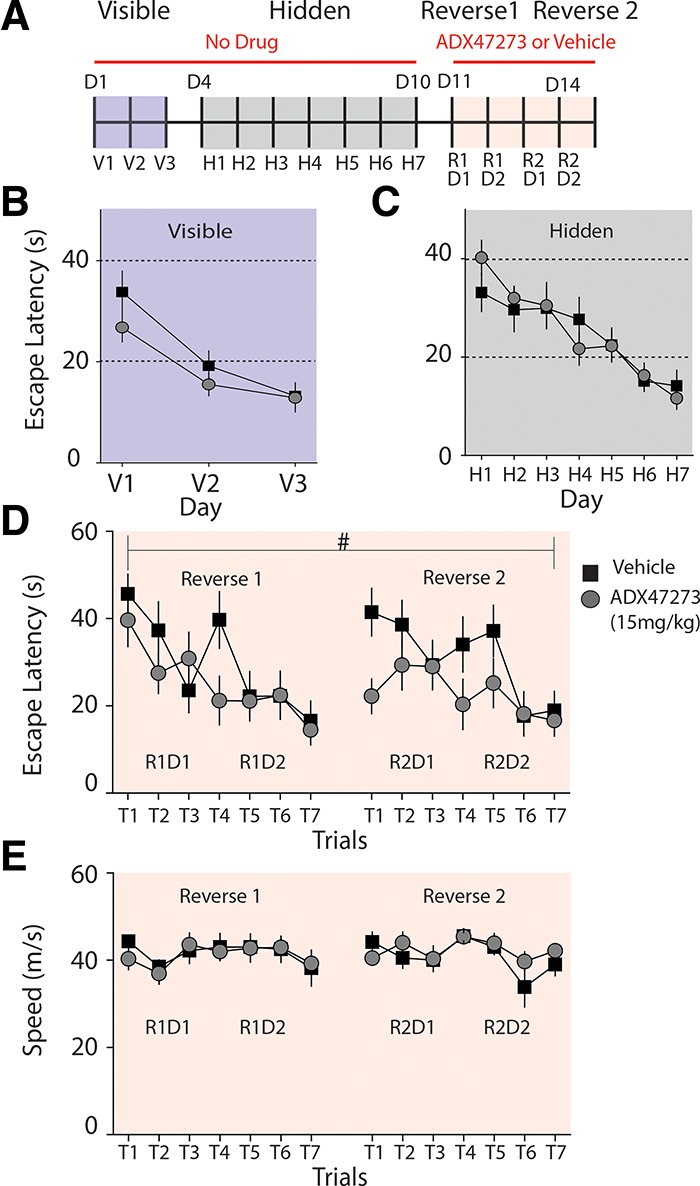
Figure 1.
Figure 1.
ADX47273 enhanced reversal learning in the MWM. (A) Schematic of experimental design for MWM. D1–D3 animals were trained with a visible platform. D4–D10 mice were subjected to a hidden platform test. For D11 and D12, the platform was moved to the opposite quadrant, and mice were trained in reversal learning for two consecutive days with a total of seven trials. Finally, the platform was again moved to the opposite quadrant and mice were allowed seven trials for 2 d to relearn the new location (D13 and D14). Twenty to 30 min prior to each reversal trial, animals were injected with ADX47272 or vehicle. Three probe tests were conducted on D11, D13, and D15 at the beginning of each day (data not shown). (B, C) Escape latency of the mice during each day of the visible platform (B) and hidden platform test (C). (D) Escape latency during the reversal test. Drug group, n = 13; vehicle group, n = 12. (#) Two-way RM ANOVA, P < 0.05. (E) Swim speeds during the reversal test.
Figure 2.
Figure 2.
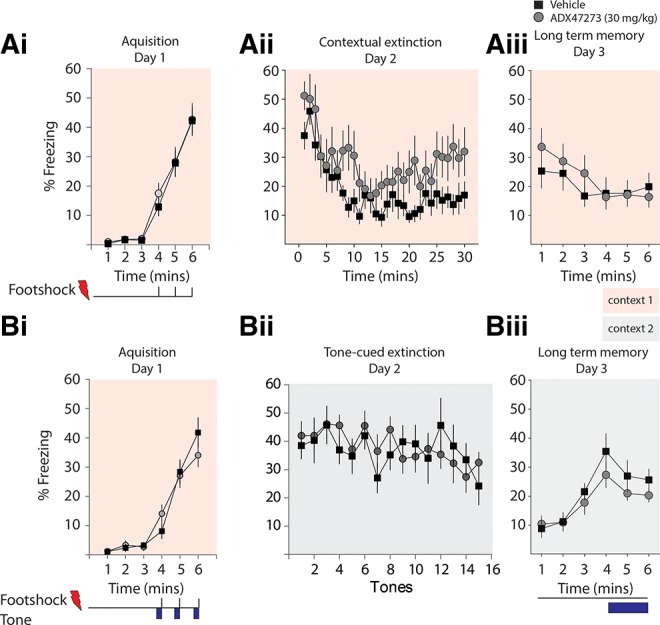
Prior administration of ADX47273 did not enhance single-session fear extinction. (Ai–Aiii) Freezing during contextual fear conditioning on Day 1 (Ai); 30-min contextual fear extinction on Day 2 (Aii); and 6 min of LTM test on Day 3 (Aiii). Drug group, n = 12; vehicle group, n = 12. (Bi–Biii) Freezing during tone cued fear extinction. Fear conditioning (three tone–shock pairings) on Day 1 (Bi); tone-cued fear extinction on Day 2 (15 tones of 1 min at 2-min intervals, shown are freezing during tone presentations) (Bii); and tone-cued LTM test on Day 3 (3-min tone after 3 min of acclimation) (Biii). Drug group, n = 8; vehicle group, n = 8.
Figure 3.
Figure 3.
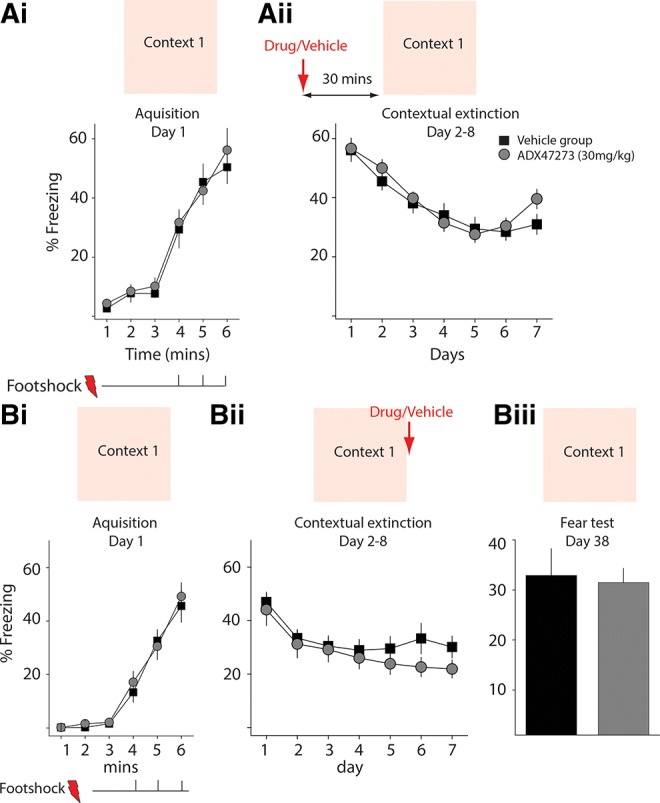
ADX47273 administered prior to or after multi-session extinction did not enhance fear extinction. (Ai,Aii) Effects of prior administration of ADX47273 on extinction. Freezing during contextual fear conditioning (three footshocks) on Day 1 (Ai) and contextual extinction training during seven consecutive days (Aii). ADX47273 or vehicle was administered 30 min prior to training. Drug group, n = 9; vehicle group, n = 8. (Bi–Biii) Effects of post-extinction administration of ADX47273. Contextual fear conditioning on Day 1 (Bi) and multi-session extinction training during seven subsequent consecutive days. ADX47273 or vehicle was administered immediately after training (Bii). (Biii) LTM test performed 1 mo after extinction. Drug group, n = 12; vehicle group, n = 11.
Figure 4.
Figure 4.
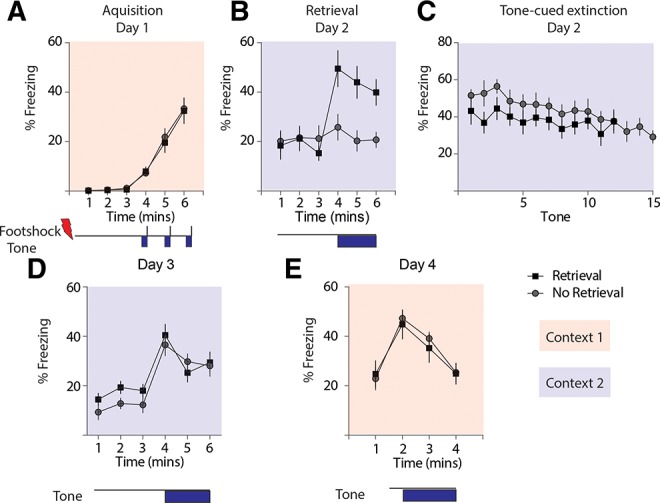
Single retrieval trial alone did not enhance fear extinction. (A) Freezing during tone-cued fear conditioning in Day 1. (B) Freezing in the extinction context. Single CS presentation (180 sec) was given only to the retrieval group but not to the nonretrieval group. (C) Within-session fear extinction after the single retrieval trial. The retrieval group received 12 1-min tones at 2-min intervals, and the nonretrieval group received 15 tones. (D) Fear extinction memory test for spontaneous recovery in the extinction context. Animals were given a single 3-min tone after 3 min of acclimation. (E) Fear renewal test conducted in the fear acquisition context. On Day 4, animals were returned to the fear acquisition chamber and received a single 3-min tone presentation. Retrieval group, n = 10; nonretrieval group, n = 10.
Figure 5.
Figure 5.
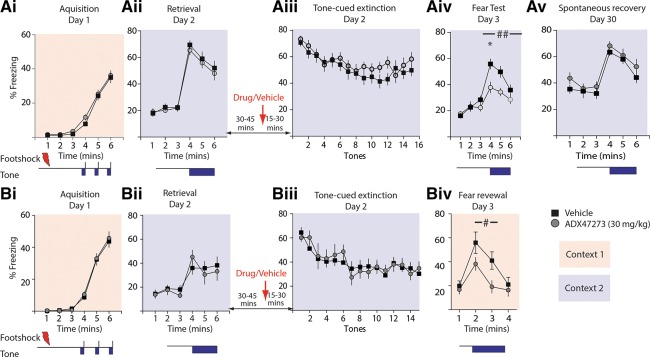
ADX47273 administration coupled to a single retrieval trial enhances fear extinction. (Ai) Freezing during tone-cued fear conditioning in Day 1. (Aii) Tone-cued freezing upon a single CS presentation (180 sec) on Day 2 (retrieval). (Aiii) Within-session fear extinction after the single retrieval trial. The extinction protocol consisted of 15 1-min tones at 2-min intervals. (Aiv) Fear memory test in the extinction context on Day 4 (short-term spontaneous recovery). (Av) Fear memory test in the extinction context after 1 mo (long-term spontaneous recovery). (Ai–Aiv) Drug group, n = 19; vehicle group, n = 20. (Av) Drug group, n = 15; vehicle group, n = 16. (Bi–Biii) Freezing during tone-cued conditioning (Bi), retrieval trial (Bii), and extinction (Biii). (Biv) Renewal test conducted in the fear acquisition context (context 2,). Drug group, n = 7; vehicle group, n = 8. (#) Two-way RM ANOVA, P < 0.05, (##) P < 0.01, (*) post-hoc Bonferroni test, P < 0.05.
Figure 6.
Figure 6.
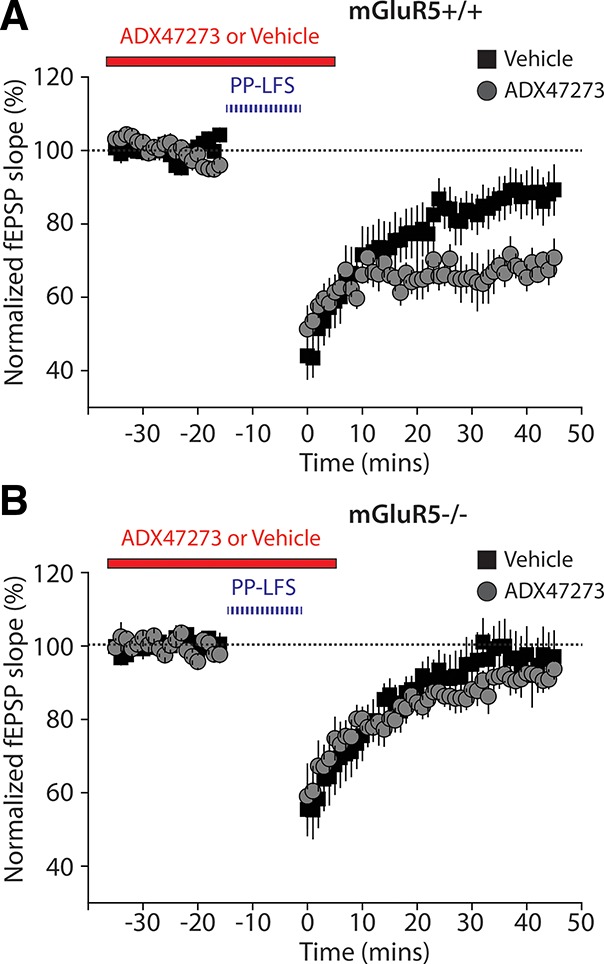
ADX47273 enhances PP-LFS induced LTD in the CA1 region of the hippocampus. (A) Normalized fEPSP slopes recorded in CA1 from slices from wild-type mice. Interleaved experiments were performed in the presence of vehicle or ADX47273. LTD was significantly enhanced in the presence of the mGluR5 PAM. The PP-LFS protocol consisted of 900 pairs of stimuli (40-msec inter-stimulus interval) delivered at 1 Hz for 15 min. (B) PP-LFS failed to induce LTD in slices taken from mGluR5−/− mice. ADX47273 had no effect on mGluR5−/− slices. PP-LFS protocol consists of 900 pairs of stimuli (40-msec inter-stimulus interval) delivered at 1 Hz for 15 min.

References

    1. Alberini CM 2005. Mechanisms of memory stabilization: Are consolidation and reconsolidation similar or distinct processes? Trends Neurosci 28: 51–56 - PubMed
    1. Ayala JE, Chen Y, Banko JL, Sheffler DJ, Williams R, Telk AN, Watson NL, Xiang Z, Zhang Y, Jones PJ, et al. 2009. mGluR5 positive allosteric modulators facilitate both hippocampal LTP and LTD and enhance spatial learning. Neuropsychopharmacology 34: 2057–2071 - PMC - PubMed
    1. Balschun D, Zuschratter W, Wetzel W 2006. Allosteric enhancement of metabotropic glutamate receptor 5 function promotes spatial memory. Neuroscience 142: 691–702 - PubMed
    1. Brunet A, Orr SP, Tremblay J, Robertson K, Nader K, Pitman RK 2008. Effect of post-retrieval propranolol on psychophysiologic responding during subsequent script-driven traumatic imagery in post-traumatic stress disorder. J Psychiatr Res 42: 503–506 - PubMed
    1. Carroll FI 2008. Antagonists at metabotropic glutamate receptor subtype 5: Structure activity relationships and therapeutic potential for addiction. Ann N Y Acad Sci 1141: 221–232 - PubMed

Publication types

MeSH terms

Substances

LinkOut - more resources