


The source of cognitive complaints predicts diagnostic conversion differentially among nondemented older adults
- PMID: 23871264
- PMCID: PMC4064681
- DOI: 10.1016/j.jalz.2013.02.007
The source of cognitive complaints predicts diagnostic conversion differentially among nondemented older adults
Abstract
Objective: The objective of this study was to compare whether different sources of cognitive complaint (i.e., subjective and informant) predict diagnostic conversion in nondemented older adults.
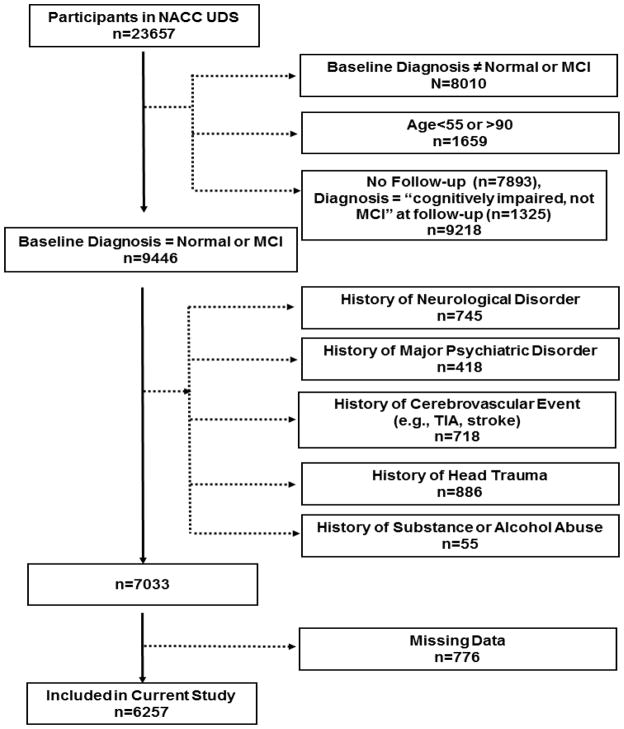
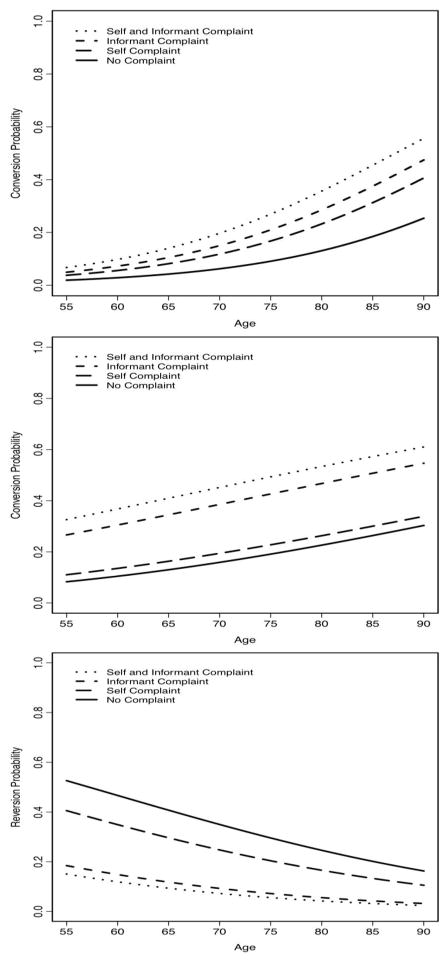
Methods: Participants from the National Alzheimer's Coordinating Center had a baseline diagnosis of normal cognition (NC; n = 4414; mean age, 73 ± 8 years; 69% female) or mild cognitive impairment (MCI; n = 1843; mean age, 74 ± 8 years; 52% female). Multinomial logistic regression related baseline cognitive complaint (no complaint, self only, informant only, or both self and informant) to diagnostic outcome (reversion, stable, or conversion).
Results: At follow-up, 14% of NC participants converted to MCI/dementia (3.5 ± 1.8 years), and 41% of MCI participants converted to dementia (3.0 ± 1.6 years). Among NC participants, self complaint only (odds ratio [OR], 2.1; 99% confidence interval (CI),1.5-2.9; P < .001), informant complaint only (OR, 2.2; 99% CI, 1.2-3.9; P < .001), and both self and informant complaint (OR, 4.2; 99% CI, 2.9-6.0; P < .001) were associated with diagnostic conversion compared with no complaint. Among participants with MCI-compared with no complaint, informant complaint only (OR, 2.2; 99% CI, 1.2-4.3, P = .002), and both self and informant complaint (OR, 2.9; 99% CI, 1.8-4.8; P < .001)-were associated with conversion.
Conclusions: Cognitive complaints are related to conversion among nondemented older adults. Complaint from both (i.e. mutual complaint) sources was most predictive of diagnostic outcome, followed by informant complaint, highlighting the need for obtaining informant corroboration to enhance prognosis and distinguish underlying pathological processes from normal cognitive aging. Self complaint was related inconsistently to diagnostic outcome.
Keywords: Alzheimer’s disease; Cognitive complaints; Conversion; Mild cognitive impairment; Prognosis.
Copyright © 2014 The Alzheimer's Association. Published by Elsevier Inc. All rights reserved.
Figures
References
-
- Petersen RC, Doody R, Kurz A, Mohs RC, Morris JC, Rabins PV, Ritchie K, Rossor M, Thal L, Winblad B. Current concepts in mild cognitive impairment. Archives of Neurology. 2001;58:1985–1992. - PubMed
-
- Albert MS, Dekosky ST, Dickson D, Dubois B, Feldman HH, Fox NC, Gamst A, Holtzman DM, Jagust WJ, Petersen RC, Snyder PJ, Carrillo MC, Thies B, Phelps CH. The diagnosis of mild cognitive impairment due to Alzheimer’s disease: Recommendations from the National Institute on Aging-Alzheimer’s Association workgroups on diagnostic guidelines for Alzheimer’s disease. Alzheimers Dement. 2011;7:270–279. - PMC - PubMed
-
- Glodzik-Sobanska L, Reisberg B, De Santi S, Babb JS, Pirraglia E, Rich KE, Brys M, de Leon MJ. Subjective memory complaints: presence, severity and future outcome in normal older subjects. Dementia and Geriatric Cognitive Disorders. 2007;24:177–184. - PubMed
-
- Wang L, van Belle G, Crane PK, Kukull WA, Bowen JD, McCormick WC, Larson EB. Subjective memory deterioration and future dementia in people aged 65 and older. Journal of the American Geriatrics Society. 2004;52:2045–2051. - PubMed
Publication types
MeSH terms
Grants and funding
- P30-AG013846/AG/NIA NIH HHS/United States
- M01 RR000533/RR/NCRR NIH HHS/United States
- U01 AG016976/AG/NIA NIH HHS/United States
- T32 AG036697/AG/NIA NIH HHS/United States
- R01-AG034962/AG/NIA NIH HHS/United States
- M01-RR00533/RR/NCRR NIH HHS/United States
- K23 AG030962/AG/NIA NIH HHS/United States
- T32-AG036697/AG/NIA NIH HHS/United States
- K24 AG046373/AG/NIA NIH HHS/United States
- R01 AG034962/AG/NIA NIH HHS/United States
- K23-AG030962/AG/NIA NIH HHS/United States
- R01 HL111516/HL/NHLBI NIH HHS/United States
- P30 AG013846/AG/NIA NIH HHS/United States
- R01-HL11516/HL/NHLBI NIH HHS/United States
- U01-AG016976/AG/NIA NIH HHS/United States
LinkOut - more resources
Full Text Sources
Other Literature Sources
Medical
