. 2013 Jul 25;4(2):255-61.
doi: 10.1016/j.celrep.2013.06.029. Epub 2013 Jul 18.

NSun2-mediated cytosine-5 methylation of vault noncoding RNA determines its processing into regulatory small RNAs

Affiliations

NSun2-mediated cytosine-5 methylation of vault noncoding RNA determines its processing into regulatory small RNAs

Shobbir Hussain et al. Cell Rep. .

Abstract

Autosomal-recessive loss of the NSUN2 gene has been identified as a causative link to intellectual disability disorders in humans. NSun2 is an RNA methyltransferase modifying cytosine-5 in transfer RNAs (tRNAs), yet the identification of cytosine methylation in other RNA species has been hampered by the lack of sensitive and reliable molecular techniques. Here, we describe miCLIP as an additional approach for identifying RNA methylation sites in transcriptomes. miCLIP is a customized version of the individual-nucleotide-resolution crosslinking and immunoprecipitation (iCLIP) method. We confirm site-specific methylation in tRNAs and additional messenger and noncoding RNAs (ncRNAs). Among these, vault ncRNAs contained six NSun2-methylated cytosines, three of which were confirmed by RNA bisulfite sequencing. Using patient cells lacking the NSun2 protein, we further show that loss of cytosine-5 methylation in vault RNAs causes aberrant processing into Argonaute-associated small RNA fragments that can function as microRNAs. Thus, impaired processing of vault ncRNA may contribute to the etiology of NSun2-deficiency human disorders.


Figures

None
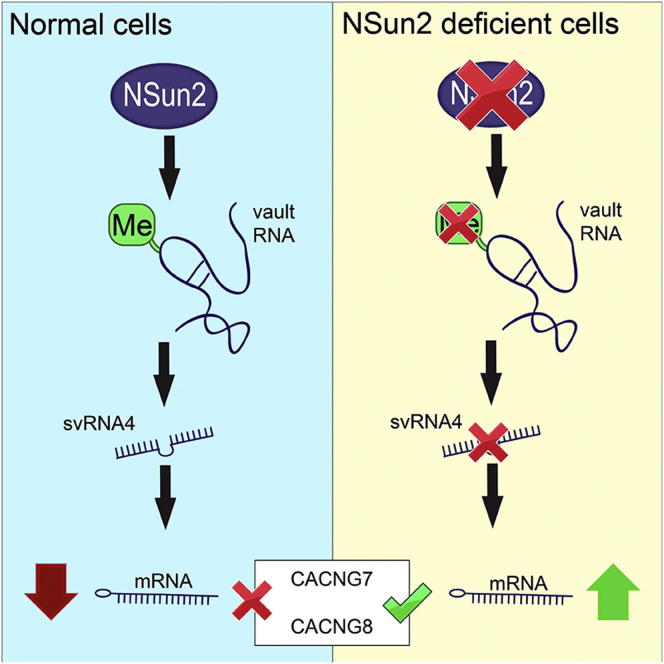
Graphical abstract
Figure 1
Figure 1
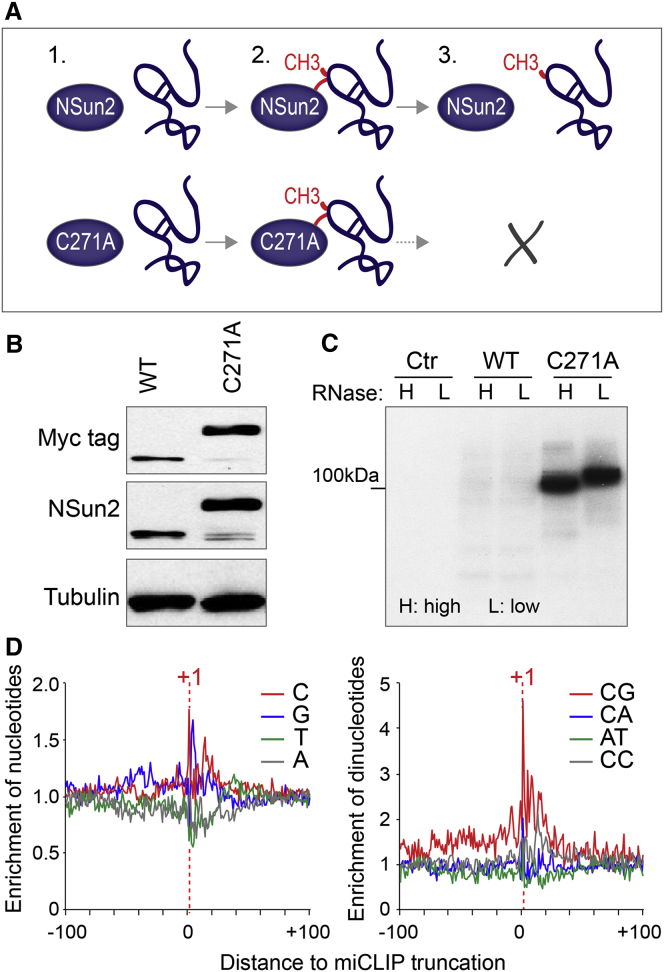
miCLIP Identifies Cytosine-5-Methylated Nucleosides (A) Schematics of NSun2-mediated cytosine-5 methylation and how the C271A mutation causes irreversible covalent crosslinks between the protein and substrate. (B) Western blot detecting wild-type (WT) and mutant (C271A) NSun2 proteins using an antibody for the Myc tag (top) or NSun2 (middle). Tubulin (bottom) serves as a loading control. (C) Detection of radiolabeled immunoprecipitated protein-RNA complexes (32P-ATP) after transfection of an empty vector control (Ctr), wild-type NSun2 (WT), or mutant NSun2 (C271A) using a Myc antibody. Lysates were incubated with high (H) or low (L) concentration of RNase. (D) Enrichment of nucleotides (left) and dinucleotides (right) in the region up to 100 nt around all crosslink sites. Only the top 4 dinucleotides at position +1 are shown (see also Table S1). See also Figure S1.
Figure 2
Figure 2
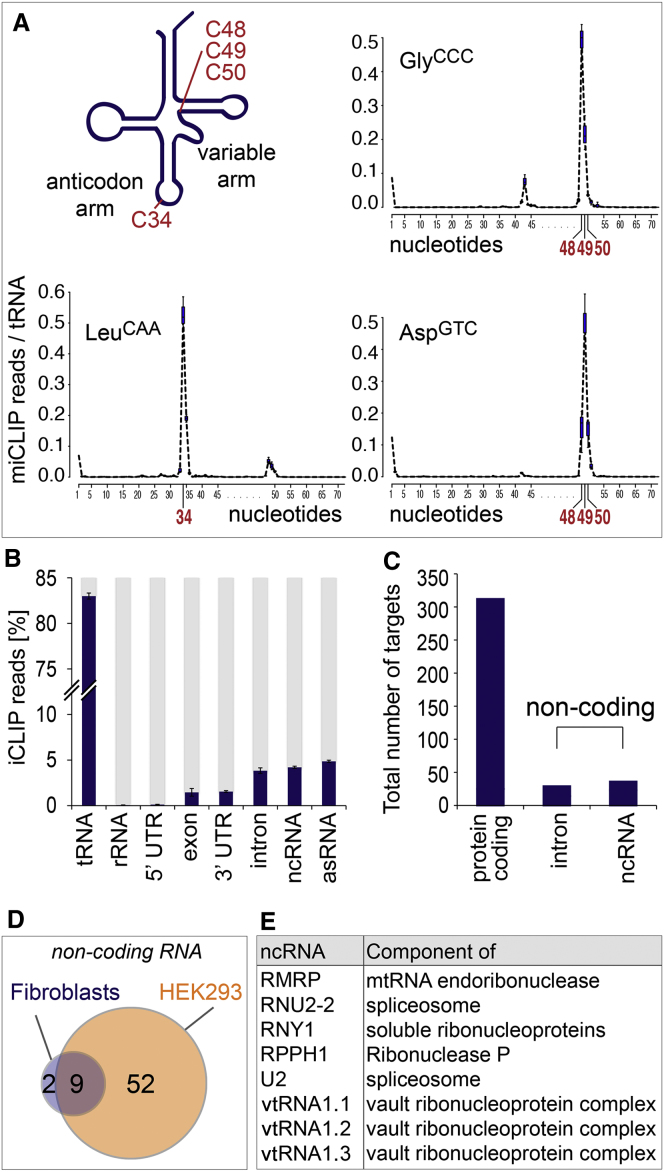
Detection of Coding and Noncoding RNA by miCLIP (A) Schematics of tRNA carrying m5C at positions 48, 49, and 50 in the variable arm or at position 34 in the anticodon arm (top left). Frequency of miCLIP reads per tRNA identifies all cytosine-5 methylated sites in tRNA GlyCCC, LeuCAA, and AspGTC (top right and bottom). See also Figure S2. (B) Percentage of miCLIP reads in noncoding (tRNA, rRNA, 5′ and 3′ UTR, intron, ncRNA, and asRNA) and protein-coding RNAs. Shown are common miCLIP targets of three replicates after 25 cycles of amplification. Error estimates represent SD of the mean. See also Figure S2. (C) Total number of protein-coding, intron, and other noncoding RNAs (ncRNAs) in three replicates after 35 cycles of amplification. See also Figure S3. (D) Venn diagram of common miCLIP-identified ncRNAs in HEK293 (orange) and human fibroblasts (blue). See also Figure S3. (E) Description of eight ncRNAs with differential abundance in human fibroblast carrying a heterozygous (+/−) or homozygous (−/−) loss-of-function mutation for NSUN2.
Figure 3
Figure 3
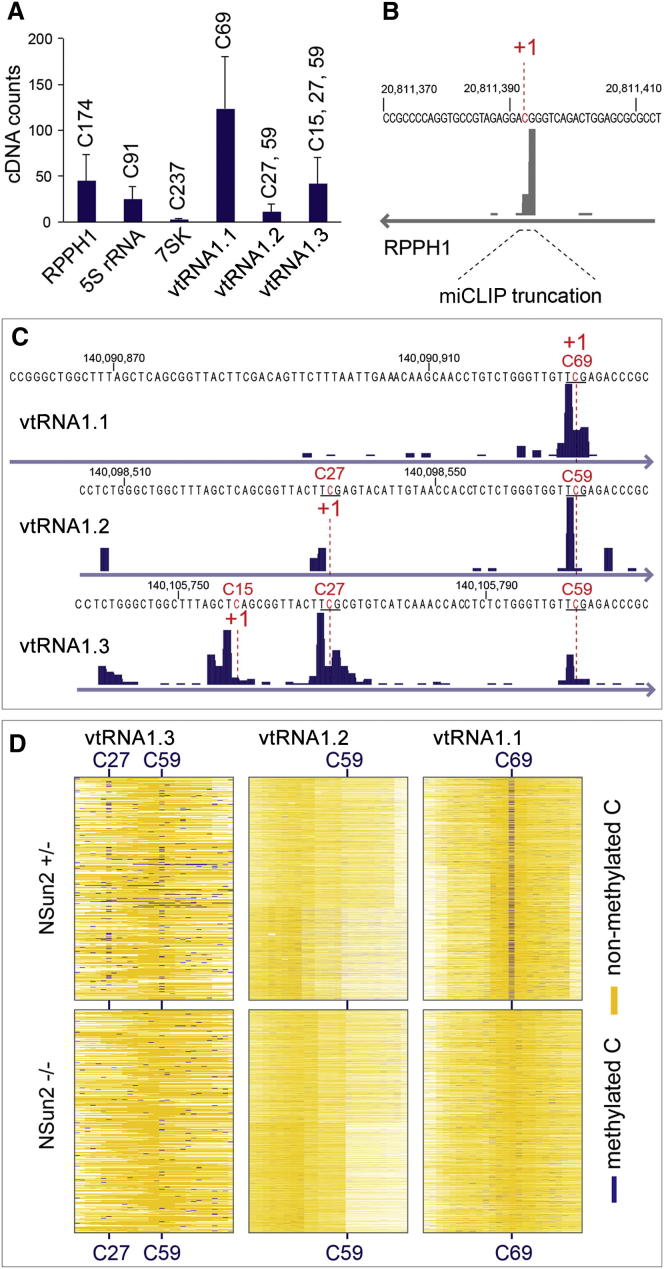
Identification of m5C in Noncoding RNAs (A) Total number of cDNAs and position of the m5C modification mapping to RPPH1, 5S rRNA, 7SK, and vtRNA (vtRNA1.1, vtRNA1.2, vtRNA1.3) in three independent miCLIP experiments after 25 cycles of amplification. Error estimates represent SD of the mean. (B and C) Detection of miCLIP sites mapped as a custom track on the UCSC genome browser in RPPH1 (B) and vtRNA1.1, vtRNA1.2, and vtRNA1.3 (C). +1 indicates the crosslinked cytosine. Underlined is the potential consensus site T(m5C)G. (D) RNA bisulfite sequencing showing the total number of reads with methylated (blue) and nonmethylated (yellow) cytosines in vtRNA1.1, vtRNA1.2, and vtRNA1.3 in NSUN2+/− and NSUN2−/− human fibroblasts. See also Figure S4.
Figure 4
Figure 4
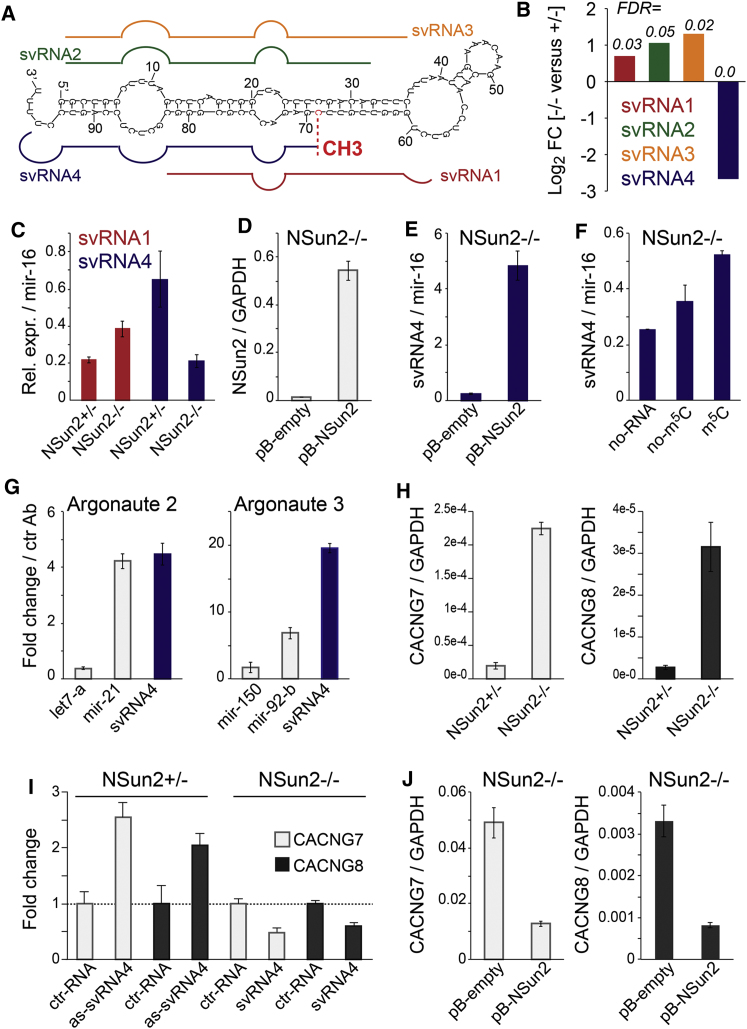
Differential Processing of vtRNA1.1 into svRNAs in the Absence of m5C (A) Schematics of secondary structure of vtRNA1.1 and small vault RNA (svRNA) found to be differentially abundant in NSUN2+/− and NSUN2−/− fibroblasts. CH3, cytosine-5 methylated site at position 69. (B) Fold-change (log2) and false discovery rate (FDR) values for reads of svRNA1-4 in NSUN2+/− versus NSUN2−/− human fibroblasts. (C) Detection of svRNA1 and svRNA4 in NSUN2+/− and NSUN2−/− cells using qPCR. (D and E) RNA levels of NSun2 (D) and svRNA4 (E) in NSun2 null (−/−) fibroblasts rescued by viral infection of NSun2 (pB-NSun2) compared to the empty vector control (pB-empty). (F) Abundance of svRNA4 in NSUN2−/− cell lysates (no-RNA) or incubated with synthetic vtRNA1.1 carrying (m5C) or lacking (no-m5C) at position 69. (G) Detection of svRNA4 in small RNA pool copurified with Argonaute 2 (left) and Argonaute 3 (right). Let7-a and mir-150 are negative and mir-21 and mir-92-b are positive controls for Argonaute 2- and 3-bound microRNAs, respectively. (H) qPCR showing expression of CACNG7 and CACNG8 RNA relative to GAPDH in NSUN2−/− and NSUN2+/− fibroblasts. (I) Fold-change expression of CACNG7 and CACNG8 RNA in NSUN2−/− and NSUN2+/− fibroblasts transduced with svRNA antagomirs (as-svRNA4) or svRNA4 microRNA mimics (svRNA) versus respective control RNAs (ctr-RNA). (J) RNA levels of CACNG7 and CACNG8 relative to GAPDH in NSun2 null (−/−) fibroblasts rescued by viral infection of NSun2 (pB-NSun2) compared to the empty vector control (pB-empty). Error estimates represent SEM (C–J). See also Figures S5 and S6.
Figure S1
Figure S1
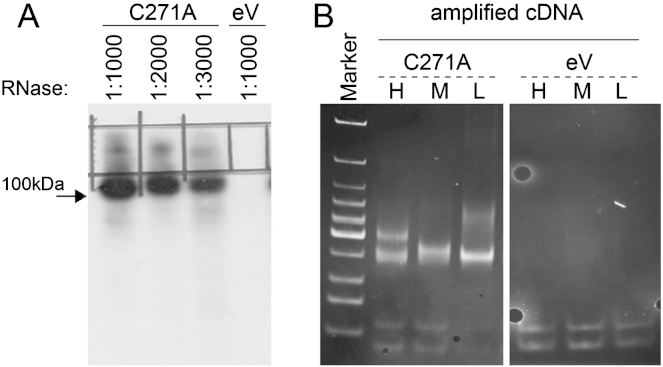
NSun2-RNA Complex Detection and cDNA Amplification, Related to Figure 1 (A) Radiolabeled NSun2-RNA complexes run on denaturing gels and blotted onto nitrocellulose membranes. Marking indicates NSun2-RNA complexes of higher molecular weight dissected for library preparation. A range of RNaseI conditions were tested and a dilution of 1:1000 gave the best results. HEK293 cells transfected with empty vector (eV) used as a negative control to exclude contamination in the subsequent PCR step during library preparation. (B) TBE polyacrylamide gel showing PCR miCLIP cDNA fragments after 25 cycles of amplification. DNA was stained using ethidium bromide. High- (H), Medium- (M), and Low- (L) indicates the size of excised TBE-Urea gels fragments before the amplification step.
Figure S2
Figure S2
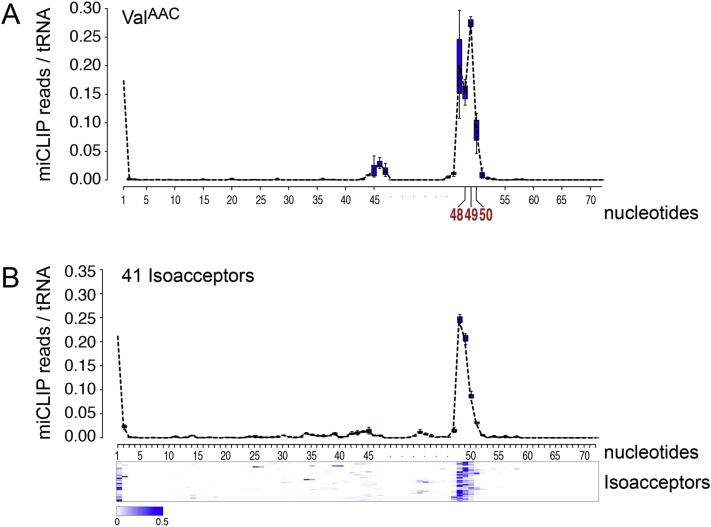
Identification of m5C in tRNAs Using miCLIP, Related to Figures 2A and 2B (A) Frequency of miCLIP reads in tRNA VAlAAC. (B) Frequency of miCLIP reads and heat map identify position 48, 49 and 50 as main NSun2-targeted site in tRNA isoacceptors.
Figure S3
Figure S3
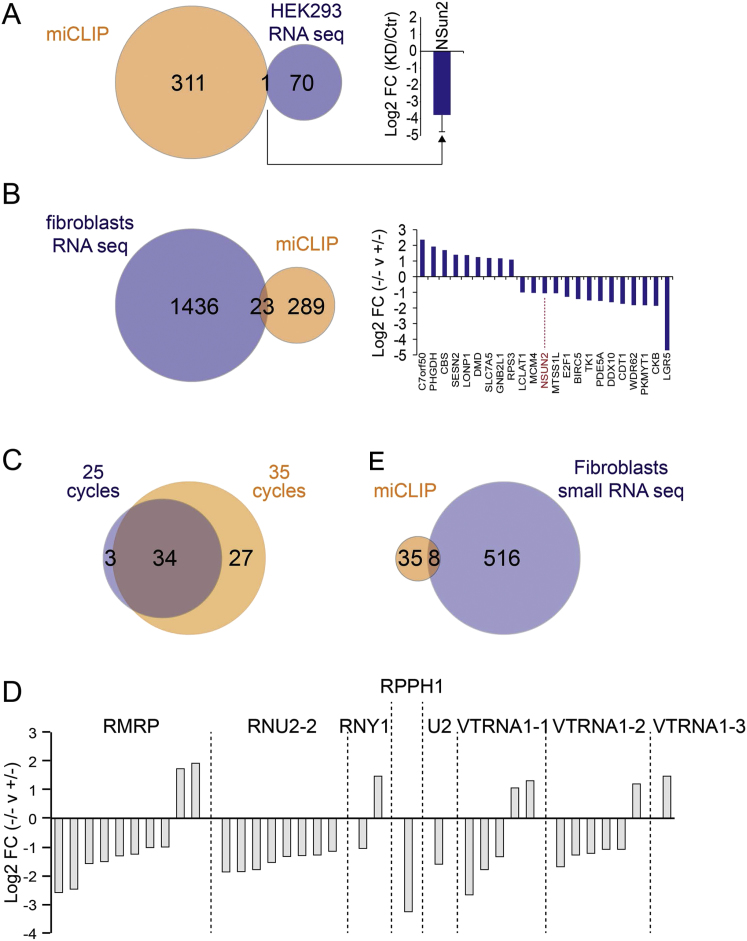
miCLIP Identified RNAs, Related to Figures 2C and 2D (A) Venn diagram (left hand panel) of miCLIP identified mRNAs and differentially expressed mRNAs in HEK293 cells overexpressing an NSun2 RNAi versus a scrambled vector control identifies NSun2 as the only common target (right hand panel). KD: knockdown; Ctr: scrambled vector control). (B) Venn diagram (left hand panel) showing miCLIP mRNA targets and differentially expressed mRNAs in NSUN2 (+/−) versus (−/−) human fibroblasts reveal a small over-lap of 23 (7%) that can be both up- and downregulated in NSUN2 (+/−) versus (−/−) human fibroblasts (right hand panel). (C) Venn diagram miCLIP identified non-coding RNA in HEK293 cells after 25 or 35 cycles of amplification. (D) Venn diagram miCLIP non-coding RNA targets with differentially abundant small RNAs in NSUN2 (+/−) versus (−/−) human fibroblasts. (E) Log2-fold change (FC) of non-coding RNAs obtained by small RNA sequencing in NSun2 null (−/−) versus NSun2-expressing (+/−) fibroblasts identified in Figure 2E.
Figure S4
Figure S4
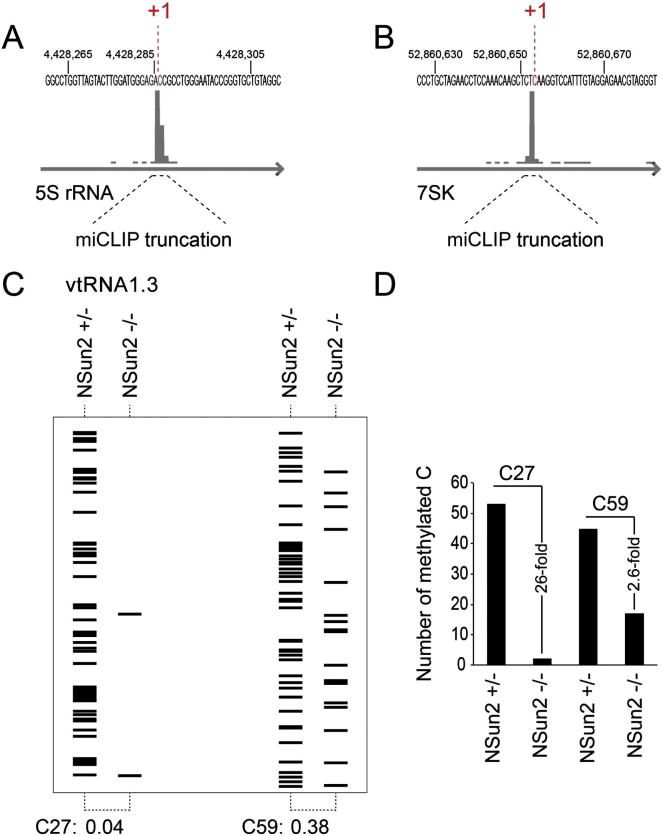
Identification of m5C Using miCLIP and Bisulfite Conversion, Related to Figure 3 (A and B) Detection of miCLIP sites using UCSC genome browser in 5S rRNA (A) and 7SK (B). (C) Schematic representation of the number of m5C modifications in bisulfite converted VTRNA1.3 at positions 27 and 59 in NSUN2+/− and NSUN2−/− cells shown in Figure 3D. (D) Quantification of (C).
Figure S5
Figure S5
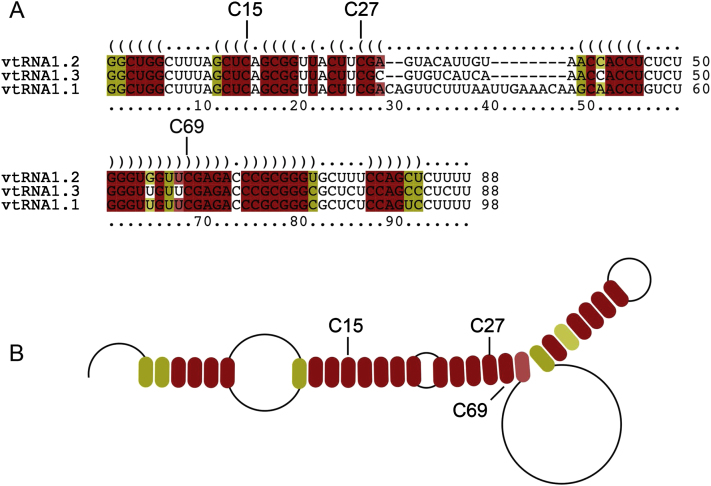
Structural Position of Methylated Cytosines in VtRNAs, Related to Figure 4 Sequence (A) and structural (B) alignment of VTRNA1.1, VTRNA1.2 and VTRNA1.3 using LocARNA (http://rna.informatik.uni-freiburg.de). All miCLIP identified sites are located within the RNA stem structure (C15, C27,C59/69).
Figure S6
Figure S6
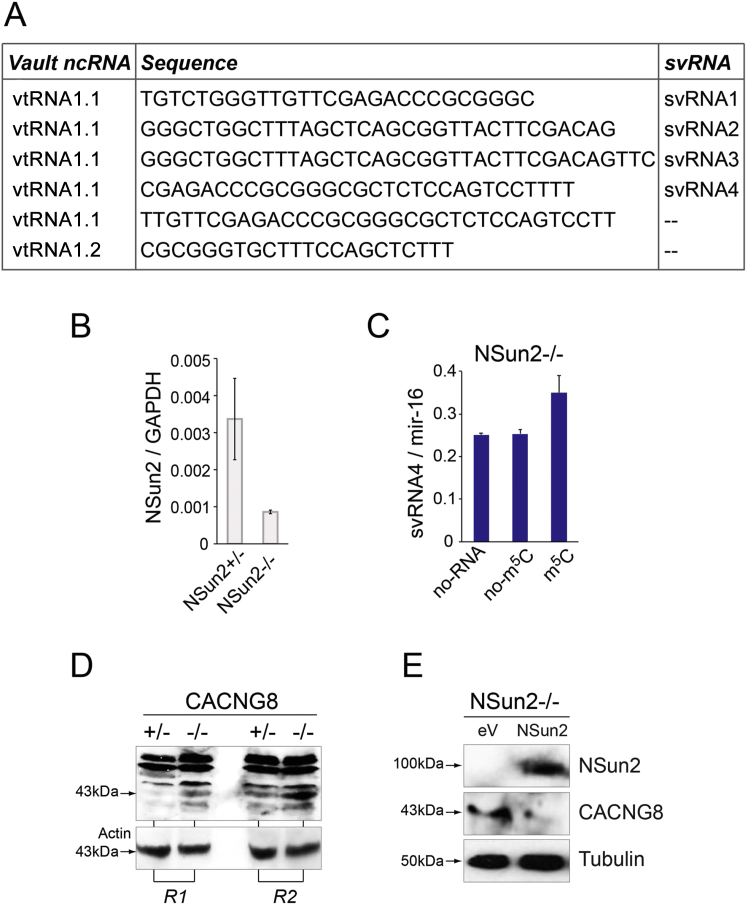
Processing of VTRNA1.1 into svRNAs, Related to Figure 4 (A) Complete list of svRNAs derived from VtRNAs found in human fibroblasts. (B) QPCR showing expression of NSun2 RNA relative to GAPDH in NSUN2 (−/−) and (+/−) fibroblasts. (C) Abundance of svRNA4 in NSUN2−/− cell lysates (no-RNA) or incubated with synthetic VTRNA1.1 carrying (m5C) or lacking (no-m5C) at position 69 at 37°C. (D) Western Blot detecting CACNG8 protein (43kDa) (upper panel) in NSUN2 (−/−) and (+/−) fibroblasts in two independent replicates (R1, R2). Bands at higher molecular weight are unspecific. Actin served as a loading control (lower panel). (E) Western Blot detecting NSun2 (100kDa) (upper panel) and CACNG8 protein (43kDa) (middle panel) in NSUN2 −/− cells infected with an empty vector control (eV) or full length NSun2 (NSun2). Tubulin (50kDa) (lower panel) served as loading control.

References

    1. Abbasi-Moheb L., Mertel S., Gonsior M., Nouri-Vahid L., Kahrizi K., Cirak S., Wieczorek D., Motazacker M.M., Esmaeeli-Nieh S., Cremer K. Mutations in NSUN2 cause autosomal-recessive intellectual disability. Am. J. Hum. Genet. 2012;90:847–855. - PMC - PubMed
    1. Blanco S., Kurowski A., Nichols J., Watt F.M., Benitah S.A., Frye M. The RNA-methyltransferase Misu (NSun2) poises epidermal stem cells to differentiate. PLoS Genet. 2011;7:e1002403. - PMC - PubMed
    1. Brzezicha B., Schmidt M., Makalowska I., Jarmolowski A., Pienkowska J., Szweykowska-Kulinska Z. Identification of human tRNA:m5C methyltransferase catalysing intron-dependent m5C formation in the first position of the anticodon of the pre-tRNA Leu (CAA) Nucleic Acids Res. 2006;34:6034–6043. - PMC - PubMed
    1. Burgess D.L., Gefrides L.A., Foreman P.J., Noebels J.L. A cluster of three novel Ca2+ channel gamma subunit genes on chromosome 19q13.4: evolution and expression profile of the gamma subunit gene family. Genomics. 2001;71:339–350. - PubMed
    1. Burroughs A.M., Ando Y., de Hoon M.J., Tomaru Y., Suzuki H., Hayashizaki Y., Daub C.O. Deep-sequencing of human Argonaute-associated small RNAs provides insight into miRNA sorting and reveals Argonaute association with RNA fragments of diverse origin. RNA Biol. 2011;8:158–177. - PMC - PubMed

Supplemental References

    1. Anders S., Huber W. Differential expression analysis for sequence count data. Genome Biol. 2010;11:R106. - PMC - PubMed
    1. Krueger F., Andrews S.R. Bismark: a flexible aligner and methylation caller for Bisulfite-Seq applications. Bioinformatics. 2011;27:1571–1572. - PMC - PubMed
    1. Langmead B., Trapnell C., Pop M., Salzberg S.L. Ultrafast and memory-efficient alignment of short DNA sequences to the human genome. Genome Biol. 2009;10:R25. - PMC - PubMed
    1. Shi R., Chiang V.L. Facile means for quantifying microRNA expression by real-time PCR. Biotechniques. 2005;39:519–525. - PubMed
    1. Trapnell C., Pachter L., Salzberg S.L. TopHat: discovering splice junctions with RNA-Seq. Bioinformatics. 2009;25:1105–1111. - PMC - PubMed

Publication types