


Early postnatal inhibition of serotonin synthesis results in long-term reductions of perseverative behaviors, but not aggression, in MAO A-deficient mice
- PMID: 23871843
- PMCID: PMC3849223
- DOI: 10.1016/j.neuropharm.2013.07.003
Early postnatal inhibition of serotonin synthesis results in long-term reductions of perseverative behaviors, but not aggression, in MAO A-deficient mice
Abstract
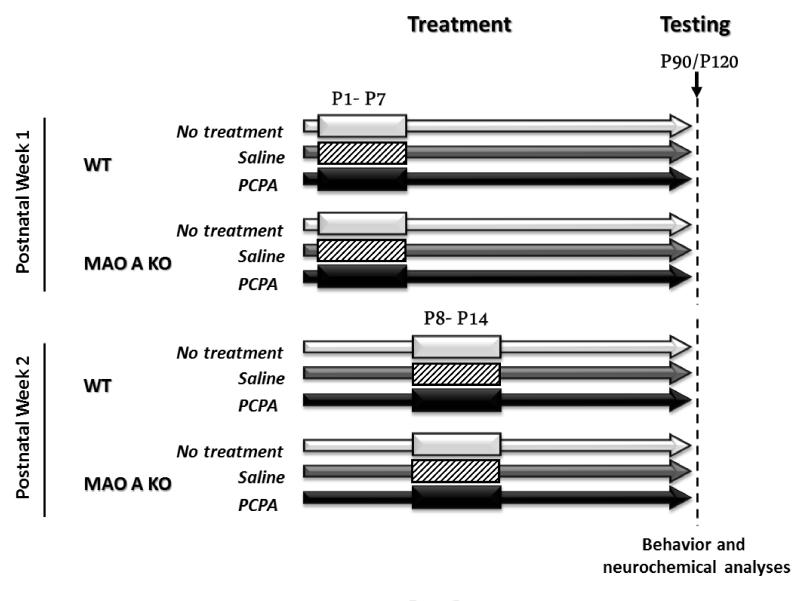
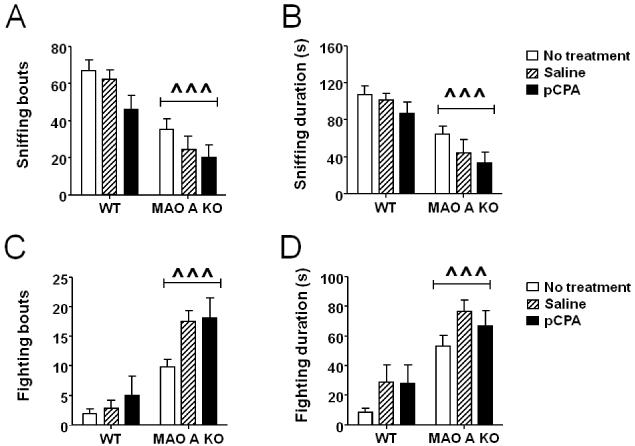
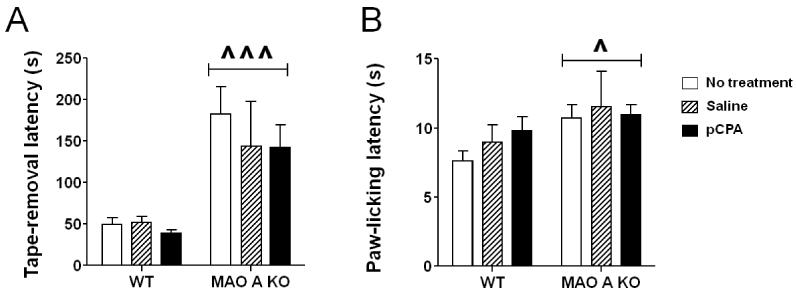
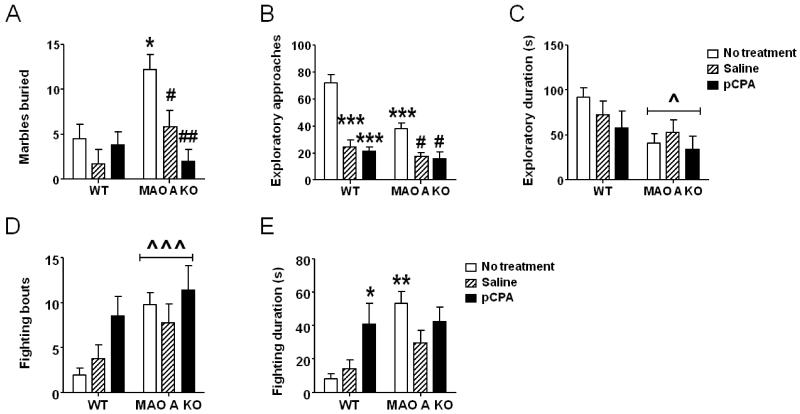
Monoamine oxidase (MAO) A, the major enzyme catalyzing the oxidative degradation of serotonin (5-hydroxytryptamine, 5-HT), plays a key role in emotional regulation. In humans and mice, MAO-A deficiency results in high 5-HT levels, antisocial, aggressive, and perseverative behaviors. We previously showed that the elevation in brain 5-HT levels in MAO-A knockout (KO) mice is particularly marked during the first two weeks of postnatal life. Building on this finding, we hypothesized that the reduction of 5-HT levels during these early stages may lead to enduring attenuations of the aggression and other behavioral aberrances observed in MAO-A KO mice. To test this possibility, MAO-A KO mice were treated with daily injections of a 5-HT synthesis blocker, the tryptophan hydroxylase inhibitor p-chloro-phenylalanine (pCPA, 300 mg/kg/day, IP), from postnatal day 1 through 7. As expected, this regimen significantly reduced 5-HT forebrain levels in MAO-A KO pups. These neurochemical changes persisted throughout adulthood, and resulted in significant reductions in marble-burying behavior, as well as increases in spontaneous alternations within a T-maze. Conversely, pCPA-treated MAO-A KO mice did not exhibit significant changes in anxiety-like behaviors in a novel open-field and elevated plus-maze; furthermore, this regimen did not modify their social deficits, aggressive behaviors and impairments in tactile sensitivity. Treatment with pCPA from postnatal day 8 through 14 elicited similar, yet milder, behavioral effects on marble-burying behavior. These results suggest that early developmental enhancements in 5-HT levels have long-term effects on the modulation of behavioral flexibility associated with MAO-A deficiency.
Keywords: Aggression; Animal models; Early developmental stages; Monoamine oxidase A; Perseverative behaviors; Serotonin.
Copyright © 2013 Elsevier Ltd. All rights reserved.
Figures

References
-
- Amen DG, Stubblefield M, Carmichael B. Brain SPECT findings and aggressiveness. Ann Clin Psychiatry. 1996;8:129–137. - PubMed
-
- Anderson GM, Horne WC, Chatterjee D, Cohen DJ. The hyperserotonemia of autism. Ann N Y Acad Sci. 1990;600:331–340. discussion 341-332. - PubMed
-
- Anderson GM, Freedman DX, Cohen DJ, Volkmar FR, Hoder EL, McPhedran P, et al. Whole blood serotonin in autistic and normal subjects. J Child Psychol Psychiatry. 1987;28:885–900. - PubMed
-
- Baldwin D, Rudge S. The role of serotonin in depression and anxiety. Int Clin Psychopharmacol. 1995;9(Suppl 4):41–45. - PubMed
Publication types
MeSH terms
Substances
Grants and funding
LinkOut - more resources
Full Text Sources
Other Literature Sources
Molecular Biology Databases
Research Materials
