


Fever-induced Brugada pattern: how common is it and what does it mean?
- PMID: 23872691
- PMCID: PMC3832740
- DOI: 10.1016/j.hrthm.2013.07.030
Fever-induced Brugada pattern: how common is it and what does it mean?
Abstract
Background: Fever is known to unmask the Brugada pattern on the electrocardiogram (ECG) and trigger ventricular arrhythmias in patients with Brugada syndrome. Genetic studies in selected cases with fever-induced Brugada pattern have identified disease-causing mutations. Thus, "fever-induced Brugada" is a recognized clinical entity. However, its prevalence has not been systematically evaluated.
Objective: The purpose of this study was to assess the prevalence of Brugada pattern in consecutive patients with fever.
Methods: ECGs of patients with fever admitted to the emergency department were evaluated for the presence of Brugada pattern and compared with ECGs of consecutive nonfebrile patients.
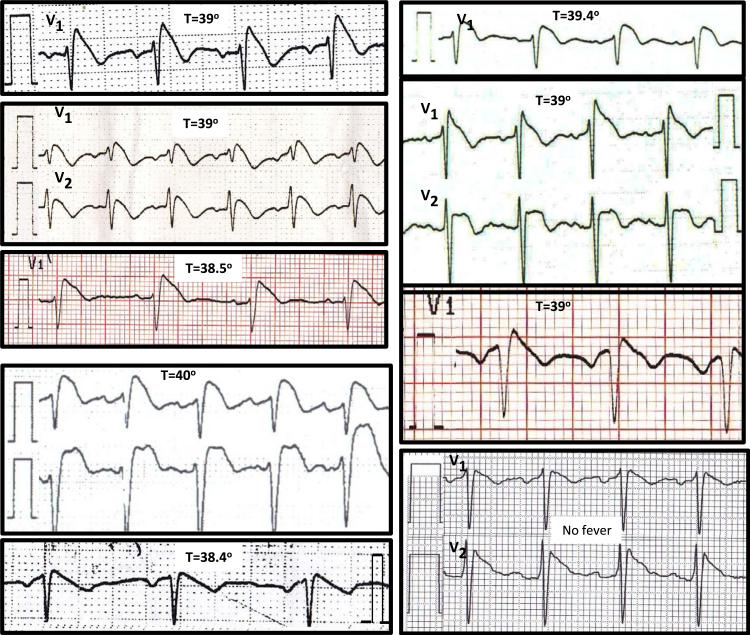
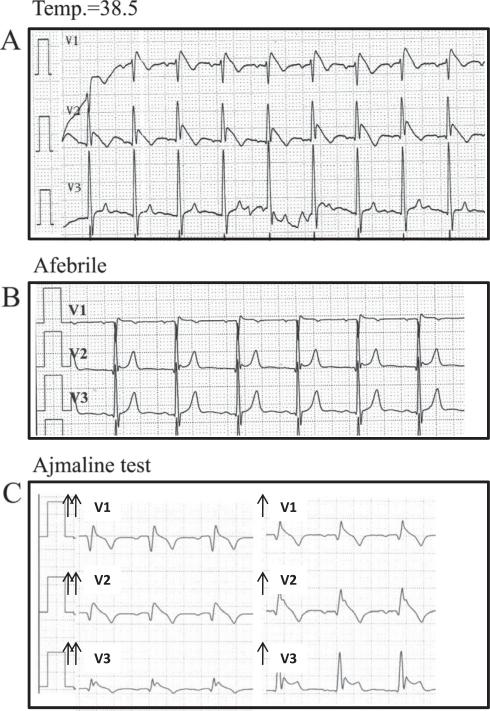
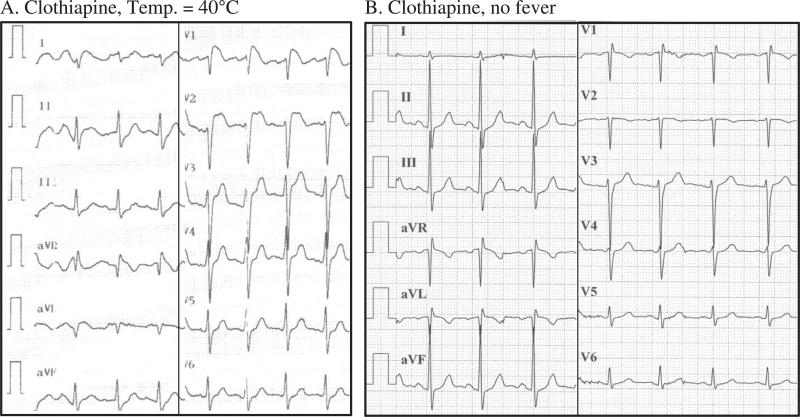
Results: ECGs of 402 patients with fever and 909 without were evaluated. Type I Brugada pattern was 20 times more common in the febrile group than in the afebrile group (2% vs. 0.1%, respectively, P = .0001). All patients with fever-induced type I Brugada pattern were asymptomatic and remained so during 30 months of follow-up.
Conclusion: Type I Brugada pattern is definitively more common among patients with fever, suggesting that asymptomatic Brugada syndrome is more prevalent than previously estimated.
Keywords: AIDS; Brugada syndrome; ECG; Fever; Ventricular fibrillation; acquired immunodeficiency syndrome; electrocardiogram.
© 2013 Heart Rhythm Society. All rights reserved.
Figures
Comment in
-
Fever and the electrocardiogram: what about Brugada syndrome?Heart Rhythm. 2013 Sep;10(9):1383-4. doi: 10.1016/j.hrthm.2013.07.048. Epub 2013 Aug 2. Heart Rhythm. 2013. PMID: 23911895 No abstract available.
References
-
- Antzelevitch C, Brugada P, Borggrefe M, et al. Brugada syndrome: report of the second consensus conference: endorsed by the Heart Rhythm Society and the European Heart Rhythm Association. Circulation. 2005;111:659–670. - PubMed
-
- Richter S, Sarkozy A, Veltmann C, et al. Variability of the diagnostic ECG pattern in an ICD patient population with Brugada syndrome. J Cardiovasc Electrophysiol. 2009;20:69–75. - PubMed
-
- Dumaine R, Towbin JA, Brugada P, et al. Ionic mechanisms responsible for the electrocardiographic phenotype of the Brugada syndrome are temperature dependent. Circ Res. 1999;85:803–809. - PubMed
-
- Porres JM, Brugada J, Urbistondo V, Garcia F, Reviejo K, Marco P. Fever unmasking the Brugada syndrome. Pacing Clin Electrophysiol. 2002;25:1646–1648. - PubMed
-
- Kum LC, Fung JW, Sanderson JE. Brugada syndrome unmasked by febrile illness. Pacing Clin Electrophysiol. 2002;25:1660–1661. - PubMed
MeSH terms
Grants and funding
LinkOut - more resources
Full Text Sources
Other Literature Sources
Medical
