


Oral cancer chemotherapy adherence and adherence assessment tools: a report from North Central Cancer Group Trial N0747 and a systematic review of the literature
- PMID: 23872949
- PMCID: PMC3815511
- DOI: 10.1007/s13187-013-0511-z
Oral cancer chemotherapy adherence and adherence assessment tools: a report from North Central Cancer Group Trial N0747 and a systematic review of the literature
Abstract
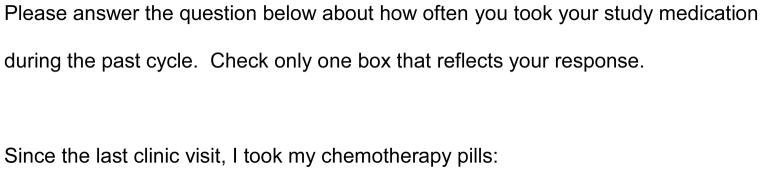
Oncologists are now prescribing more oral chemotherapy than ever before, thus placing the onus for taking the right dose at the right time under the right circumstances directly on the patient. This study was undertaken to understand emerging adherence issues and to explore available adherence assessment tools. This two-part study (1) examined N0747, a randomized phase II trial that tested the oral agents, sunitinib and capecitabine, in patients with metastatic esophageal cancer from an adherence standpoint, and (2) conducted a systematic review to compile and assess adherence tools that can be used in future clinical trials. First, in N0747, patients were assigned to sunitinib and capecitabine versus capecitabine; 53 chemotherapy cycles were prescribed to this 12-patient cohort. Nearly all patients denoted that they "always or almost always" took their pills as prescribed, and two patients who reported lack of full adherence suffered from grade 3+ adverse events. Surprisingly, however, over 14 cycles, 9 patients reported grade 3+ toxicity but checked "always or almost always" to describe their adherence. No relationships were observed between adherence and cancer outcomes. Secondly, 21 articles identified the following adherence tools: (1) healthcare providers' interviews, (2) patient-reported adherence with diaries/calendars, (3) patient-completed adherence scales, (4) medication event monitoring, (5) automated voice response, (6) drug/metabolite assays, and (7) prescription databases. Of note, only the automated voice response seems capable of real-time detection of over-adherence, as observed in N0747. Oral chemotherapy adherence should be further studied, particularly from the standpoint of over-adherence.
Figures


References
-
- [last accessed March 20, 2013]; http://chemoth.com/economics.
-
- [last accessed March 20 2013]; http://clinicaltrials.gov/ct2/show/NCT00891878?term=N0747+AND+jatoi&rank=1.
-
- Therasse P, Arbuck SG, Eisenhauer EA, et al. New guidelines to evaluate the response to treatment in solid tumors. European Organization for Research and Treatment of Cancer, National Cancer Institute of the United States, National Cancer Institute of Canada. J Natl Cancer Inst. 2000;92:205–16. - PubMed
-
- Ruddy K, Mayer E, Partridge A. Patient adherence and persistence with oral anticancer treatment. CA Cancer J Clin. 2009;59:56–66. - PubMed
-
- Sommers RM, Miller K, Berry DL. Feasibility pilot on medication adherence and knowledge in ambulatory patients with gastrointestinal cancer. Oncology Nursing Forum. 2012;39:373–379. - PubMed
Publication types
MeSH terms
Substances
Grants and funding
- U10 CA035267/CA/NCI NIH HHS/United States
- K24 CA131099/CA/NCI NIH HHS/United States
- CA-37404/CA/NCI NIH HHS/United States
- U10 CA037404/CA/NCI NIH HHS/United States
- CA-35103/CA/NCI NIH HHS/United States
- CA-25224/CA/NCI NIH HHS/United States
- CA-35113/CA/NCI NIH HHS/United States
- U10 CA035113/CA/NCI NIH HHS/United States
- U10 CA035119/CA/NCI NIH HHS/United States
- CA-35448/CA/NCI NIH HHS/United States
- U10 CA025224/CA/NCI NIH HHS/United States
- CA-35267/CA/NCI NIH HHS/United States
- N01 CA035119/CA/NCI NIH HHS/United States
- U10 CA035448/CA/NCI NIH HHS/United States
- 5K24CA131099/CA/NCI NIH HHS/United States
- U10 CA035103/CA/NCI NIH HHS/United States
LinkOut - more resources
Full Text Sources
Other Literature Sources
Medical
