Stress-induced inflammatory responses in women: effects of race and pregnancy
- PMID: 23873713
- PMCID: PMC3788648
- DOI: 10.1097/PSY.0b013e31829bbc89
Stress-induced inflammatory responses in women: effects of race and pregnancy
Abstract
Objective: African Americans experience preterm birth at nearly twice the rate of whites. Chronic stress associated with minority status is implicated in this disparity. Inflammation is a key biological pathway by which stress may affect birth outcomes. This study examined the effects of race and pregnancy on stress-induced inflammatory responses.
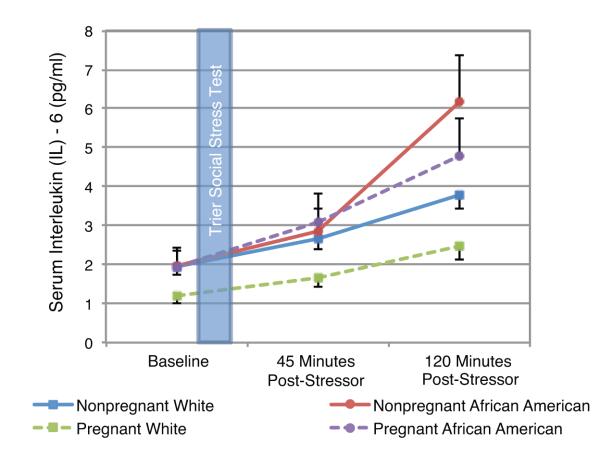
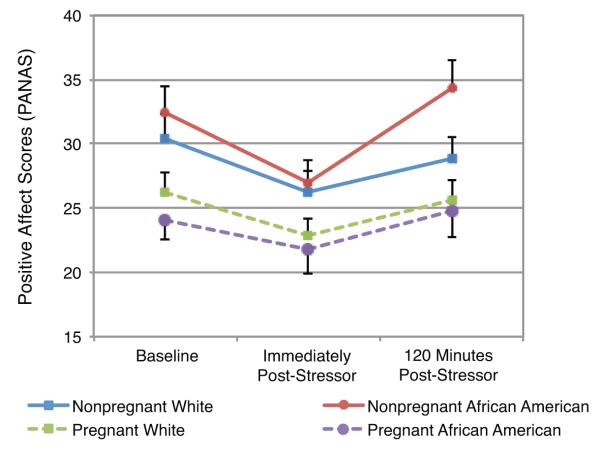
Methods: Thirty-nine women in the second trimester of pregnancy (19 African American, 20 white) and 39 demographically similar nonpregnant women completed an acute stressor (Trier Social Stress Test). Psychosocial characteristics, health behaviors, and affective responses were assessed. Serum interleukin (IL)-6 was measured at baseline, 45 minutes, and 120 minutes poststressor.
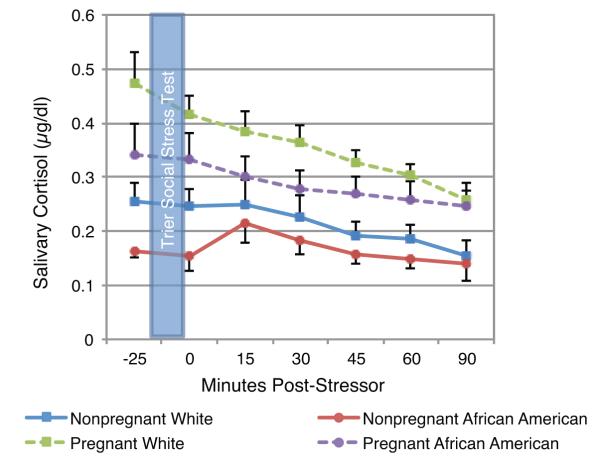
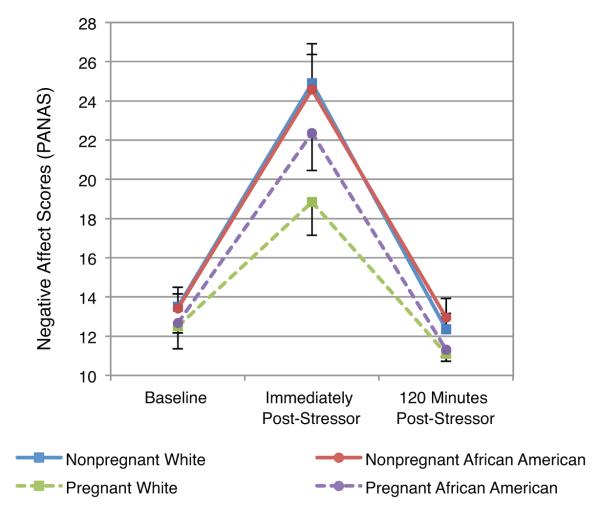
Results: IL-6 responses at 120 minutes poststressor were 46% higher in African Americans versus whites (95% confidence interval = 8%-81%, t(72) = 3.51, p = .001). This effect was present in pregnancy and nonpregnancy. IL-6 responses at 120 minutes poststressor tended to be lower (15%) in pregnant versus nonpregnant women (95% confidence interval = -5%-32%, p = .14). Racial differences in inflammatory responses were not accounted for by demographics, psychological characteristics, health behaviors, or differences in salivary cortisol. Pregnant whites showed lower negative affective responses than did nonpregnant women of either race (p values ≤ .007).
Conclusions: This study provides novel evidence that stress-induced inflammatory responses are more robust among African American women versus whites during pregnancy and nonpregnancy. The ultimate impact of stress on health is a function of stressor exposure and physiological responses. Individual differences in stress-induced inflammatory responses represent a clear target for continued research efforts in racial disparities in health during pregnancy and nonpregnancy.
Keywords: acute stress; affective response; inflammatory response; interleukin-6; pregnancy; racial disparities.
Figures
References
-
- Committee on Understanding Premature Birth and Assuring Healthy Outcomes . In: Preterm birth : causes, consequences, and prevention. Behrman RE, Butler AS, editors. National Academies Press; Washington, D.C.: 2007. - PubMed
-
- Callaghan WM, MacDorman MF, Rasmussen SA, Qin C, Lackritz EM. The contribution of preterm birth to infant mortality rates in the United States. Pediatrics. 2006;118(4):1566–1573. - PubMed
-
- Martin JA, Hamilton BE, Sutton PD, Ventura SJ, Menacker F, Kirmeyer S, Munson ML. Births: final data for 2005. Natl Vital Stat Rep. 2007;56(6):1–103. - PubMed
-
- Mcgrady GA, Sung JFC, Rowley DL, Hogue CJR. Preterm Delivery and Low-Birth-Weight among 1st-Born Infants of Black-and-White College Graduates. American Journal of Epidemiology. 1992;136(3):266–276. - PubMed
-
- Goldenberg RL, Cliver SP, Mulvihill FX, Hickey CA, Hoffman HJ, Klerman LV, Johnson MJ. Medical, psychosocial, and behavioral risk factors do not explain the increased risk for low birth weight among black women. American Journal of Obstetrics and Gynecology. 1996;175(5):1317–1324. - PubMed
Publication types
MeSH terms
Substances
Grants and funding
LinkOut - more resources
Full Text Sources
Other Literature Sources
Medical