


Short-term administration of progesterone and estradiol independently alter carotid-vasomotor, but not carotid-cardiac, baroreflex function in young women
- PMID: 23873800
- PMCID: PMC3798755
- DOI: 10.1152/ajpheart.00194.2013
Short-term administration of progesterone and estradiol independently alter carotid-vasomotor, but not carotid-cardiac, baroreflex function in young women
Abstract
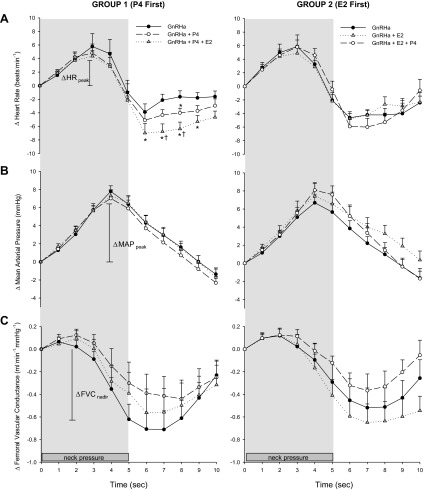
The individual effects of estrogen and progesterone on baroreflex function remain poorly understood. We sought to determine how estradiol (E2) and progesterone (P4) independently alter the carotid-cardiac and carotid-vasomotor baroreflexes in young women by using a hormone suppression and exogenous add-back design. Thirty-two young women were divided into two groups and studied under three conditions: 1) after 4 days of endogenous hormone suppression with a gonadotropin releasing hormone antagonist (control condition), 2) after continued suppression and 3 to 4 days of supplementation with either 200 mg/day oral progesterone (N = 16) or 0.1 to 0.2 mg/day transdermal 17β-estradiol (N = 16), and 3) after continued suppression and 3 to 4 days of supplementation with both hormones. Changes in heart rate (HR), mean arterial pressure (MAP), and femoral vascular conductance (FVC) were measured in response to 5 s of +50 mmHg external neck pressure to unload the carotid baroreceptors. Significant hormone effects on the change in HR, MAP, and FVC from baseline at the onset of neck pressure were determined using mixed model covariate analyses accounting for P4 and E2 plasma concentrations. Neither P4 (P = 0.95) nor E2 (P = 0.95) affected the HR response to neck pressure. Higher P4 concentrations were associated with an attenuated fall in FVC (P = 0.01), whereas higher E2 concentrations were associated with an augmented fall in FVC (P = 0.02). Higher E2 was also associated with an augmented rise in MAP (P = 0.01). We conclude that progesterone blunts whereas estradiol enhances carotid-vasomotor baroreflex sensitivity, perhaps explaining why no differences in sympathetic baroreflex sensitivity are commonly reported between low and high combined hormone phases of the menstrual cycle.
Keywords: arterial baroreceptors; blood pressure; estrogen; hormones; menstrual cycle.
Figures
References
-
- Abdel-Rahman AR, Merrill RH, Wooles WR. Gender-related differences in the baroreceptor reflex control of heart rate in normotensive humans. J Appl Physiol 77: 606–613, 1994 - PubMed
-
- Beske SD, Alvarez GE, Ballard TP, Davy KP. Gender difference in cardiovagal baroreflex gain in humans. J Appl Physiol 91: 2088–2092, 2001 - PubMed
Publication types
MeSH terms
Substances
Grants and funding
LinkOut - more resources
Full Text Sources
Other Literature Sources
