


Volunteer bias in recruitment, retention, and blood sample donation in a randomised controlled trial involving mothers and their children at six months and two years: a longitudinal analysis
- PMID: 23874465
- PMCID: PMC3706448
- DOI: 10.1371/journal.pone.0067912
Volunteer bias in recruitment, retention, and blood sample donation in a randomised controlled trial involving mothers and their children at six months and two years: a longitudinal analysis
Abstract
Background: The vulnerability of clinical trials to volunteer bias is under-reported. Volunteer bias is systematic error due to differences between those who choose to participate in studies and those who do not.
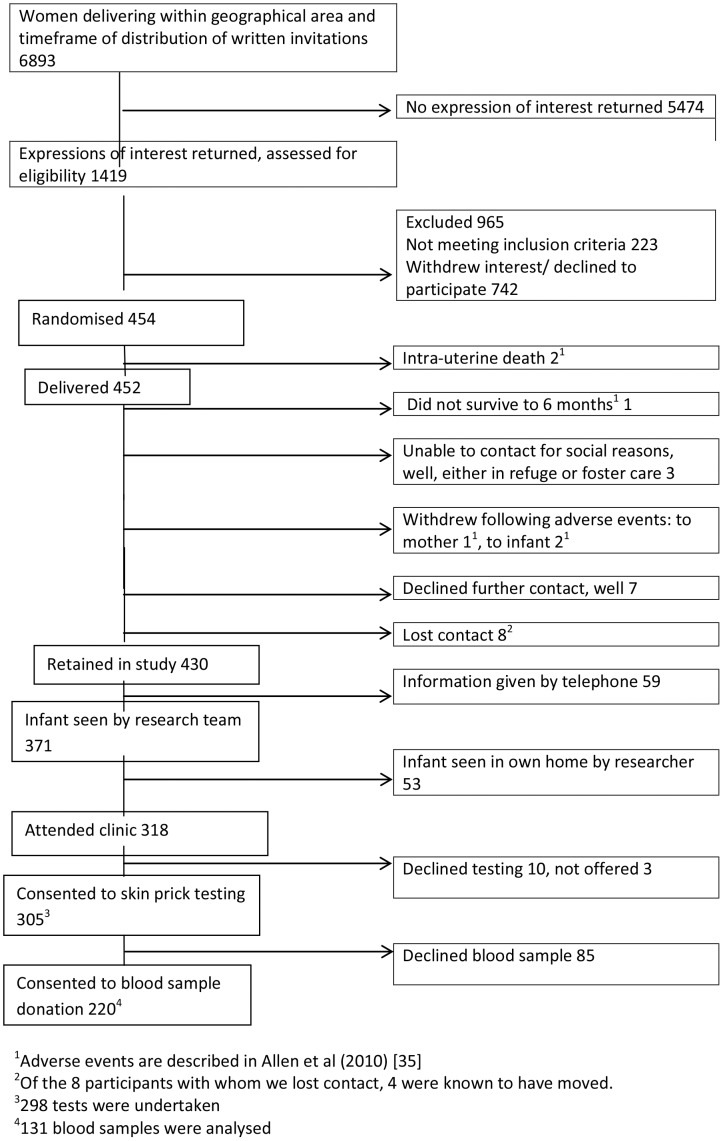
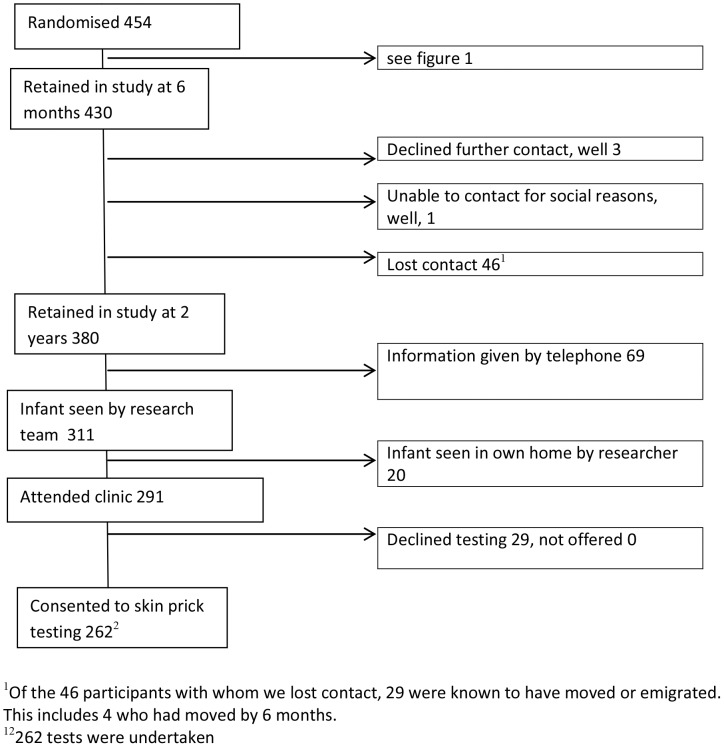
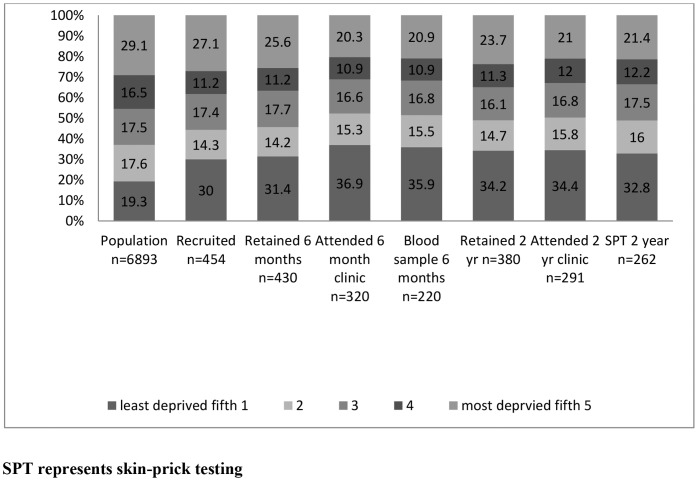
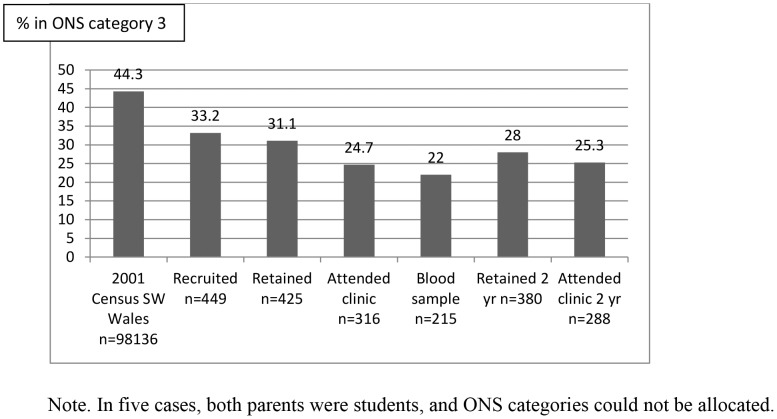
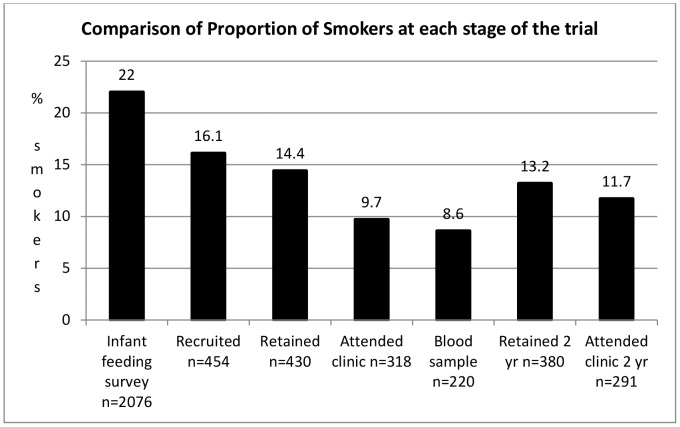
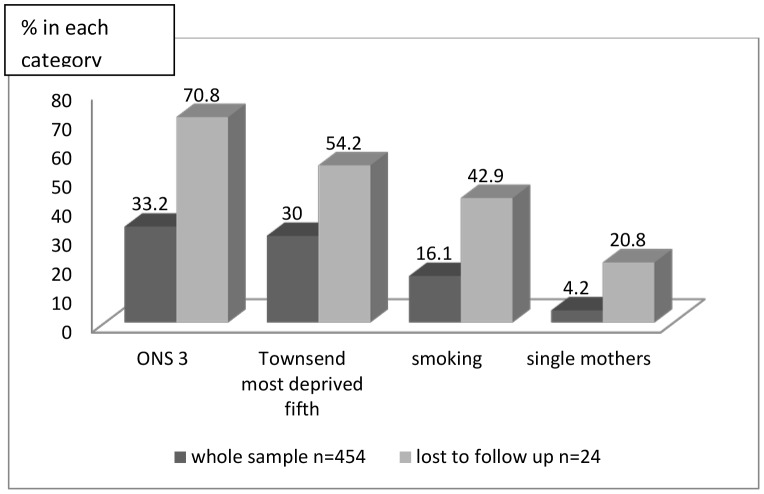
Methods and results: This paper extends the applications of the concept of volunteer bias by using data from a trial of probiotic supplementation for childhood atopy in healthy dyads to explore 1) differences between a) trial participants and aggregated data from publicly available databases b) participants and non-participants as the trial progressed 2) impact on trial findings of weighting data according to deprivation (Townsend) fifths in the sample and target populations. 1) a) Recruits (n = 454) were less deprived than the target population, matched for area of residence and delivery dates (n = 6,893) (mean [SD] deprivation scores 0.09[4.21] and 0.79[4.08], t = 3.44, df = 511, p<0.001). b) i) As the trial progressed, representation of the most deprived decreased. These participants and smokers were less likely to be retained at 6 months (n = 430[95%]) (OR 0.29,0.13-0.67 and 0.20,0.09-0.46), and 2 years (n = 380[84%]) (aOR 0.68,0.50-0.93 and 0.55,0.28-1.09), and consent to infant blood sample donation (n = 220[48%]) (aOR 0.72,0.57-0.92 and 0.43,0.22-0.83). ii) Mothers interested in probiotics or research or reporting infants' adverse events or rashes were more likely to attend research clinics and consent to skin-prick testing. Mothers participating to help children were more likely to consent to infant blood sample donation. 2) In one trial outcome, atopic eczema, the intervention had a positive effect only in the over-represented, least deprived group. Here, data weighting attenuated risk reduction from 6.9%(0.9-13.1%) to 4.6%(-1.4-+10.5%), and OR from 0.40(0.18-0.91) to 0.56(0.26-1.21). Other findings were unchanged.
Conclusions: Potential for volunteer bias intensified during the trial, due to non-participation of the most deprived and smokers. However, these were not the only predictors of non-participation. Data weighting quantified volunteer bias and modified one important trial outcome.
Trial registration: This randomised, double blind, parallel group, placebo controlled trial is registered with the International Standard Randomised Controlled Trials Register, Number (ISRCTN) 26287422. Registered title: Probiotics in the prevention of atopy in infants and children.
Conflict of interest statement
Figures
References
-
- Institute of Medicine (US) (2012) Public engagement and clinical trials: New models and disruptive technologies: Workshop summary. Washington (DC): National Academies Press (US). Available: http://www.ncbi.nlm.nih.gov/books/NBK91498/pdf/TOC.pdf. Accessed 2012 Aug 14. - PubMed
-
- Eisner J, Jones L (2009) Patient recruitment: Are we looking in the right place? Clinical Discovery 4(2): 19–21.
-
- Wahlbeck K, Tuunainen A, Ahokas A, Leucht S (2001) Dropout rates in randomised antipsychotic drug trials. Psychopharmacology (Berl) 155(3): 230–233. - PubMed
-
- O’Neill RT, Temple R (2012) The prevention and treatment of missing data in clinical trials: An FDA perspective on the importance of dealing with it. Clin Pharmacol Ther 91(3): 550–4 doi:10.1038/clpt.2011.340 - DOI - PubMed
-
- Higgins JPT, Altman DG, Sterne JAC, editors (2011) Assessing risk of bias in included studies. In: Higgins JPT, Green S (editors). Cochrane Handbook for Systematic Reviews of Interventions Version 5.1.0 (updated March 2011). The Cochrane Collaboration, 2011. Available: www.cochrane-handbook.org. Accessed 2012 Dec 15.
Publication types
MeSH terms
Associated data
LinkOut - more resources
Full Text Sources
Other Literature Sources
Research Materials
Miscellaneous
