Comparative Study
. 2013 Jul 12;8(7):e68242.
doi: 10.1371/journal.pone.0068242. Print 2013.

New metrics for comparison of taxonomies reveal striking discrepancies among species delimitation methods in Madascincus lizards

Affiliations
Comparative Study

New metrics for comparison of taxonomies reveal striking discrepancies among species delimitation methods in Madascincus lizards

Aurélien Miralles et al. PLoS One. .

Abstract

Delimiting and describing species is fundamental to numerous biological disciplines such as evolution, macroecology, and conservation. Delimiting species as independent evolutionary lineages may and often does yield different outcomes depending on the species criteria applied, but methods should be chosen that minimize the inference of objectively erroneous species limits. Several protocols exploit single-gene or multi-gene coalescence statistics, assignment tests or other rationales related to nuclear DNA (nDNA) allele sharing to automatically delimit species. We apply seven different species delimitation protocols to a taxonomically confusing group of Malagasy lizards (Madascincus), and compare the resulting taxonomies with two newly developed metrics: the Taxonomic index of congruence C tax which quantifies the congruence between two taxonomies, and the Relative taxonomic resolving power index R tax which quantifies the potential of an approach to capture a high number of species boundaries. The protocols differed in the total number of species proposed, between 9 and 34, and were also highly incongruent in placing species boundaries. The Generalized Mixed Yule-Coalescent approach captured the highest number of potential species boundaries but many of these were clearly contradicted by extensive nDNA admixture between sympatric mitochondrial DNA (mtDNA) haplotype lineages. Delimiting species as phenotypically diagnosable mtDNA clades failed to detect two cryptic species that are unambiguous due to a lack of nDNA gene flow despite sympatry. We also consider the high number of species boundaries and their placement by multi-gene Bayesian species delimitation as poorly reliable whereas the Bayesian assignment test approach provided a species delimitation highly congruent with integrative taxonomic practice. The present study illustrates the trade-off in taxonomy between reliability (favored by conservative approaches) and resolving power (favored by inflationist approaches). Quantifying excessive splitting is more difficult than quantifying excessive lumping, suggesting a priority for conservative taxonomies in which errors are more liable to be detected and corrected by subsequent studies.


Conflict of interest statement

Competing Interests: The authors have declared that no competing interests exist.

Figures

Figure 1
Figure 1. Calculation of the Relative taxonomic resolving power index (Rtax) and Taxonomic index of congruence (Ctax).
Calculations are exemplified on two distinct species delimitation approaches (X and Y) supporting different taxonomies. For a better understanding, calculations are first exemplified on a tree-based taxonomy (a). Although these calculations are based on a underlying phylogenetic perspective, knowledge of tree topology is not mandatory to perform the calculations (b). In (a), speciation event hypotheses supported by the approaches X and Y are represented by black and white circles, respectively. The Ctax between both approaches is defined as the ratio of the total number of speciation events congruently supported ( = shared) by both approaches (dark grey boxes), relative to the total number of speciation events cumulatively suggested by both approaches (in light grey boxes). The Rtax of a given approach represents the proportion of speciation events that it supports ( = single), relative to the complete set of speciation events (set of boundaries cumulatively revealed by all the different approaches – only two approaches in this example). In (b), representing the same taxonomy, the same calculations have been performed without relying on a phylogenetic tree, the number of speciation events being indirectly inferred from the number of species (in a dichotomic species tree, N cladogenetic speciation events = N species – 1). Little black dots represent specimens or populations, and each colored oval represents a distinct species hypothesis according to the approach (or combination of approaches) used.
Figure 2
Figure 2. Summary of the taxonomies proposed for the genus Madascincus using different species delimitation approaches.
Correspondences with clades are shown on the mtDNA gene tree (BI analysis of concatenated ND1and 16S sequences, posterior probabilities indicated for each node). The seven vertical multicolored bars represent alternative taxonomies, respectively supported by the Mitochondrial Tree – Morphological character Congruence (MTMC), Integrative Taxonomy (ITAX), Wiens-Penkrot (WP), Bayesian Assignment Test (BAT), Haploweb (HW), Bayesian Species Delimitation (BSD) and Generalized Mixed Yule-Coalescent (GMYC) approaches for species delimitation, each segment of these bars representing distinct species according to the respective approach. White lines connecting different samples in the phylogeny represent instances of sympatry between different clades.
Figure 3
Figure 3. Results from the Integrative Taxonomic (ITAX) and Wiens and Penkrot (WP) approaches to species delimitation.
Taxonomies are summarized above each figure by a horizontal multicolored bar, each segment representing a different species. A: Application of the ITAX protocol on the mtDNA gene tree. Four distinct criteria have been applied for speciation delimitation within the genus Madascincus. White lines connecting terminal taxa represent occurrences of sympatry (localities a-i) between major clades. B: Application of the WP protocol on the mtDNA gene tree. All the seven focal species tested represent exclusive haplotype lineages, with the exception of M. polleni. Two haplotypes have being considered as the minimal acceptable sampling to support the distinctiveness of a given species. Therefore, species revealed by the WP protocol that were represented by a single haplotype (white circle) were merged with their sister species. The unique sample of M. stumpffi from Antanambao (red circle) constitutes the only exception to this rule: this sample represents the sister lineage of two clades (Files S1 and S2) which are both well sampled and recovered as distinct species. Therefore, in accordance with the concept of phylogenetic species on which this protocol is based, the distinctiveness of the Antanambao sample as a third species has been validated. Red lines represent a selection of the most relevant instances of “gene flow” within each inferred species.
Figure 4
Figure 4. Results from the Bayesian Assignment Test (BAT) and the Haploweb (HW) approaches for species delimitation.
Correspondence with clades is shown on the mtDNA gene tree (BI analysis of concatenated ND1 and 16S sequences). Taxonomies resulting from both approaches are summarized above each figure by a horizontal multicolored bar, each segment representing a species. A: Clusters in the nuclear STRUCTURE plot resulting from BAT, and their correspondence with clades in the mtDNA gene tree. Each cluster is marked with a different color with horizontal bars representing specimens and the proportion of a bar assigned to a single color representing the posterior probability that a specimen is assigned to that cluster. This can also be interpreted as the percentage of a specimen’s genome derived from that particular genetic cluster. mtDNA clades not mapped to the assignment plot represent out-group samples. Graphics in grey boxes represent calculations for various K values in STRUCTURE analysis of the nuclear data (ten replicates): left, the mean of the estimated log probability of the data for K = 3 to 18 ; right, ΔK values for K = 2 to 17. B: For each marker, single locus fields for recombination (pools of co-occurring haplotypes) inferred from the HW approach are represented by distinct segments of the grey bars, each bar representing one of the four nuclear haploweb reconstruction (cf. File S11). Species delimitation is based on a majority consensus of these four haplowebs: two populations being only considered as distinct species if at least three markers out of a total of four congruently recognize them as distinct fields for recombination. Taxonomies resulting from both BAT and HW approaches are summarized above each figure by a horizontal multicolor bar, each segment representing a species. Note that only haplotype sharing and not the connections between haplotypes are taken into account for species delimitation.
Figure 5
Figure 5. Results from the Bayesian Species Delimitation (BSD) and Generalized Mixed Yule-Coalescent (GMYC) approaches.
Taxonomies resulting from both species delimitation approaches are summarized above each figure by a horizontal multicolored bar, each segment representing a different species. A: Guide trees used for each of the four BSD analyses (separately for the M. polleni, M. mouroundavae, M. igneocaudatus and M. melanopleura groups and assuming ten, two, six and nine species respectively (colored squares), cf. File S10 for details) are presented, with speciation probabilities provided for each node under each combination of priors for θ and τo (top, prior means = 0.1; middle, prior means = 0.001; bottom, prior mean θ = 0.1, prior mean τo = 0.001). Only speciation events simultaneously supported by probabilities superior or equal to 0.99 for all three combinations of priors were considered to be relevant for species delimitation. The distinction between supported and non supported speciation events is represented by a horizontal red line above which each lineage represent a single and distinct species. B: The distinction between “inter-specific” versus “intra-specific” nodes estimated by the GMYC approach is represented by a horizontal red line, and all intra-specific relationships are colored in red on the mtDNA chronogram. The graphic in the grey box represent the lineages-through-time plot based on the ultrametric tree obtained from all mitochondrial haplotypes. The sharp increase in branching rate, corresponding to the transition from interspecies to intraspecies branching events, is indicated by a red line.
Figure 6
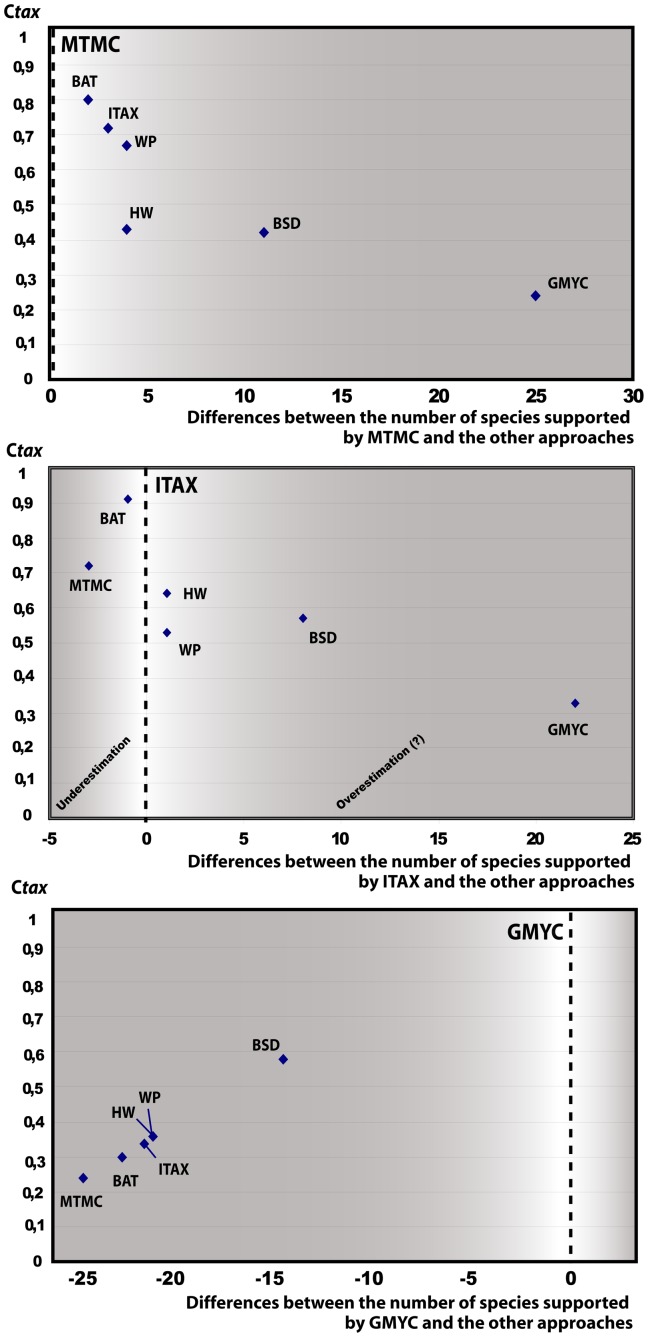
Figure 6. Comparison of the relative performance of species delimitation approaches relative to MTMC, ITAX and GMYC.
Figure 7
Figure 7. Relative taxonomic resolving power index (Rtax) and Taxonomic index of congruence (Ctax) calculation for each species delimitation approaches tested.
Each putative speciation event inferred by all seven approaches (cf. Fig. 2) is reported for better visualization on the mtDNA tree topology (although these indices can also be understood without relying on a specific tree topology). Each color represents a distinct method. The Rtax of a given approach represents the proportion of speciation events that are really supported by this approach, among the complete set of speciation event hypotheses (set of boundaries cumulatively revealed by different approaches. The Ctax between two approaches is defined as the ratio of the total number of speciation events congruently supported by both approaches, to the total number of pairwise species boundaries cumulatively supported by both approaches. The mean Ctax value (mean of all Ctax values involving each of these approaches) and the number of species supported by each approaches is also presented.

References

    1. Wiens JJ, Servedio MR (2000) Species delimitation in systematics: inferring diagnostic differences between species. Proc R Soc B 267: 631–636. - PMC - PubMed
    1. Wheeler QD, Knapp S, Stevenson DW, Stevenson J, Blum SD, et al. (2012) Mapping the biosphere: Exploring species to understand the origin, organization, and sustainability of biodiversity. Syst Biodivers 10: 1–20.
    1. Areekul Butcher B, Quicke DLJ (2012) A turbo-taxonomic study of Thai Aleiodes (Aleiodes) and Aleiodes (Arcaleiodes) (Hymenoptera: Braconidae: Rogadinae) based largely on COI barcoded specimens, with rapid descriptions of 179 new species. Zootaxa 3457: 1–232.
    1. Costello MJ, May RM, Stork NE (2013) Can we name Earth’s species before they go extinct? Science 339: 413–416. - PubMed
    1. Riedel A, Sagata K, Suhardjono YR, Tänzler R, Balke M (2013) Integrative taxonomy on the fast track - towards more sustainability in biodiversity research. Front Zool 10: e15. - PMC - PubMed

Publication types

LinkOut - more resources