


Influenza vaccine effectiveness against hospitalisation with confirmed influenza in the 2010-11 seasons: a test-negative observational study
- PMID: 23874754
- PMCID: PMC3712933
- DOI: 10.1371/journal.pone.0068760
Influenza vaccine effectiveness against hospitalisation with confirmed influenza in the 2010-11 seasons: a test-negative observational study
Abstract
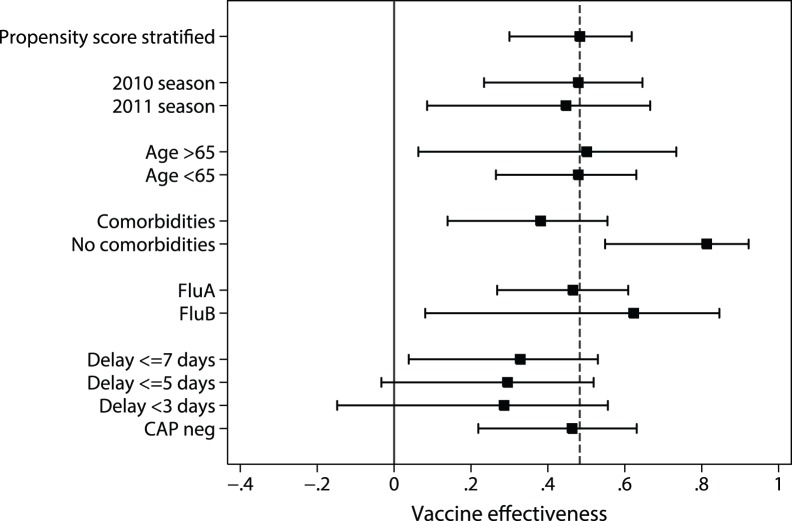
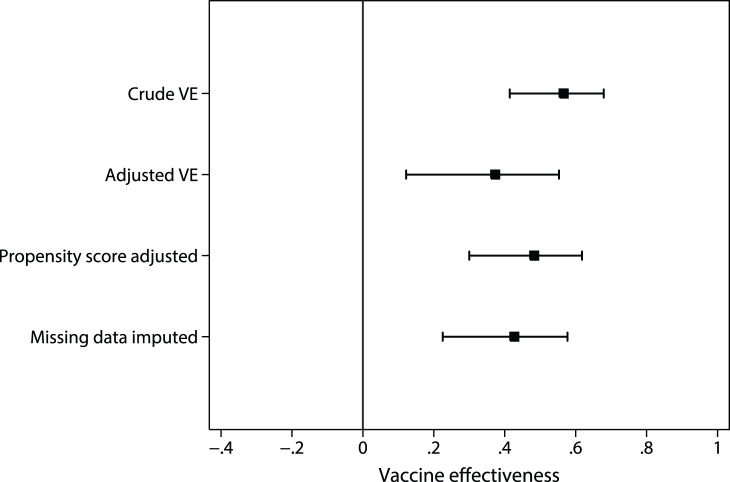
Immunisation programs are designed to reduce serious morbidity and mortality from influenza, but most evidence supporting the effectiveness of this intervention has focused on disease in the community or in primary care settings. We aimed to examine the effectiveness of influenza vaccination against hospitalisation with confirmed influenza. We compared influenza vaccination status in patients hospitalised with PCR-confirmed influenza with patients hospitalised with influenza-negative respiratory infections in an Australian sentinel surveillance system. Vaccine effectiveness was estimated from the odds ratio of vaccination in cases and controls. We performed both simple multivariate regression and a stratified analysis based on propensity score of vaccination. Vaccination status was ascertained in 333 of 598 patients with confirmed influenza and 785 of 1384 test-negative patients. Overall estimated crude vaccine effectiveness was 57% (41%, 68%). After adjusting for age, chronic comorbidities and pregnancy status, the estimated vaccine effectiveness was 37% (95% CI: 12%, 55%). In an analysis accounting for a propensity score for vaccination, the estimated vaccine effectiveness was 48.3% (95% CI: 30.0, 61.8%). Influenza vaccination was moderately protective against hospitalisation with influenza in the 2010 and 2011 seasons.
Conflict of interest statement
Figures

References
-
- ATAGI (2008) Australian Immunisation Handbook. Canberra: Commonwealth of Australia, National Health and Medical Research Council.
-
- Jefferson TO, Rivetti D, Di Pietrantonj C, Rivetti A, Demicheli V (2007) Vaccines for preventing influenza in healthy adults. Cochrane Database Syst Rev: CD001269. - PubMed
-
- Osterholm MT, Kelley NS, Sommer A, Belongia EA (2011) Efficacy and effectiveness of influenza vaccines: a systematic review and meta-analysis. Lancet Infect Dis. - PubMed
-
- Rivetti D, Jefferson T, Thomas R, Rudin M, Rivetti A, et al. (2006) Vaccines for preventing influenza in the elderly. Cochrane Database Syst Rev 3: CD004876. - PubMed
-
- Cheng AC, Kotsimbos AT, Kelly H, Irving L, Bowler S, et al. (2011) Effectiveness of H1N1/09 monovalent and trivalent influenza vaccines against hospitalization with laboratory-confirmed H1N1/09 influenza in Australia: a test-negative case control study. Vaccine 29: 7320–7325. - PubMed
Publication types
MeSH terms
Substances
LinkOut - more resources
Full Text Sources
Other Literature Sources
Medical
