


Significant impact of the MTHFR polymorphisms and haplotypes on male infertility risk
- PMID: 23874907
- PMCID: PMC3715460
- DOI: 10.1371/journal.pone.0069180
Significant impact of the MTHFR polymorphisms and haplotypes on male infertility risk
Abstract
Background: Methylenetetrahydrofolate reductase (MTHFR) converts 5,10-methylene tetrahydrofolate to 5-methyl tetrahydrofolate and affects the activity of cellular cycles participating in nucleotide synthesis, DNA repair, genome stability, maintenance of methyl pool, and gene regulation. Genetically compromised MTHFR activity has been suggested to affect male fertility. The objective of the present study was to find the impact on infertility risk of c.203G>A, c.1298A>C, and c.1793G>A polymorphisms in the MTHFR gene.
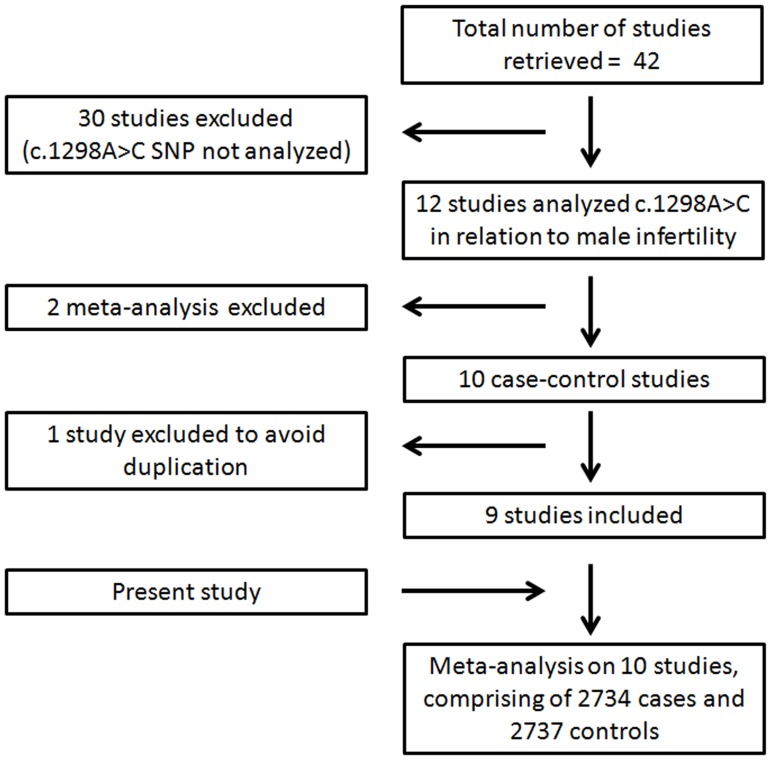
Methods: PCR-RFLP and DNA sequencing were used to genotype the common SNPs in the MTHFR gene in 630 infertile and 250 fertile males. Chi-square test was applied for statistical comparison of genotype data. Linkage disequilibrium between the SNPs and the frequency of common haplotypes were assessed using Haploview software. Biochemical levels of total homocysteine (tHcy) and folic acid were measured. Meta-analysis on c.1298A>C polymorphism was performed using data from ten studies, comprising 2734 cases and 2737 controls.
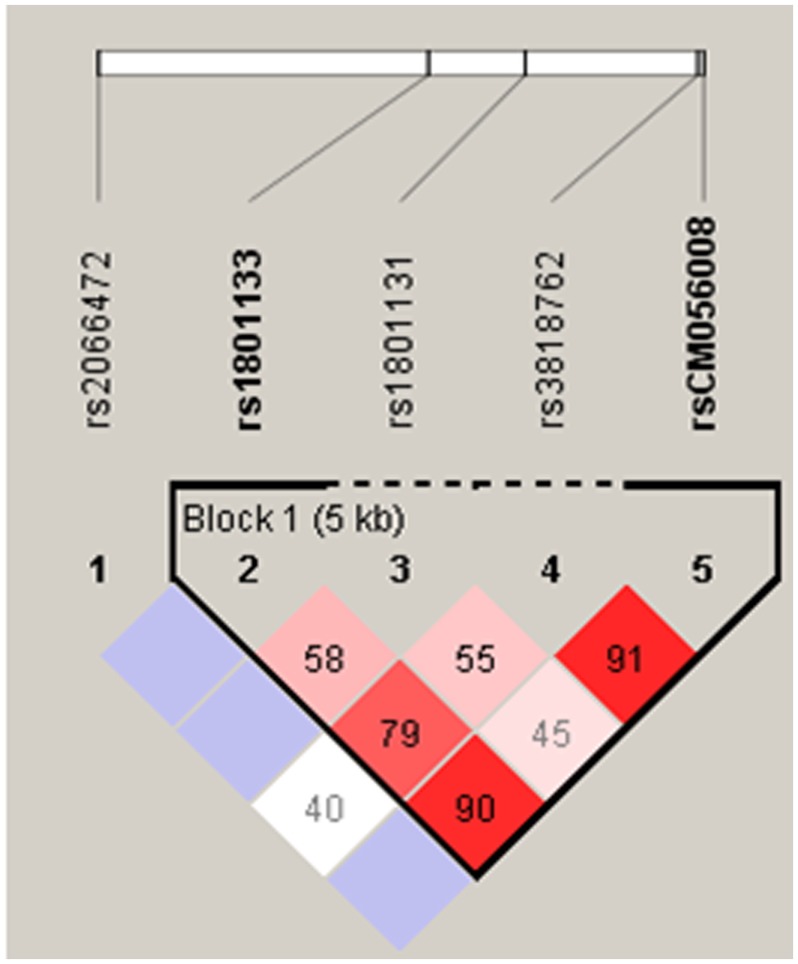
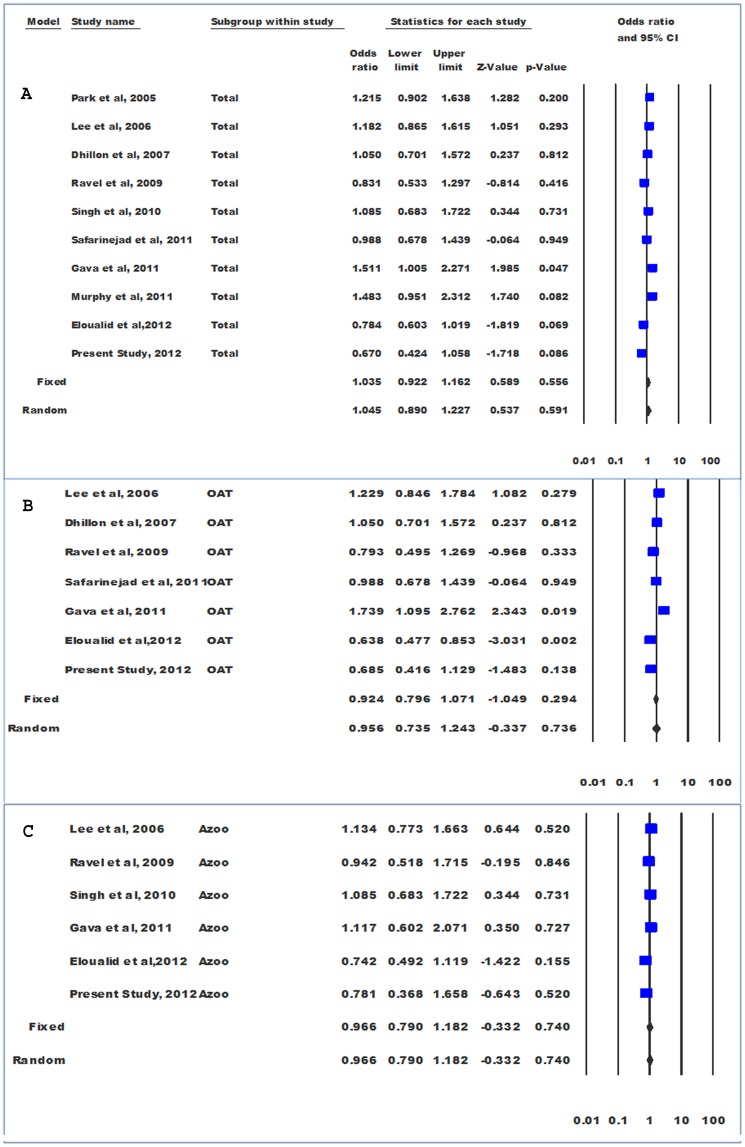
Results: c.203G>A and c.1298A>C were found to be unrelated to infertility risk. c.1793G>A was protective against infertility (P = 0.0008). c.677C>T and c.1793G>A were in significant LD (D' = 0.9). Folic acid and tHcy level did not correlate with male infertility. Pooled estimate on c.1298A>C data from all published studies including our data showed no association of this polymorphism with male infertility (Odds ratio = 1.035, P = 0.56), azoospermia (Odds ratio = 0.97, P = 0.74), or oligoasthenoteratozoospermia (Odds ratio = 0.92, p = 0.29). Eight haplotypes with more than 1% frequency were detected, of which CCGA was protective against infertility (p = 0.02), but the significance of the latter was not seen after applying Bonferroni correction.
Conclusion: Among MTHFR polymorphisms, c.203G>A and c.1298A>C do not affect infertility risk and c.1793G>A is protective against infertility. Haplotype analysis suggested that risk factors on the MTHFR locus do not extend too long on the DNA string.
Conflict of interest statement
Figures
References
-
- Oliva A, Spira A, Multigner L (2001) Contribution of environmental factors to the risk of male infertility. Hum Reprod 16: 1768–1776. - PubMed
-
- Gava MM, Chagas Ede O, Bianco B, Christofolini DM, Pompeo AC, et al. (2011) Methylenetetrahydrofolate Reductase Polymorphisms Are Related to Male Infertility in Brazilian Men. Genet Test Mol Biomarkers 15: 153–157. - PubMed
-
- Tüttelmann F, Rajpert-De Meyts E, Nieschlag E, Simoni M (2007) Gene polymorphisms and male infertility–a meta-analysis and literature review. Reprod Biomed Online 15: 643–658. - PubMed
-
- Forti G, Krausz C (1998) Clinical review 100: Evaluation and treatment of the infertile couple. J Clin Endocrinol Metab 83: 4177–4188. - PubMed
-
- Jungwirth A, Giwercman A, Tournaye H, Diemer T, Kopa Z, et al. (2012) European Association of Urology guidelines on Male Infertility: the 2012 update. Eur Urol 62: 324–332. - PubMed
Publication types
MeSH terms
Substances
LinkOut - more resources
Full Text Sources
Other Literature Sources
Medical
Research Materials
