Prospective evaluation of three rapid diagnostic tests for diagnosis of human leptospirosis
- PMID: 23875034
- PMCID: PMC3708816
- DOI: 10.1371/journal.pntd.0002290
Prospective evaluation of three rapid diagnostic tests for diagnosis of human leptospirosis
Abstract
Background: Diagnosis of leptospirosis by the microscopic agglutination test (MAT) or by culture is confined to specialized laboratories. Although ELISA techniques are more common, they still require laboratory facilities. Rapid Diagnostic Tests (RDTs) can be used for easy point-of-care diagnosis. This study aims to evaluate the diagnostic performance of the RDTs LeptoTek Dri Dot, LeptoTek Lateral Flow, and Leptocheck-WB, prospectively.
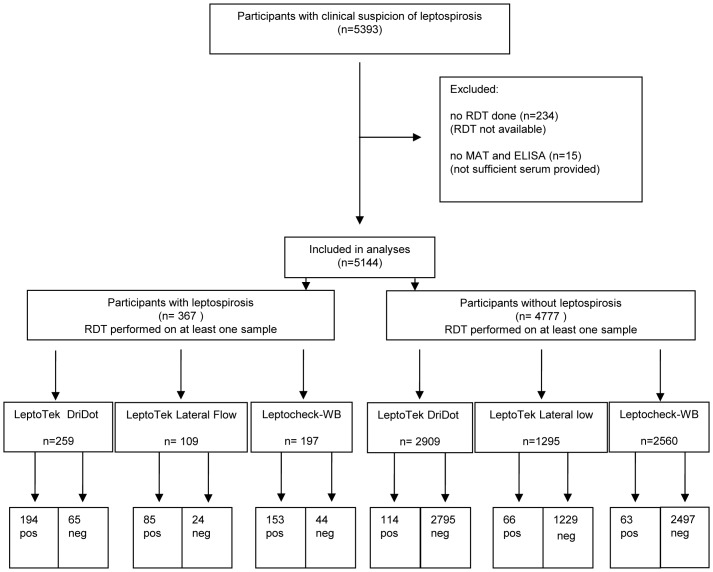
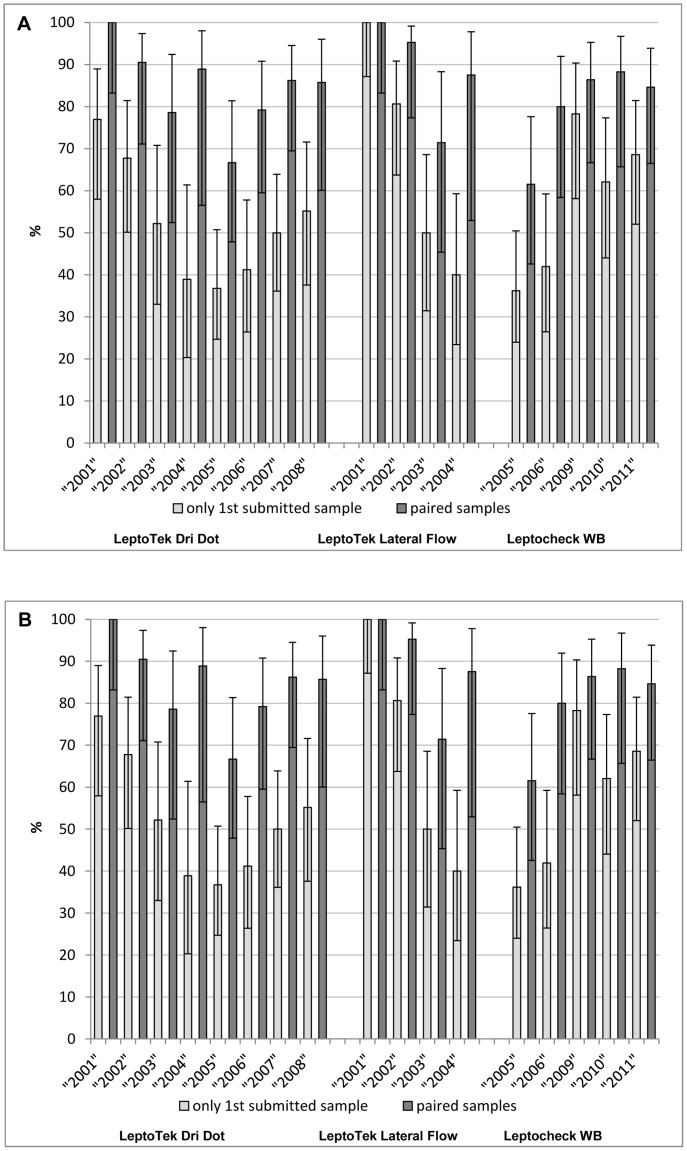
Methodology: During 2001 to 2012, one or two of the RDTs at the same time have been applied prior to routine diagnostics (MAT, ELISA and culture) on serum specimens from participants sent in for leptospirosis diagnosis. The case definition was based on MAT, ELISA and culture results. Participants not fulfilling the case definition were considered not to have leptospirosis. The diagnostic accuracy was determined based on the 1(st) submitted sample and paired samples, either in an overall analysis or stratified according to days post onset of illness.
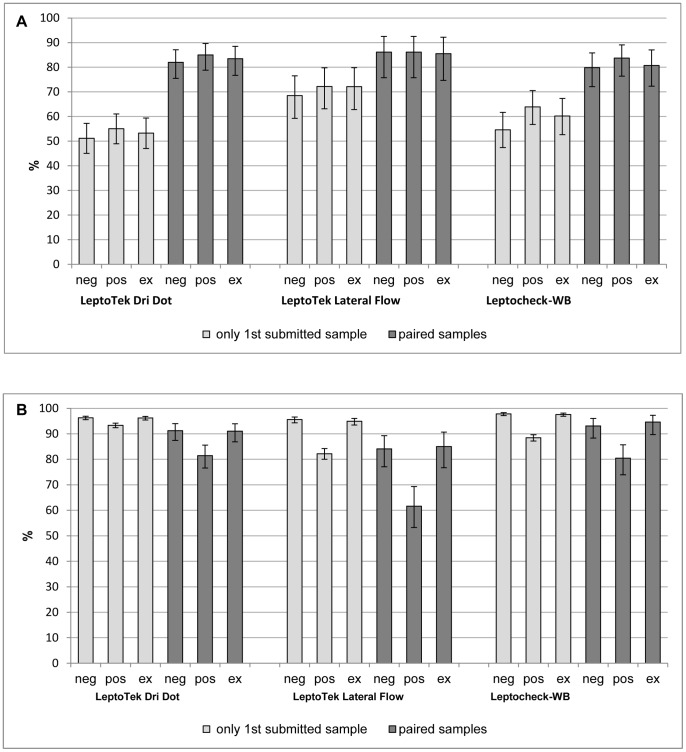
Results: The overall sensitivity and specificity for the LeptoTek Dri Dot was 75% respectively 96%, for the LeptoTek Lateral Flow 78% respectively 95%, and for the Leptocheck-WB 78% respectively 98%. Based on the 1(st) submitted sample the sensitivity was low (51% for LeptoTek Dri Dot, 69% for LeptoTek Lateral Flow, and 55% for Leptocheck-WB), but substantially increased when the results of paired samples were combined, although accompanied by a lower specificity (82% respectively 91% for LeptoTek Dri Dot, 86% respectively 84% for LeptoTek Lateral Flow, and 80% respectively 93% for Leptocheck-WB).
Conclusions: All three tests present antibody tests contributing to the diagnosis of leptospirosis, thus supporting clinical suspicion and contributing to awareness. Since the overall sensitivity of the tested RDTs did not exceed 80%, one should be cautious to rely only on an RDT result, and confirmation by reference tests is strongly recommended.
Conflict of interest statement
I have read the journal's policy and have the following conflicts: KIT Biomedical Research provided leptospiral biomaterials at a cost recovery basis to the manufacturers of all three RDTs.
Figures
References
-
- World Health Organization (2011) Report of the Second Meeting of the Leptospirosis Burden Epidemiology Reference Group. Availaible: http://who.int/zoonoses/diseases/lerg2010/en/index.html. Accessed 1 April 2013.
-
- Farr RW (1995) Leptospirosis. Clin Infect Dis 21: 1–6. - PubMed
-
- Segura ER, Ganoza CA, Campos K, Ricaldi JN, Torres S, et al. (2005) Clinical spectrum of pulmonary involvement in leptospirosis in a region of endemicity, with quantification of leptospiral burden. Clin Infect Dis 40: 343–351 CID34242 [pii];10.1086/427110 [doi]. - DOI - PMC - PubMed
-
- World Health Organization (2003) Human leptospirosis: guidance for diagnosis, surveillance and control. Available: http://www.who.int/zoonoses/resources/Leptospirosis/en/. Accessed 1 April 2013.
-
- Levett PN (2001) Leptospirosis. Clin Microbiol Rev 14: 296–326 10.1128/CMR.14.2.296-326.2001 [doi]. - DOI - PMC - PubMed
Publication types
MeSH terms
Substances
LinkOut - more resources
Full Text Sources
Other Literature Sources
Medical