


Glycemic variability in relation to oral disposition index in the subjects with different stages of glucose tolerance
- PMID: 23876034
- PMCID: PMC3728076
- DOI: 10.1186/1758-5996-5-38
Glycemic variability in relation to oral disposition index in the subjects with different stages of glucose tolerance
Abstract
Background: Glucose variability could be an independent risk factor for diabetes complications in addition to average glucose. The deficiency in islet β cell secretion and insulin sensitivity, the two important pathophysiological mechanisms of diabetes, are responsible for glycemic disorders. The oral disposition index evaluated by product of insulin secretion and sensitivity is a useful marker of islet β cell function. The aim of the study is to investigate glycemic variability in relation to oral disposition index in the subjects across a range of glucose tolerance from the normal to overt type 2 diabetes.
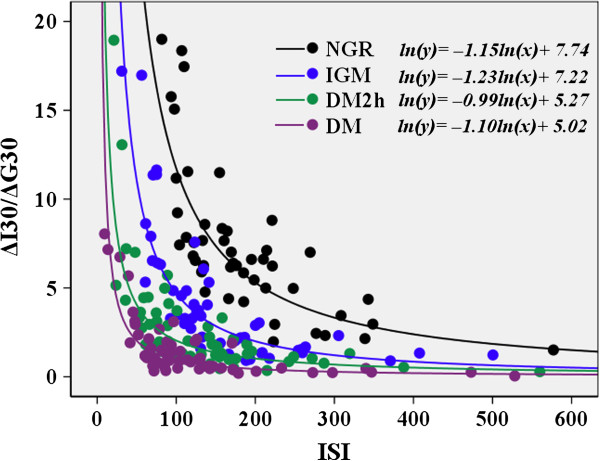
Methods: 75-g oral glucose tolerance test (OGTT) was performed in total 220 subjects: 47 with normal glucose regulation (NGR), 52 with impaired glucose metabolism (IGM, 8 with isolated impaired fasting glucose [IFG], 18 with isolated impaired glucose tolerance [IGT] and 26 with combined IFG and IGT), 61 screen-diagnosed diabetes by isolated 2-h glucose (DM2h) and 60 newly diagnosed diabetes by both fasting and 2-h glucose (DM). Insulin sensitivity index (Matsuda index, ISI), insulin secretion index (ΔI30/ΔG30), and integrated β cell function measured by the oral disposition index (ΔI30/ΔG30 multiplied by the ISI) were derived from OGTT. All subjects were monitored using the continuous glucose monitoring system for consecutive 72 hours. The multiple parameters of glycemic variability included the standard deviation of blood glucose (SD), mean of blood glucose (MBG), high blood glucose index (HBGI), continuous overlapping net glycemic action calculated every 1 h (CONGA1), mean of daily differences (MODD) and mean amplitude of glycemic excursions (MAGE).
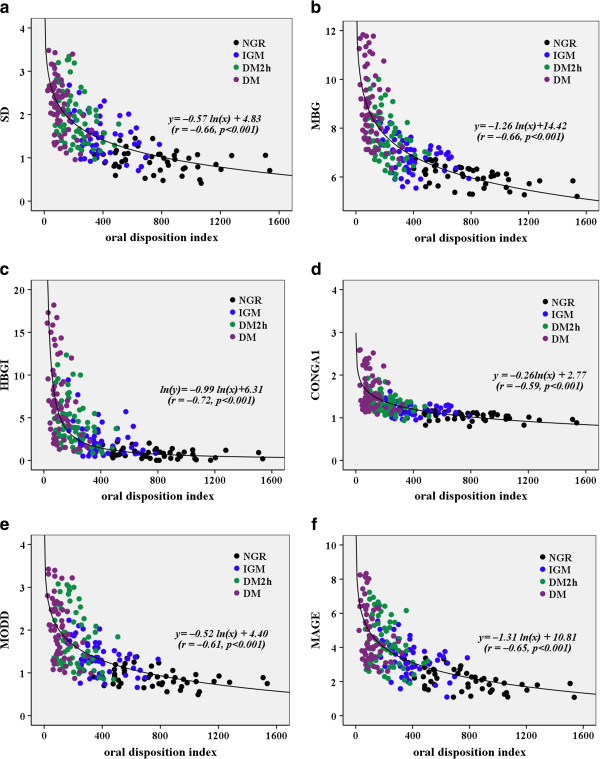
Results: From the NGR to IGM to DM2h to DM group, the respective values of SD (mean ± SD) (0.9 ± 0.3, 1.5 ± 0.5, 1.9 ± 0.6 and 2.2 ± 0.6 mmol/), MBG (5.9 ± 0.5, 6.7 ± 0.7, 7.7 ± 1.0 and 8.7 ± 1.5 mmol/L), HGBI [median(Q1-Q3)][0.8(0.2-1.2), 2.0(1.2-3.7), 3.8(2.4-5.6) and 6.4(3.2-9.5)], CONGA1 (1.0 ± 0.2, 1.3 ± 0.2, 1.5 ± 0.3 and 1.8 ± 0.4 mmol/L), MODD (0.9 ± 0.3, 1.4 ± 0.4, 1.8 ± 0.7 and 2.1 ± 0.7 mmol/L) and MAGE (2.1 ± 0.6, 3.3 ± 1.0, 4.3 ± 1.4 and 4.8 ± 1.6 mmol/L) were all increased progressively (all p < 0.05), while their oral disposition indices [745(546-947), 362(271-475), 203(134-274) and 91(70-139)] were decreased progressively (p < 0.05). In addition, SD, MBG, HGBI, CONGA1, MODD and MAGE were all negatively associated with the oral disposition index in each group (all p < 0.05) and in the entire data set (r = -0.66, -0.66, -0.72, -0.59, -0.61 and -0.65, respectively, p < 0.05).
Conclusions: Increased glycemic variability parameters are consistently associated with decreased oral disposition index in subjects across the range of glucose tolerance from the NGR to IGM to DM2h to DM group.
Keywords: Continuous glucose monitoring; Glycemic variability; Oral disposition index; Type 2 diabetes.
Figures
References
-
- Festa A, Williams K, Hanley AJ, Haffner SM. Beta-cell dysfunction in subjects with impaired glucose tolerance and early type 2 diabetes: comparison of surrogate markers with first-phase insulin secretion from an intravenous glucose tolerance test. Diabetes. 2008;57:1638–1644. doi: 10.2337/db07-0954. - DOI - PubMed
LinkOut - more resources
Full Text Sources
Other Literature Sources
Medical
