Review
. 2013 Jul:1292:21-31.
doi: 10.1111/nyas.12223.

New paradigms for treatment-resistant depression

Affiliations
Review

New paradigms for treatment-resistant depression

Carlos Zarate et al. Ann N Y Acad Sci. 2013 Jul.

Abstract

Clinical depression is a serious mental disorder characterized by low mood, anhedonia, loss of interest in daily activities, and other symptoms, and is associated with severe consequences including suicide and increased risk of cardiovascular events. Depression affects nearly 15% of the population. The standard of care for the last 50 years has focused on monoamine neurotransmitters, including such treatments as selective serotonin reuptake inhibitors (SSRIs) and serotonin-norepinephrine reuptake inhibitors (SNRIs). However, these treatments have significant limitations: they can take weeks before showing mood-altering effects, and only one to two out of ten patients shows clinical effects beyond those associated with placebo. A major paradigm shift in research into the treatment of depression is underway, based on promising results with the glutamatergic NMDA receptor antagonist ketamine. Further research has demonstrated the significance of glutamatergic pathways in depression and the association of this system with the stress pathway and magnesium homeostasis. Treatment with NMDA receptor antagonists and magnesium have shown the ability to sprout new synaptic connections and reverse stress-induced neural changes, opening up promising new territory for the development of drugs to meet the unmet need in patients with clinical depression.

Keywords: CP-AMPA; NMDA; SNRI; SSRI; depression; glutamate antagonist; glutamine; ketamine; magnesium; scopolamine.


Conflict of interest statement

Conflicts of interest

The authors declare no conflicts of interest. J.Q. is employed by Roche, and H.M. is employed by Covance.

Figures
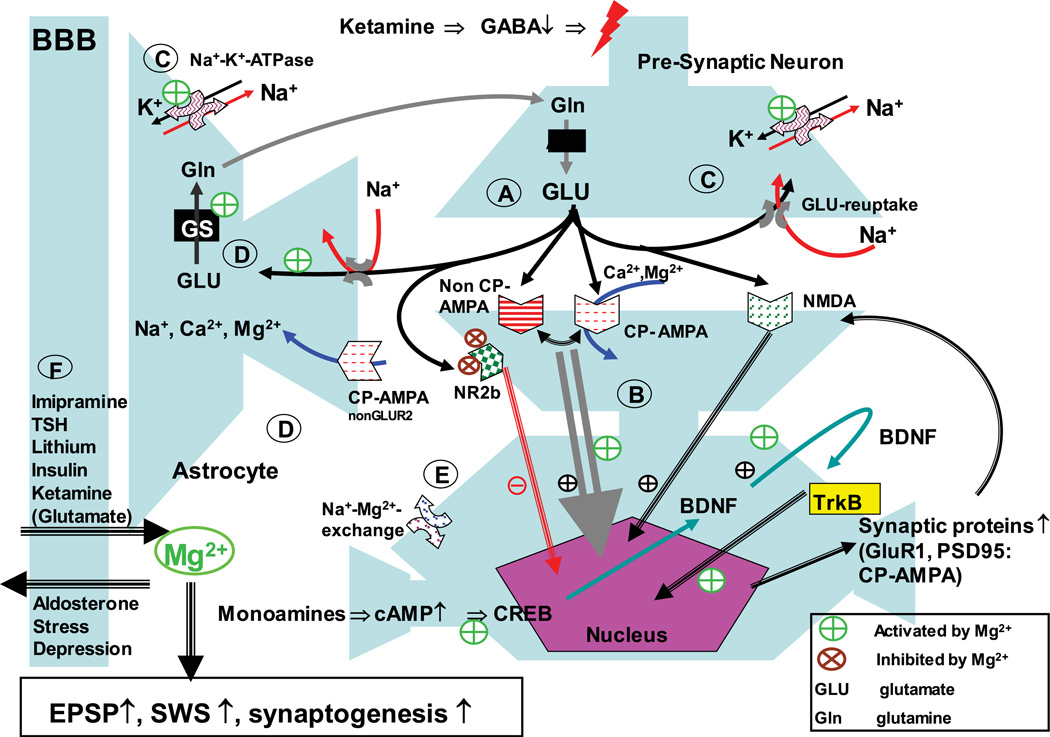
Figure 1
Figure 1
Magnesium involvement in ketamine-induced pathways. Ketamine administration leads to a cascade of events finally resulting in modifications of glutamatergic receptor profile and synaptogenesis. Functional consequences are increased excitatory postsynaptic potentials (EPSP) and increased slow-wave sleep; both phenomena are also induced by Mg2+. In detail: (A) ketamine inhibits GABAergic interneurons and therefore activates the release of glutamate downstream in the context of partial NR2b receptor blockade. (B) AMPA mediates BDNF expression and release. BDNF activates TrkB receptor, which induces changes in gene expression. BNDF induces its own expression. NMDA receptor activation is facilitating this process. This could constitute a feedforward mechanism, explaining the long-term effect of ketamine administration. Further, the expression of synaptic proteins is induced, in particular GluR1 and PSD-95, which constitute the synaptic expression of Ca2+-permeable AMPA receptors (CP-AMPA). Importantly, CP-AMPA are permeable for Mg2+. (C) Glutamate is taken up quickly by neurons and astrocytes. This is of importance as high concentrations of glutamate can spill over to extrasynaptic NMDA receptors, which appear to be primarily from the NR2b type. Their activation can block synaptogenesis and lead to cell damage. Rapid reuptake of glutamate prevents this spillover. Glutamate reuptake is an energy-dependent process driven by the Na+-gradient over the membrane, which in itself is driven by the Na+–K+–ATPase. The Na+–K+–ATPase is dependent on Mg2+, therefore increased Mg2+ availability supports its activity and secondarily glutamate clearance. (D) In parallel glutamate receptors at astrocytes are activated. CP-AMPA receptor activation can lead to an increase in astrocytic Ca2+ and Mg2+ A potential consequence of increased Mg2+ in astrocytes is activation of glutamine synthetase (GS), which is Mg2+ dependent.37,38 (E) A neuronal Na+–Mg2+–exchange mechanism regulates intracellular Mg2+ concentration. Imipramine appears to block Na+–Mg2+ exchange, preventing the efflux of Mg2+ from the neuron. (F) Magnesium uptake into the brain has been described with compounds, which are known to be efficacious in treatment-refractory depression, i.e., ketamine (via its glutamate-releasing capability), TSH, lithium, imipramine, and potentially an insulin-related mechanism (metformin, glitazones). On the other hand, stress and refractory depression are linked to lower Mg2+ levels in the brain, which may in part be mediated via an aldosterone mediated mechanism. Adapted with permission from Ref. .
Figure 2
Figure 2
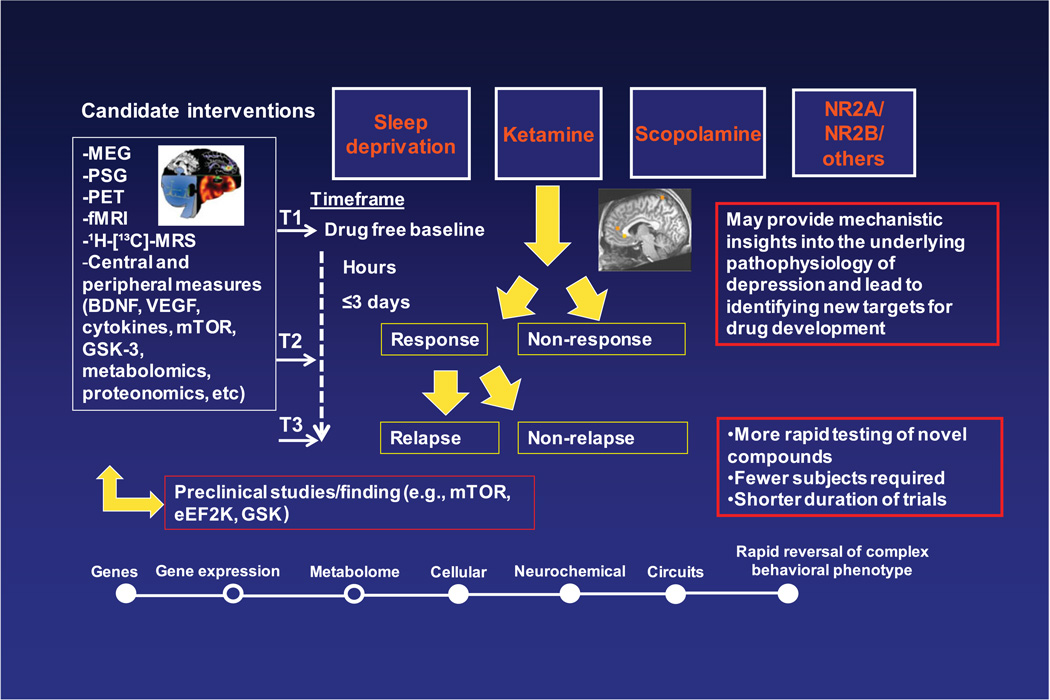
Conceptual framework for advancing translational findings across a systems level of biomarkers of response/relapse to develop rapid-acting antidepressants.

References

    1. Eby GA, Eby KL, Murck H. Magnesium and major depression. In: Vink R, Nechifor M, editors. Magnesium in the Central Nervous System. Adelaide: University of Adelaide Press; 2011. pp. 313–330. - PubMed
    1. Vale S, Espejel MA, Dominguez JC. Amantadine in depression. Lancet. 1971;2:437. - PubMed
    1. Paul IA, Skolnick P. Glutamate and depression: clinical and preclinical studies. Ann. N. Y. Acad. Sci. 2003;1003:250–272. - PubMed
    1. Watkins JC, Jane DE. The glutamate story. Br. J. Pharmacol. 2006;147:S100–S108. - PMC - PubMed
    1. Schildkraut JJ. The catecholamine hypothesis of affective disorders: a review of supporting evidence. Am. J. Psychiatry. 1965;122:509–522. - PubMed

Publication types

MeSH terms