Review
. 2013 Jul 23:12:71.
doi: 10.1186/1475-2859-12-71.

Role of commensal and probiotic bacteria in human health: a focus on inflammatory bowel disease

Affiliations
Review

Role of commensal and probiotic bacteria in human health: a focus on inflammatory bowel disease

Rebeca Martín et al. Microb Cell Fact. .

Abstract

The human gut is one of the most complex ecosystems, composed of 1013-1014 microorganisms which play an important role in human health. In addition, some food products contain live bacteria which transit through our gastrointestinal tract and could exert beneficial effects on our health (known as probiotic effect). Among the numerous proposed health benefits attributed to commensal and probiotic bacteria, their capacity to interact with the host immune system is now well demonstrated. Currently, the use of recombinant lactic acid bacteria to deliver compounds of health interest is gaining importance as an extension of the probiotic concept. This review summarizes some of the recent findings and perspectives in the study of the crosstalk of both commensal and probiotic bacteria with the human host as well as the latest studies in recombinant commensal and probiotic bacteria. Our aim is to highlight the potential roles of recombinant bacteria in this ecosystem.


Figures
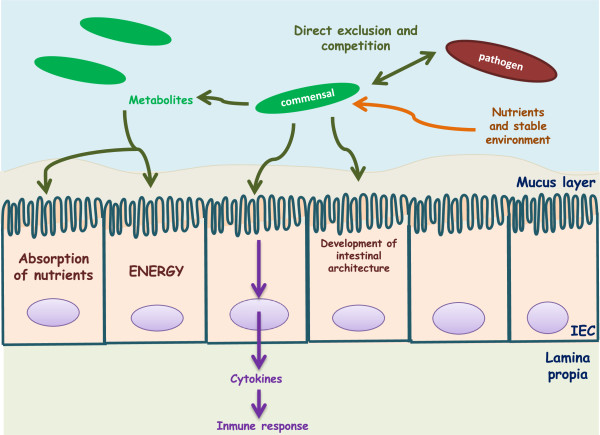
Figure 1
Figure 1
Commensal bacteria cross talk with the host. Commensal bacteria supply the host with essential nutrients and defend the host against opportunistic pathogens. They are involved in the development of the intestinal architecture and immunomodulatory processes. On the other hand, the host provides the bacteria with nutrients and a stable environment.
Figure 2
Figure 2
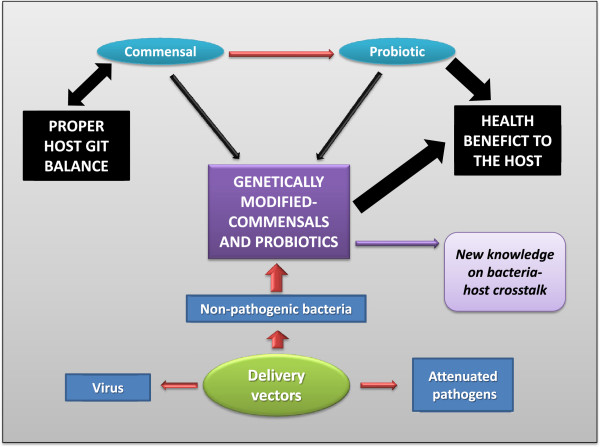
Extension of the commensals-probiotics hypothesis. The development of a genetically modified commensal (or probiotic) could reach all the beneficial properties found in a commensal bacterium joint to the probiotic effects due to the ability to deliver molecules to the gastrointestinal tract (GIT).

References

    1. Hooper LV, Gordon JI. Commensal host-bacterial relationships in the gut. Science. 2001;292:1115–1118. doi: 10.1126/science.1058709. - DOI - PubMed
    1. Sekirov I, Russell SL, Antunes LC, Finlay BB. Gut microbiota in health and disease. Physiol Rev. 2010;90:859–904. doi: 10.1152/physrev.00045.2009. - DOI - PubMed
    1. Frank DN, St Amand AL, Feldman RA, Boedeker EC, Harpaz N, Pace NR. Molecular-phylogenetic characterization of microbial community imbalances in human inflammatory bowel diseases. Proc Natl Acad Sci USA. 2007;104:13780–13785. doi: 10.1073/pnas.0706625104. - DOI - PMC - PubMed
    1. Qin JJ, Li RQ, Raes J, Arumugam M, Burgdorf KS, Manichanh C, Nielsen T, Pons N, Levenez F, Yamada T. et al. A human gut microbial gene catalogue established by metagenomic sequencing. Nature. 2010;464:59–U70. doi: 10.1038/nature08821. - DOI - PMC - PubMed
    1. Leser TD, Molbak L. Better living through microbial action: the benefits of the mammalian gastrointestinal microbiota on the host. Environ Microbiol. 2009;11:2194–2206. doi: 10.1111/j.1462-2920.2009.01941.x. - DOI - PubMed

Publication types

MeSH terms

Substances