


doi: 10.3201/eid1908.121824.
Diarrhetic shellfish poisoning, Washington, USA, 2011
Affiliations
- PMID: 23876232
- PMCID: PMC3739508
- DOI: 10.3201/eid1908.121824
Item in Clipboard
Diarrhetic shellfish poisoning, Washington, USA, 2011
Emerg Infect Dis.
2013 Aug.
Abstract
Diarrhetic shellfish poisoning is a gastrointestinal illness caused by consumption of bivalves contaminated with dinophysistoxins. We report an illness cluster in the United States in which toxins were confirmed in shellfish from a commercial harvest area, leading to product recall. Ongoing surveillance is needed to prevent similar illness outbreaks.
Keywords: DSP; Diarrhetic shellfish poisoning; Dinophysis spp.; United States; Washington; dinophysistoxins; enteric infections; marine biotoxins; shellfish; toxins.
Figures
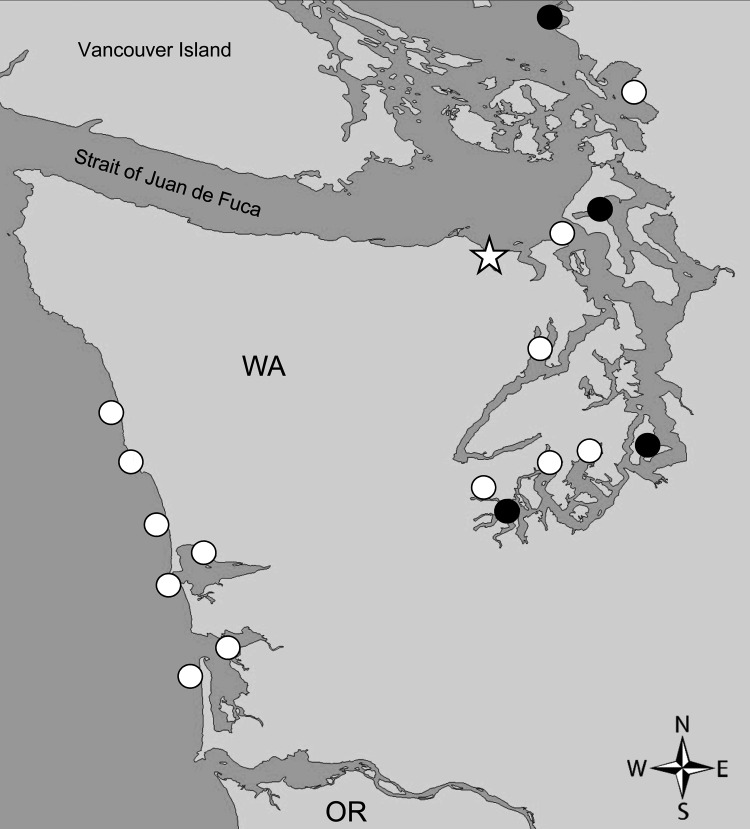
Diarrhetic shellfish poisoning toxin monitoring sites, Washington, USA, 2010–2011. Eighteen sites were monitored during the 2010 pilot study (open circles); 5 pilot sites were selected for continued monitoring during 2011 (solid circles). Sequim Bay State Park (star), the site implicated in the human illnesses described in this article, was among the sites monitored in 2011.
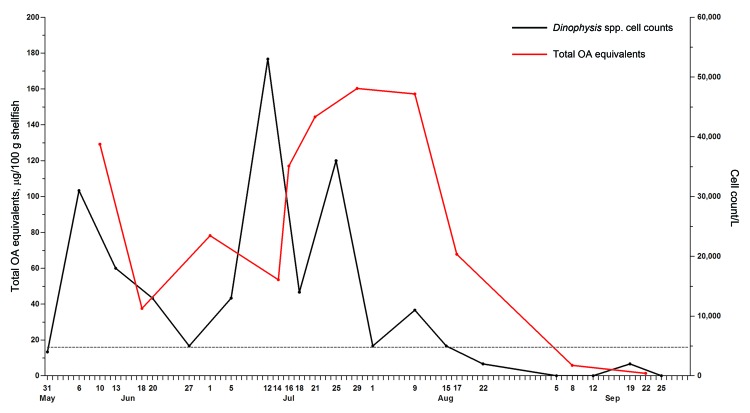
Timeline comparing blooms of Dinophysis spp. dinoflagellates and diarrhetic shellfish poisoning toxin levels detected in mussels collected during 2011 from Sequim Bay State Park, Sequim, Washington, USA. Dinophysis spp. cell counts per liter (black line) were determined by using light microscopy. Total okadaic acid (OA) equivalents (red line), in micrograms per 100 g shellfish tissue, were determined by using liquid chromatography mass spectrometry analysis (14). Dashed line indicates US Food and Drug Administration guidance level of 16 µg total OA equivalents per 100 g shellfish tissue. Dates shown are collection dates for each tested sample.
References
-
- Center for Food Safety and Applied Nutrition, US Food and Drug Administration. Bad bug book: foodborne pathogenic microorganisms and natural toxins handbook, various shellfish-associated toxins [cited 2012 Nov 30]. http://www.fda.gov/Food/FoodborneIllnessContaminants/CausesOfIllnessBadB...
-
- Food and Agriculture Organization of the United Nations. FAO food and nutrition paper 80: marine biotoxins [cited 2012 Nov 30]. http://www.fao.org/docrep/007/y5486e/y5486e00.htm
-
- Heymann DL, editor. Control of communicable diseases manual. 19th ed. Washington (DC): American Public Health Association Press; 2008.
-
- Cembella AD. Occurrence of okadaic acid, a major diarrheic shellfish toxin, in natural populations of Dinophysis spp. from the eastern coast of North America. J Appl Phycol. 1989;1:307–10. 10.1007/BF00003466 - DOI
-
- Barceloux DG. Diarrhetic shellfish poisoning and okadaic acid. In: Medical toxicology of natural substances: foods, fungi, medicinal herbs, plants, and venomous animals. Hoboken (NJ): John Wiley & Sons; 2008. p. 222–6.
MeSH terms
Substances
LinkOut - more resources
Full Text Sources
Other Literature Sources
Miscellaneous