A high risk of hospitalization following release from correctional facilities in Medicare beneficiaries: a retrospective matched cohort study, 2002 to 2010
- PMID: 23877707
- PMCID: PMC4069256
- DOI: 10.1001/jamainternmed.2013.9008
A high risk of hospitalization following release from correctional facilities in Medicare beneficiaries: a retrospective matched cohort study, 2002 to 2010
Abstract
Importance: Little is known about the risk of individuals who are released from correctional facilities, a time when there may be discontinuity in care.
Objective: To study the risk for hospitalizations among former inmates soon after their release from correctional facilities.
Design: Retrospective cohort study.
Participants: Data from Medicare administrative claims for 110,419 fee-for-service beneficiaries who were released from a correctional facility from 2002 through 2010 and controls matched by age, sex, race, Medicare status, and residential zip code.
Main outcomes and measures: Hospitalization rates and specifically those for ambulatory care-sensitive conditions 7, 30, and 90 days after release.
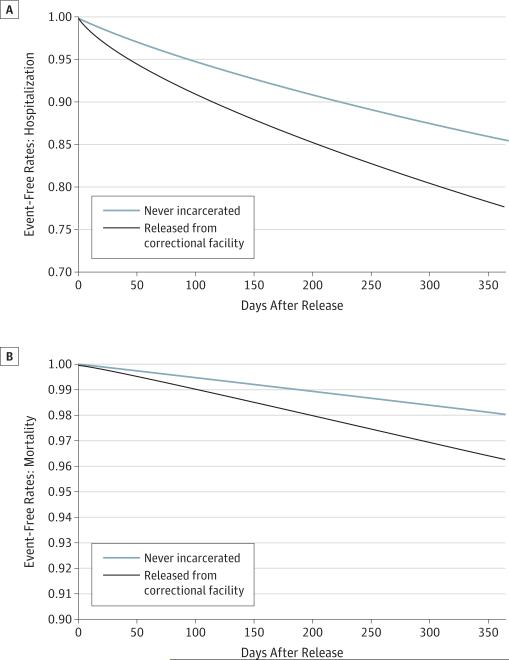
Results: Of 110,419 released inmates, 1559 individuals (1.4%) were hospitalized within 7 days after release; 4285 individuals (3.9%) within 30 days; and 9196 (8.3%) within 90 days. The odds of hospitalization was higher for released inmates compared with those of matched controls (within 7 days: odds ratio [OR], 2.5 [95% CI, 2.3-2.8]; within 30 days: OR, 2.1 [95% CI, 2.0-2.2]; and within 90 days: OR, 1.8 [95% CI, 1.7-1.9]). Compared with matched controls, former inmates were more likely to be hospitalized for ambulatory care-sensitive conditions (within 7 days: OR, 1.7 [95% CI, 1.4-2.1]; within 30 days: OR, 1.6 [95% CI, 1.5-1.8]; and within 90 days: OR, 1.6 [95% CI, 1.5-1.7]).
Conclusions and relevance: About 1 in 70 former inmates are hospitalized for an acute condition within 7 days of release, and 1 in 12 by 90 days, a rate much higher than in the general population.
Figures
References
-
- Estelle v Gamble. 1976 429 US 97.
-
- PEW Center on the States One in 100: behind bars in America. http://www.pewstates.org/research/reports/one-in-100-85899374411. Accessed June 21, 2013.
-
- Mallik-Kane K, Visher CA. Health and Prisoner Reentry: How Physical, Mental, and Substance Abuse Conditions Shape the Process of Reintegration. Urban Institute; Washington, DC: 2008.
-
- Mallik-Kane K. Returning Home Illinois Policy Brief: Health and Prisoner Reentry. Urban Institute Justice Policy Center; Washington, DC: 2005.
Publication types
MeSH terms
Grants and funding
LinkOut - more resources
Full Text Sources
Other Literature Sources
Medical