


doi: 10.1002/jcop.21501.
BUILDING A RESEARCH-COMMUNITY COLLABORATIVE TO IMPROVE COMMUNITY CARE FOR INFANTS AND TODDLERS AT-RISK FOR AUTISM SPECTRUM DISORDERS
Affiliations
- PMID: 23878409
- PMCID: PMC3716577
- DOI: 10.1002/jcop.21501
Item in Clipboard
BUILDING A RESEARCH-COMMUNITY COLLABORATIVE TO IMPROVE COMMUNITY CARE FOR INFANTS AND TODDLERS AT-RISK FOR AUTISM SPECTRUM DISORDERS
J Community Psychol.
2012 Aug.
Abstract
This article describes the formation and initial outcomes of a research-community collaborative group that was developed based on community-based participatory research principles. The group includes a transdisciplinary team of practitioners, funding agency representatives, researchers, and families of children with autism spectrum disorders, who partnered to improve community-based care for infants and toddlers at risk for autism through the implementation of evidence-based practices. Data from this group provide support for the feasibility of developing and sustaining a highly synergistic and productive research-community collaborative group who shares common goals to improve community care.
Figures
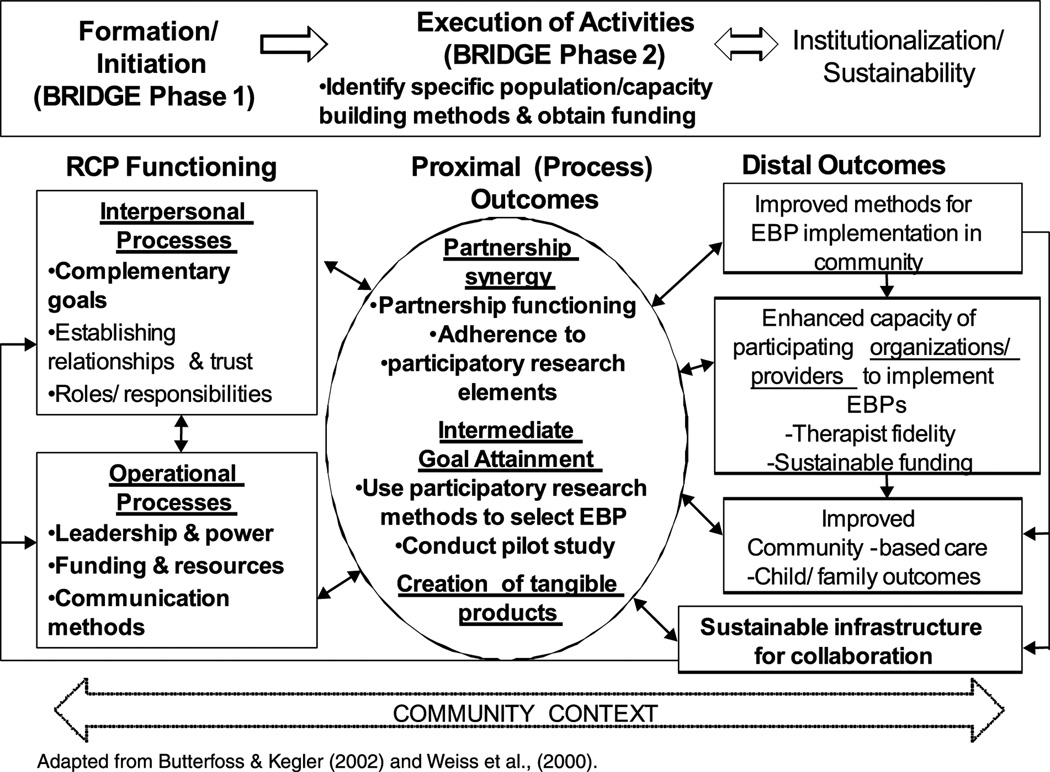
Model of research-community partnership.
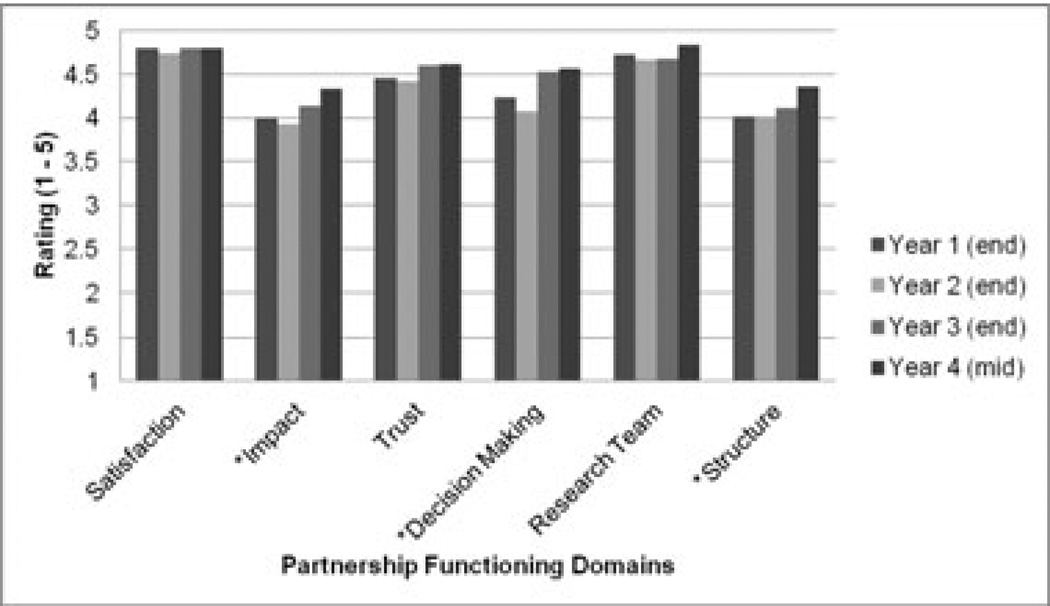
Partnership functioning ratings Year 1–4 (n = 14). Note. * = Statistically significant increases from Year 1 to Year 4.
References
-
- Addis ME. Methods for disseminating research products and increasing evidence-based practice: Promises, obstacles, and future directions. Clinical Psychology: Science and Practice. 2002;9(4):367–378.
-
- American Psychological Association. Presidential Task Force on Evidence-Based Practice. Evidence-based practice in psychology. American Psychologist. 2006;61(4):185–271. - PubMed
-
- Beutler L, Williams R, Wakefiled P, Entwistle S. Bridging scientist and practitioner perspectives in clinical psychology. American Psychologist. 1995;50(12):984–994. - PubMed
-
- Bluthenthal RN, Jones L, Fackler-Lowrie N, Ellison M, Booker T, Jones F, Wells KB. Witness for Wellness: Preliminary findings from a community-academic participatory research mental health initiative. Ethnicity Disease. 2006;16(1 suppl 1):S18–S34. - PubMed
