


Self-esteem evaluation in children and adolescents suffering from ADHD
- PMID: 23878614
- PMCID: PMC3715757
- DOI: 10.2174/1745017901309010096
Self-esteem evaluation in children and adolescents suffering from ADHD
Abstract
Background: Several recent studies investigated the relationship between self-esteem and ADHD, however, the results are still controversial. In the present study we analyze the characteristics of self-esteem in a sample of children and adolescents suffering from ADHD, with a particular focus on the relationship between ADHD symptoms severity and treatment strategies.
Methods: A total of 85 patients with ADHD (44 drug-free and 41 drug-treated, 23 of which atomoxetine-treated and 18 Methylphenidate-treated) and 26 healthy controls were enrolled in the study in order to evaluate self-esteem using the Self-esteem Multidimensional Test (TMA).
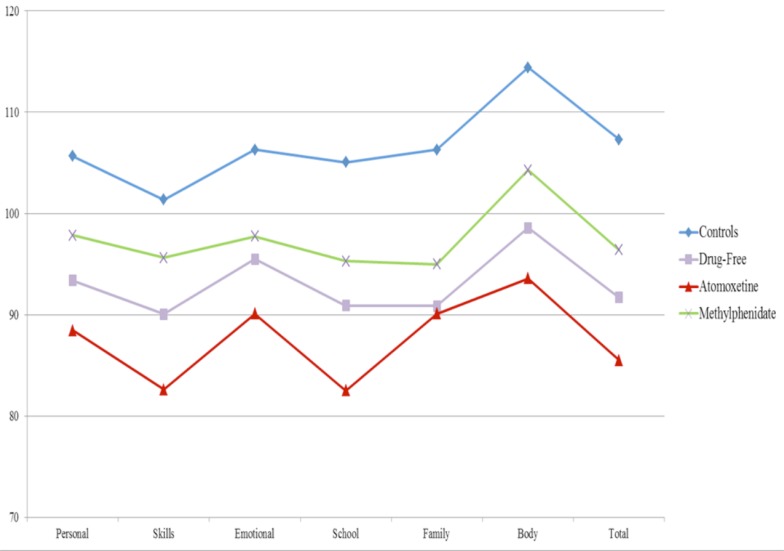
Results: ADHD subjects revealed lower scores on all self-esteem domains compared to controls. Both ADHD drug-free (47.1%) and ADHD drug-treated (44.1%) groups showed significantly higher rates of subjects in the pathological range as compared to normal control group (8.8%) (p <.001) with a higher percentage of subjects in the pathological range. Among ADHD drug-treated subjects, the methylphenidate group showed higher self-esteem scores as compared to the atomoxetine group.
Conclusion: A lower self-esteem profile is more common in subjects suffering from ADHD than in healthy controls, suggesting the importance of an early detection of psychological well-being in these children in order to reduce the ADHD symptoms long-term impacts.
Keywords: ADHD; Adolescents; Atomoxetine; Children; Methylphenidate; Self-esteem..
Figures
References
-
- Diagnostic and statistical manual of mental disorders. 4th ed. . Washinton.DC: American Psychiatric Association; 2000. American Psychiatric Association.
-
- Cantwell DP. Attention deficit disorder a review of the past 10 years. J Am Acad Child Adolesc Psychiatry. 1996;35:978–87. - PubMed
-
- Escobar R, Montoya A, Polavieja P. Evaluation of patients’ and parents’ quality of life in a randomized placebo-controlled atomoxetine study in attention-deficit/hyperactivity disorder. J Child Adolesc Psychopharmacol. 2009;19:253–63. - PubMed
-
- Klassen AF, Miller A, Fine S. Health-related quality of life in children and adolescents who have a diagnosis of attention-deficit/hyperactivity disorder. Pediatrics. 2004;114:541–7. - PubMed
-
- Matza LS, Rentz AM, Secnik K. The link between health related quality of life and clinical symptoms among children with attention-deficit hyperactivity disorder. J Dev Behav Paediatr. 2004;25:166–74. - PubMed
LinkOut - more resources
Full Text Sources
Other Literature Sources