


The amplitude of fibrillatory waves on leads aVF and V1 predicting the recurrence of persistent atrial fibrillation patients who underwent catheter ablation
- PMID: 23879275
- PMCID: PMC6932451
- DOI: 10.1111/anec.12041
The amplitude of fibrillatory waves on leads aVF and V1 predicting the recurrence of persistent atrial fibrillation patients who underwent catheter ablation
Abstract
Objective: To evaluate whether the amplitude of fibrillatory wave (F wave) on electrocardiography could predict the recurrence in persistent atrial fibrillation (AF) patients who underwent catheter ablation.
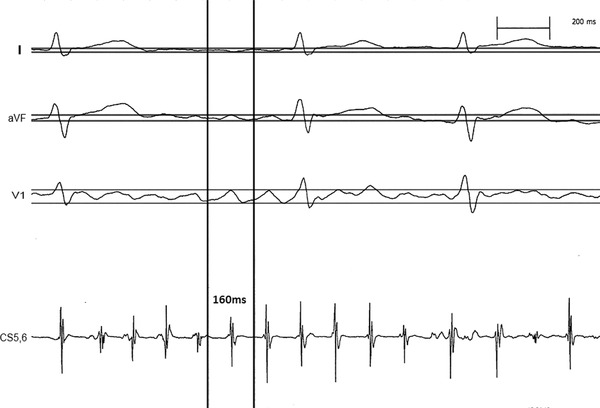
Methods: All consecutive persistent AF patients who underwent catheter ablation at Peking Union Medical College Hospital between November 2006 and February 2012, were enrolled. The amplitude of F wave was measured on three orthogonal leads (leads I, V1 and aVF) on the Prucka CardioLab recording system. The primary end point was the recurrence after catheter ablation.
Results: A total of 54 persistent AF patients were enrolled. Fifty patients (age: 58 ± 11years, 72% male) constituted the study population after excluding four patients lost of follow-up. The duration of AF was 9 ± 7 (2-18) months. Twenty-four patients (48%) recurred during the follow-up of 25 ± 19 months, constituted recurrence group. The remaining 26 patients constituted control group. The F-wave amplitude in recurrence group was significantly lower than control group (lead aVF, 0.085 ± 0.018 vs. 0.111 ± 0.036mV, P = 0.002; lead V1 , 0.116 ± 0.031 vs. 0.148 ± 0.047mV, P = 0.008). The amplitudes of leads aVF (P = 0.023) and V1 (P = 0.031) were the independent predictors of AF recurrence. The sensitivity and specificity of F-wave amplitude of lead aVF < 0.093mV or V1 < 0.123mV to predict the recurrence were 75% and 73%, 68% and 64%, respectively.
Conclusion: The low amplitudes of F wave in leads aVF and V1 could predict the recurrence of patients with persistent AF who underwent catheter ablation.
Keywords: catheter ablation; electrocardiography; fibrillatory wave; persistent atrial fibrillation; recurrence.
©2013, Wiley Periodicals, Inc.
References
-
- Calkins H, Kuck KH, Cappato R, et al. 2012 HRS/EHRA/ECAS Expert Consensus Statement on Catheter and Surgical Ablation of Atrial Fibrillation: recommendations for patient selection, procedural techniques, patient management and follow‐up, definitions, endpoints, and research trial design. Europace 2012;14:528–606. - PubMed
-
- Nademanee K, Schwab MC, Kosar EM, et al. Clinical outcomes of catheter substrate ablation for high‐risk patients with atrial fibrillation. J Am Coll Cardiol 2008;51:843–849. - PubMed
-
- Sauer WH, McKernan ML, Lin D, et al. Clinical predictors and outcomes associated with acute return of pulmonary vein conduction during pulmonary vein isolation for treatment of atrial fibrillation. Heart Rhythm 2006;3:1024–1028. - PubMed
-
- Jongnarangsin K, Chugh A, Good E, et al. Body mass index, obstructive sleep apnea, and outcomes of catheter ablation of atrial fibrillation. J Cardiovasc Electrophysiol 2008;19:668–672. - PubMed
-
- Xi Q, Sahakian AV, Ng J, et al. Atrial fibrillatory wave characteristics on surface electrogram: ECG to ECG repeatability over twenty‐four hours in clinically stable patients. J Cardiovasc Electrophysiol 2004;15:911–917. - PubMed
MeSH terms
LinkOut - more resources
Full Text Sources
Other Literature Sources
Medical
