Interference with the germination and growth of Ulva zoospores by quorum-sensing molecules from Ulva-associated epiphytic bacteria
- PMID: 23879807
- PMCID: PMC4304359
- DOI: 10.1111/1462-2920.12203
Interference with the germination and growth of Ulva zoospores by quorum-sensing molecules from Ulva-associated epiphytic bacteria
Abstract
Ulva zoospores preferentially settle on N-acylhomoserine lactone (AHL) producing marine bacterial biofilms. To investigate whether AHL signal molecules also affect the success and rate of zoospore germination in addition to zoospore attraction, the epiphytic bacteria associated with mature Ulva linza were characterized and bacterial isolates representative of this community tested for the ability to produce AHLs. Two of these AHL-producing isolates, Sulfitobacter spp. 376 and Shewanella spp. 79, were transformed with plasmids expressing the Bacillus spp. AHL lactonase gene aiiA to generate AHL-deficient variants. The germination and growth of U. linza zoospores was studied in the presence of these AHL-deficient strains and their AHL-producing counterparts. This revealed that the AHLs produced by Sulfitobacter spp. and Shewanella spp. or the bacterial products they regulate have a negative impact on both zoospore germination and the early growth of the Ulva germling. Further experiments with Escherichia coli biofilms expressing recombinant AHL synthases and synthetic AHLs provide data to demonstrate that zoospores germinated and grown in the absence of AHLs were significantly longer than those germinated in the presence of AHLs. These results reveal an additional role for AHLs per se in the interactive relationships between marine bacteria and Ulva zoospores.
© 2013 Society for Applied Microbiology and John Wiley & Sons Ltd.
Figures
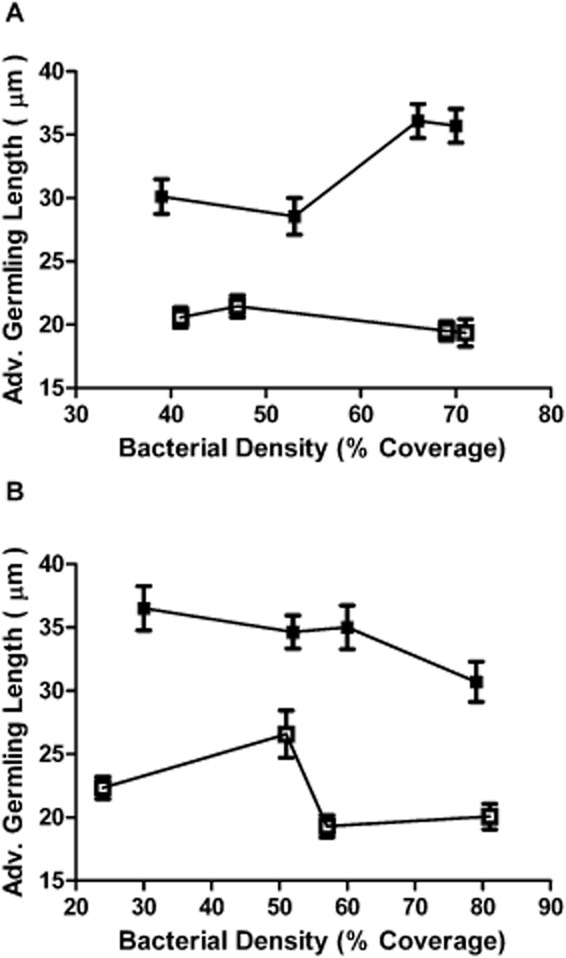
- A
Average germling length of zoospores exposed to biofilms of AHL-expressing Shewanella sp. 79 pBBRIMCS (□) and non-AHL expressing Shewanella sp. 79 pMT01 (□) at 48 h incubation.
- B
Average germling length of zoospores exposed to biofilms of AHL expressing Sulfitobacter sp. 376 pBBRIMCS (□) and non-AHL expressing Sulfitobacter sp. 376 pMT01 (□) at 48 incubation. Error bars represent 95% confidence intervals.
References
-
- Bradley PM. Plant hormones do have a role in controlling growth and development of algae. J Phycol. 1991;27:317–321.
-
- Callow JA, Stanley MS, Wetherbee R. Callow ME. Cellular and molecular approaches to understanding primary adhesion in Enteromorpha: an overview. Biofouling. 2000a;16:141–150.
-
- Callow ME. Callow JA. Substratum location and zoospore behaviour in the fouling alga Enteromorpha. Biofouling. 2000;15:49–56. - PubMed
Publication types
MeSH terms
Substances
LinkOut - more resources
Full Text Sources
Other Literature Sources
Molecular Biology Databases
Miscellaneous