


Antimicrobial compounds in tears
- PMID: 23880529
- PMCID: PMC3844110
- DOI: 10.1016/j.exer.2013.07.014
Antimicrobial compounds in tears
Abstract
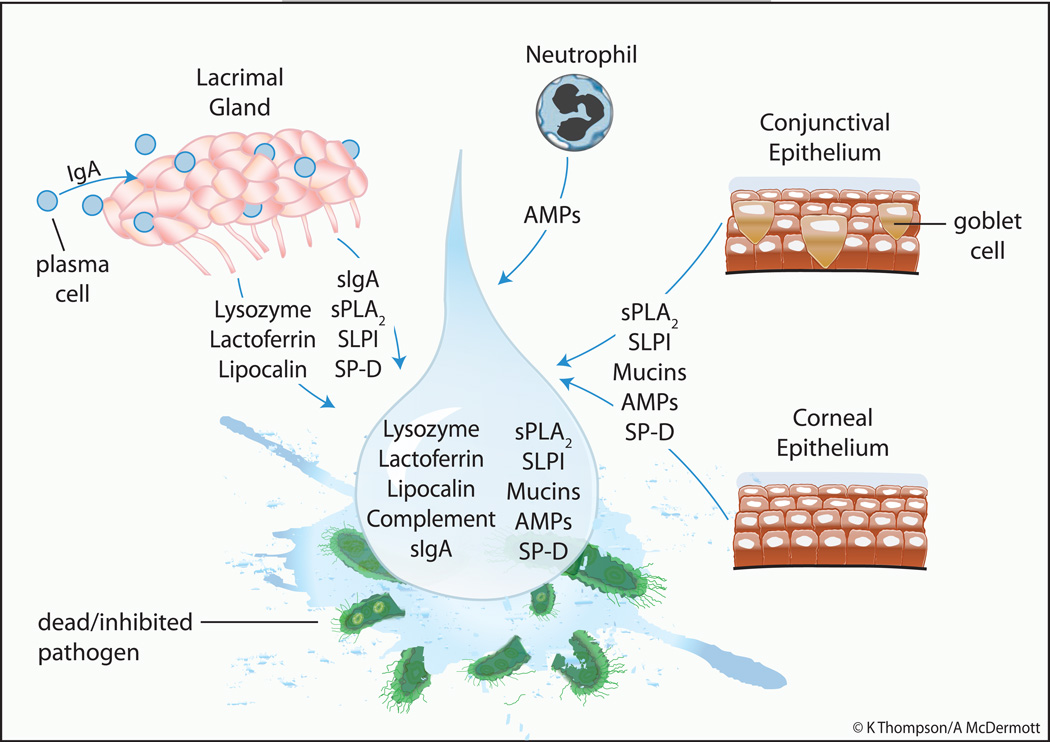
The tear film coats the cornea and conjunctiva and serves several important functions. It provides lubrication, prevents drying of the ocular surface epithelia, helps provide a smooth surface for refracting light, supplies oxygen and is an important component of the innate defense system of the eye providing protection against a range of potential pathogens. This review describes both classic antimicrobial compounds found in tears such as lysozyme and some more recently identified such as members of the cationic antimicrobial peptide family and surfactant protein-D as well as potential new candidate molecules that may contribute to antimicrobial protection. As is readily evident from the literature review herein, tears, like all mucosal fluids, contain a plethora of molecules with known antimicrobial effects. That all of these are active in vivo is debatable as many are present in low concentrations, may be influenced by other tear components such as the ionic environment, and antimicrobial action may be only one of several activities ascribed to the molecule. However, there are many studies showing synergistic/additive interactions between several of the tear antimicrobials and it is highly likely that cooperativity between molecules is the primary way tears are able to afford significant antimicrobial protection to the ocular surface in vivo. In addition to effects on pathogen growth and survival some tear components prevent epithelial cell invasion and promote the epithelial expression of innate defense molecules. Given the protective role of tears a number of scenarios can be envisaged that may affect the amount and/or activity of tear antimicrobials and hence compromise tear immunity. Two such situations, dry eye disease and contact lens wear, are discussed here.
Keywords: antimicrobial; contact lens; dry eye; tears.
Copyright © 2013 Elsevier Ltd. All rights reserved.
Figures
References
-
- The definition and classification of dry eye disease: report of the Definition and Classification Subcommittee of the International Dry Eye WorkShop (2007) The ocular surface. 2007a;5:75–92. - PubMed
-
- The epidemiology of dry eye disease: report of the Epidemiology Subcommittee of the International Dry Eye WorkShop (2007) The ocular surface. 2007b;5:93–107. - PubMed
-
- Abetz L, Rajagopalan K, Mertzanis P, Begley C, Barnes R, Chalmers R. Development and validation of the impact of dry eye on everyday life (IDEEL) questionnaire, a patient-reported outcomes (PRO) measure for the assessment of the burden of dry eye on patients. Health and quality of life outcomes. 2011;9:111. - PMC - PubMed
-
- Aho HJ, Saari KM, Kallajoki M, Nevalainen TJ. Synthesis of group II phospholipase A2 and lysozyme in lacrimal glands. Investigative ophthalmology & visual science. 1996;37:1826–1832. - PubMed
-
- Aho VV, Nevalainen TJ, Saari KM. Group IIA phospholipase A2 content of basal, nonstimulated and reflex tears. Current eye research. 2002;24:224–227. - PubMed
Publication types
MeSH terms
Substances
Grants and funding
LinkOut - more resources
Full Text Sources
Other Literature Sources
Medical
Research Materials
