. 2013 Aug 30;288(35):25001-25006.
doi: 10.1074/jbc.C113.493619. Epub 2013 Jul 23.

GTP is the primary activator of the anti-HIV restriction factor SAMHD1

Affiliations

GTP is the primary activator of the anti-HIV restriction factor SAMHD1

Sarah M Amie et al. J Biol Chem. .

Abstract

SAMHD1 (SAM domain- and HD domain-containing protein 1) is a dGTP-dependent dNTP triphosphohydrolase that converts dNTPs into deoxyribonucleosides and triphosphates. Therefore, SAMHD1 expression, particularly in non-dividing cells, can restrict retroviral infections such as HIV and simian immunodeficiency virus by limiting cellular dNTPs, which are essential for reverse transcription. It has previously been established that dGTP acts as both an activator and a substrate of this enzyme, suggesting that phosphohydrolase activity of SAMHD1 is regulated by dGTP availability in the cell. However, we now demonstrate biochemically that the NTP GTP is equally capable of activating SAMHD1, but GTP is not hydrolyzed by the enzyme. Activation of SAMHD1 phosphohydrolase activity was tested under physiological concentrations of dGTP or GTP found in either dividing or non-dividing cells. Because GTP is 1000-fold more abundant than dGTP in cells, GTP was able to activate the enzyme to a greater extent than dGTP, suggesting that GTP is the primary activator of SAMHD1. Finally, we show that SAMHD1 has the ability to hydrolyze base-modified nucleotides, indicating that the active site of SAMHD1 is not restrictive to such modifications, and is capable of regulating the levels of non-canonical dNTPs such as dUTP. This study provides further insights into the regulation of SAMHD1 with regard to allosteric activation and active site specificity.

Keywords: Allosteric Regulation; HIV; Hydrolases; Macrophages; Reverse Transcription; SAMHD1; dNTP.


Figures
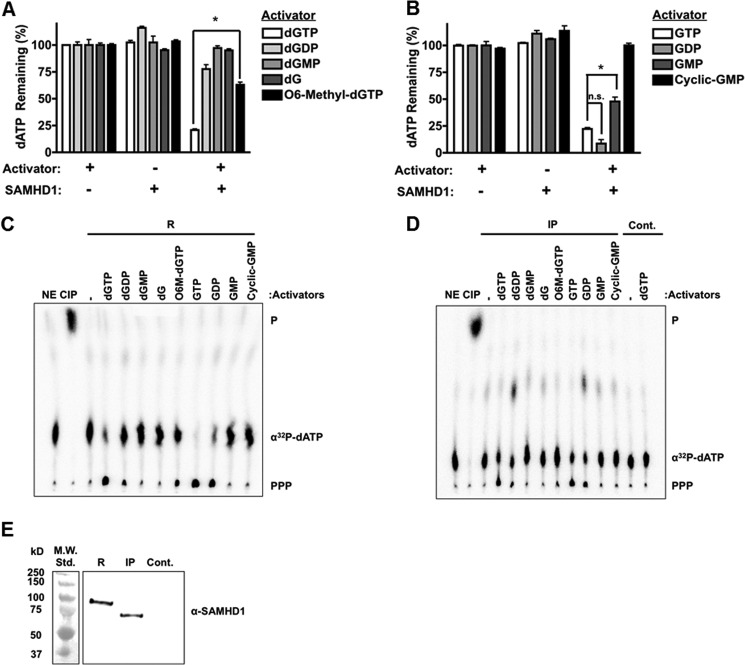
FIGURE 1.
FIGURE 1.
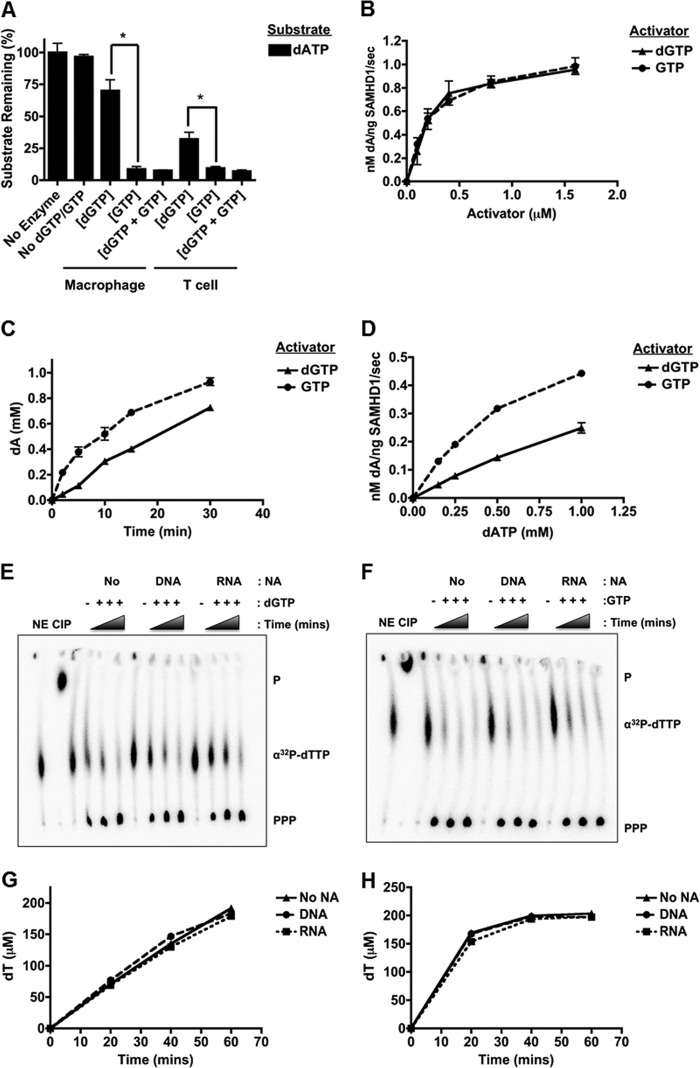
SAMHD1 allosteric activation by guanosine derivatives. A and B, R-SAMHD1 (1 μm) was incubated with 1 mm dATP (substrate) with or without the indicated activators (500 μm). The amount of non-hydrolyzed dATP remaining after incubation was measured by HPLC and normalized to the no-enzyme controls. Statistical significance was determined using an unpaired t test with the Welch correction. *, p = 0.0008 (A); *, p = 0.0179 (B). n.s., not significant. C and D, R-SAMHD1 (R), IP-SAMHD1 (IP), or immunoprecipitate from an empty vector control (Cont.) was incubated with 250 μm dATP and 0.125 μCi/μl [α-32P]dATP with or without 250 μm activator (as indicated), and reaction products were separated by TLC. No-enzyme (NE) and calf intestinal phosphatase (CIP) controls were used for detection of [α-32P]dATP and monophosphates (P), respectively. SAMHD1 hydrolysis of [α-32P]dATP is indicated (PPP). E, Western blot analysis of SAMHD1 levels used in the above TLC reactions. Std.,, standard.
FIGURE 2.
FIGURE 2.
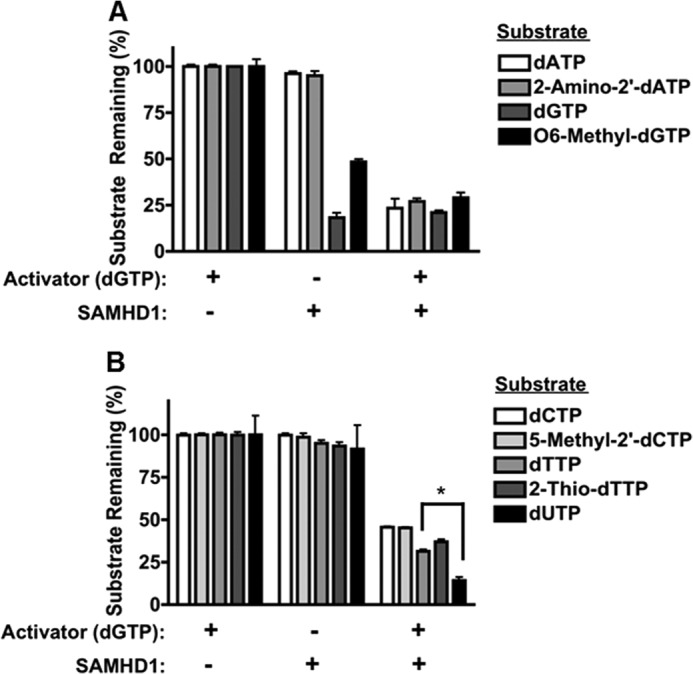
SAMHD1 allosteric activation by dGTP and GTP at physiological concentrations. A, R-SAMHD1 (1 μm) was incubated with 1 mm dATP (substrate) and physiological concentrations of either dGTP or GTP: 70 nm dGTP or 0.32 mm GTP for macrophage reactions (*, p = 0.0143) and 1.5 μm dGTP or 1.75 mm GTP for T cell reactions (*, p = 0.0451). SAMHD1 was also incubated with physiological concentrations of both nucleotides (dGTP + GTP). B, R-SAMHD1 was incubated with 1 mm dATP and increasing concentrations of dGTP or GTP. C, R-SAMHD1 was incubated with 1 mm dATP and 500 μm dGTP or GTP for the indicated time points. D, R-SAMHD1 was incubated with 250 μm dGTP or GTP and increasing concentrations of dATP. E–H, R-SAMHD1 was incubated with 250 μm dGTP (E) or GTP (D), 250 μm dTTP, and 0.125 μCi/μl [α-32P]dTTP in the presence or absence (No) of 33-mer ssDNA or ssRNA (1 μm). Reaction products were separated by TLC to detect [α-32P]dTTP hydrolysis (PPP), and densitometry was used to quantify product formation in the presence of dGTP (G) or GTP (H). NE, no-enzyme control; CIP, calf intestinal phosphatase control; P, monophosphates; NA, nucleic acids.
FIGURE 3.
FIGURE 3.
SAMHD1 hydrolysis of base-modified nucleotides. R-SAMHD1 (1 μm) was incubated with the indicated purine (A) and pyrimidine (B) nucleotide substrates (1 mm) with or without 100 μm dGTP for activation. The amount of substrate remaining in the triphosphate form was quantified by HPLC. *, p = 0.0057.

References

    1. Engström Y., Eriksson S., Jildevik I., Skog S., Thelander L., Tribukait B. (1985) Cell cycle-dependent expression of mammalian ribonucleotide reductase. Differential regulation of the two subunits. J. Biol. Chem. 260, 9114–9116 - PubMed
    1. Kennedy E. M., Gavegnano C., Nguyen L., Slater R., Lucas A., Fromentin E., Schinazi R. F., Kim B. (2010) Ribonucleoside triphosphates as substrate of human immunodeficiency virus type 1 reverse transcriptase in human macrophages. J. Biol. Chem. 285, 39380–39391 - PMC - PubMed
    1. Fox I. H. (1981) Metabolic basis for disorders of purine nucleotide degradation. Metabolism 30, 616–634 - PubMed
    1. Powell R. D., Holland P. J., Hollis T., Perrino F. W. (2011) Aicardi-Goutières syndrome gene and HIV-1 restriction factor SAMHD1 is a dGTP-regulated deoxynucleotide triphosphohydrolase. J. Biol. Chem. 286, 43596–43600 - PMC - PubMed
    1. Goldstone D. C., Ennis-Adeniran V., Hedden J. J., Groom H. C., Rice G. I., Christodoulou E., Walker P. A., Kelly G., Haire L. F., Yap M. W., de Carvalho L. P., Stoye J. P., Crow Y. J., Taylor I. A., Webb M. (2011) HIV-1 restriction factor SAMHD1 is a deoxynucleoside triphosphate triphosphohydrolase. Nature 480, 379–382 - PubMed

Publication types

MeSH terms

Substances

LinkOut - more resources