. 2013 Sep;64(12):3657-67.
doi: 10.1093/jxb/ert189. Epub 2013 Jul 23.

Genetic regulation of cold-induced albinism in the maize inbred line A661

Affiliations

Genetic regulation of cold-induced albinism in the maize inbred line A661

Víctor M Rodríguez et al. J Exp Bot. 2013 Sep.

Abstract

In spite of multiple studies elucidating the regulatory pathways controlling chlorophyll biosynthesis and photosynthetic activity, little is known about the molecular mechanism regulating cold-induced chlorosis in higher plants. Herein the characterization of the maize inbred line A661 which shows a cold-induced albino phenotype is reported. The data show that exposure of seedlings to low temperatures during early leaf biogenesis led to chlorophyll losses in this inbred. A661 shows a high plasticity, recovering resting levels of photosynthesis activity when exposed to optimal temperatures. Biochemical and transcriptome data indicate that at suboptimal temperatures chlorophyll could not be fully accommodated in the photosynthetic antenna in A661, remaining free in the chloroplast. The accumulation of free chlorophyll activates the expression of an early light inducible protein (elip) gene which binds chlorophyll to avoid cross-reactions that could lead to the generation of harmful reactive oxygen species. Higher levels of the elip transcript were observed in plants showing a cold-induced albino phenotype. Forward genetic analysis reveals that a gene located on the short arm of chromosome 2 regulates this protective mechanism.

Keywords: Albinism; Zea mays.; chlorophyll biosynthesis; cold; early light inducible protein (elip); photosystem.


Figures

Fig. 1.
Fig. 1.
The maize inbred line A661 shows a cold-induced albino phenotype. (A) Detail of B73 and A661 leaves grown under control (25 ºC) and cold (15 ºC) conditions. (B) Spectrophotometric quantification of the chlorophyll content of the second leaves from maize plants grown under different temperatures. *P < 0.05; ***P < 0.001 (t-test). (C) Chlorophyllase activity in extracts from B73 and A661 seedlings grown under control and cold conditions. (D) HPLC quantification of monovinyl-protochlorophyllide in maize leaves grown in darkness under control and cold conditions. *P < 0.05 (t-test). (B–D) Data are representative of at least two independent experiments ±SE of at least three replicates.
Fig. 2.
Fig. 2.
The inbred lines B73 and A661 accumulate similar levels of accessory pigments. (A) HPLC quantification of chlorophyll b and carotenoids in A661 and B73 seedlings grown under cold (Cd) and control (C) conditions. *P < 0.05; ***P < 0.001 (t-test). (B) HPLC quantification of anthocyanins in A661 and B73 seedlings grown under cold (Cd) and control (C) conditions. *P < 0.05; ***P < 0.001 (t-test). Abbreviations: Cy; cyanidin, Gluc; glucoside, Pg; pelargonidin. Data are representative of at least two independent experiments ±SE of three replicates.
Fig. 3.
Fig. 3.
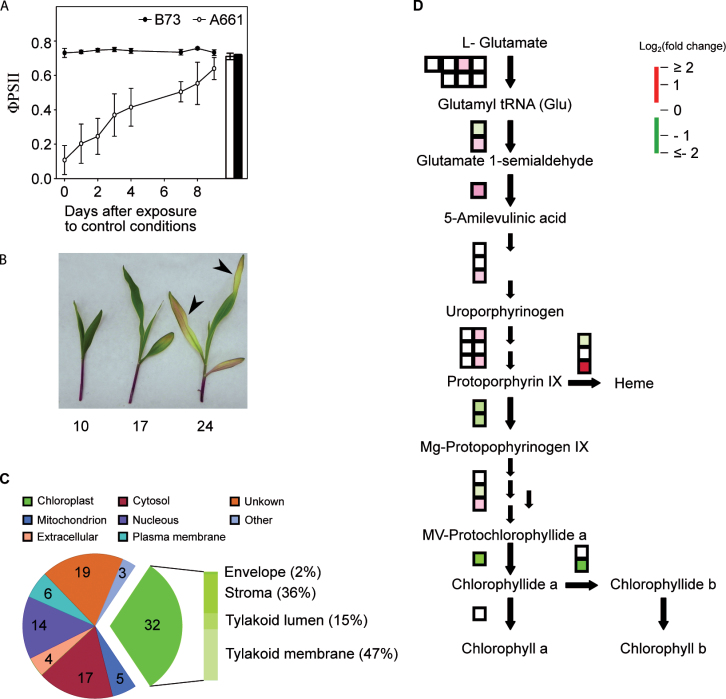
Cold-induced albino A661 plants recover chlorophyll content when exposed to control temperatures. (A) Quantum yield of photosystem II (ΦPSII) recorded using a portable fluoremeter (OS-30P) in plants grown during 24 d under cold conditions and then exposed to control temperatures. Bars denote levels of ΦPSII in plants grown under control conditions (white, A661; black, B73). Data are representative of at least two independent experiments ±SE of five replicates. (B) Seedlings of A661 exposed to control conditions at different developmental stages. A661 seeds were planted during three different periods with a 1 week interval between sowings. Ten days after the last sowing, the temperature was increased to 25 ºC under the same conditions. (C) Subcellular and subchloroplastic localization of genes differentially expressed in the CL versus CC sections of A661 leaves. The number within each sector represents the percentage of genes with that localization. Subcellular localization was predicted using the WoLF PSORT software. Subchloroplast localization was predicted using the SubChlo software. (D) Schematic representation of significant changes in transcript levels of genes involved in the tetrapyrrole pathway.
Fig. 4.
Fig. 4.
Quantitative RT–PCR expression analysis of genes involved in the chlorophyll biosynthetic pathway. (A) Relative expression of key genes involved in the chlorophyll biosynthetic pathway. Expression of glu-tRNA (glutamyl-tRNA synthetase), feche (ferrochelatase), and MgChe (magnesium chelatase) is shown on the left axis. Values of pora (protochlorophyllide reductase A) and cao (chlorophyllide a oxygenase) are shown on the right axis. The glyceraldehyde-3-phosphate dehydrogenase (gap) was used to normalize test gene transcript levels. *P < 0.05; ***P < 0.001 (t-test). (B) Relative expression of the elip (early light inducible protein) gene. The gap gene was used to normalize test gene transcript levels. ***P < 0.001 (t-test). (C) Bars represent the relative expression of the elip gene of 16 (A661×EP42) F2:3 families grown under cold conditions. The gap gene was used to normalize test gene transcript levels. Samples were collected from eight plants from each family and combined for mRNA extraction. The line graph represents the chlorophyll content index (CCI) of the same families. Values are the mean of eight plants from each family. (A and B) Data are representative of at least two independent experiments ±SE of three replicates.

References

    1. Aarti D, Tanaka R, Ito H, Tanaka A. 2007. High light inhibits chlorophyll biosynthesis at the level of 5-aminolevulinate synthesis during de-etiolation in cucumber (Cucumis sativus) cotyledons. Photochemistry and Photobiology 83, 171–176. - PubMed
    1. Adamska I, Kloppstech K, Ohad I. 1993. Early light-inducible protein in pea is stable during light stress but is degraded during recovery at low light intensity. Journal of Biological Chemistry 268, 5438–5444. - PubMed
    1. Agne B, Kessler F. 2009. Protein transport in organelles: the Toc complex way of preprotein import. FEBS Journal 276, 1156–1165. - PubMed
    1. Beale SI. 1999. Enzymes of chlorophyll biosynthesis. Photosynthesis Research 60, 43–73.
    1. Beisel KG, Jahnke S, Hofmann D, Köppchen S, Schurr U, Matsubara S. 2010. Continuous turnover of carotenes and chlorophyll a in mature leaves of Arabidopsis revealed by 14CO2 pulse-chase labeling. Plant Physiology 152, 2188–2199. - PMC - PubMed

Publication types

Associated data