Review
doi: 10.1101/cshperspect.a010397.
Break-induced DNA replication
Affiliations
- PMID: 23881940
- PMCID: PMC3839615
- DOI: 10.1101/cshperspect.a010397
Item in Clipboard
Review
Break-induced DNA replication
Cold Spring Harb Perspect Biol.
.
Abstract
Recombination-dependent DNA replication, often called break-induced replication (BIR), was initially invoked to explain recombination events in bacteriophage but it has recently been recognized as a fundamentally important mechanism to repair double-strand chromosome breaks in eukaryotes. This mechanism appears to be critically important in the restarting of stalled and broken replication forks and in maintaining the integrity of eroded telomeres. Although BIR helps preserve genome integrity during replication, it also promotes genome instability by the production of loss of heterozygosity and the formation of nonreciprocal translocations, as well as in the generation of complex chromosomal rearrangements.
Figures
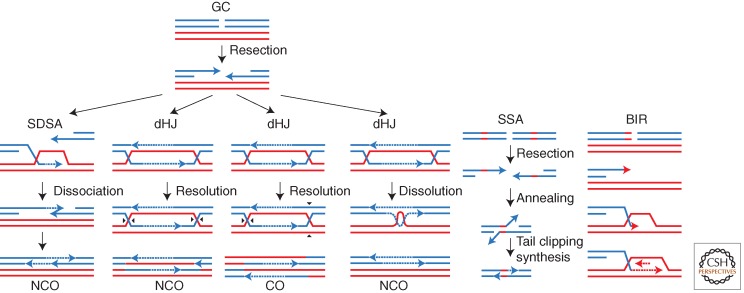
Three major repair pathways of homology-dependent recombination. Noncrossover (NCO) and crossover (CO) events are indicated. Black triangles represent resolution of Holliday junctions (HJs). Dashed lines represent new DNA synthesis. GC, gene conversion; SSA, single-strand annealing; BIR, break-induced replication.
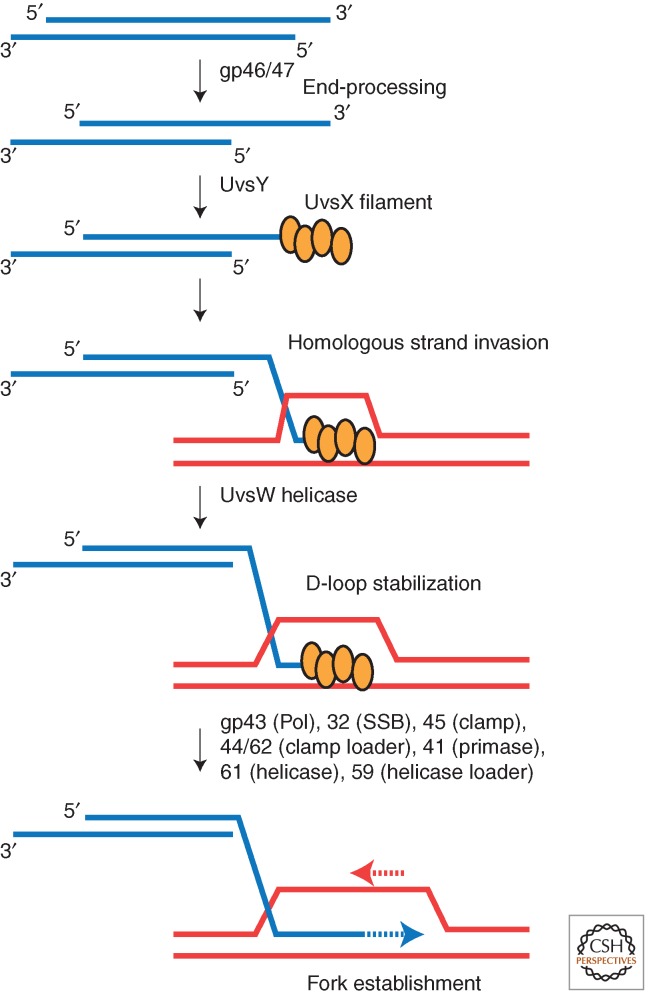
Scheme for recombination-dependent replication of T4. The end-replication problem leaves 3′ ssDNA ends on dsDNA (blue), further processed by gp46/47 nuclease. Mediator UvsY assists UvsX to form a presynaptic filament, competent for strand invasion with a homolgous duplex (red) to form D-loop intermediates. UvsW helicase stabilizes this structure. Full assembly of the replisome, consisting of gp43 (DNA polymerase), gp32 (single-strand DNA binding protein), gp45 (clamp) and gp44/62 (clamp loader), primase (gp41), and (gp61) fork helicase and helicase loader (gp59), establishing bidirectional replication.
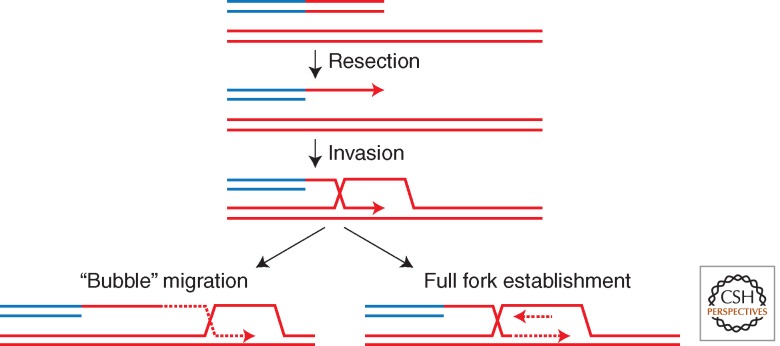
Key intermediates of replication initiated by homologous recombination. The double-stranded DNA end is resected, exposing the single-stranded 3′ end. Strand invasion results in a D-loop intermediate. Bubble migration involves priming of leading- but not lagging-strand DNA synthesis (left), whereas full fork establishment involves coupling of leading- and lagging-strand synthesis (right). The solid line with arrowhead represents the invading 3′ end. Dashed lines represent new DNA synthesis.
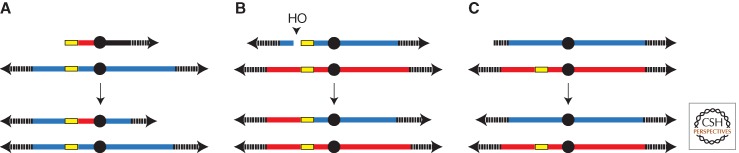
Three different assays used to explore BIR. BIR assays involving (A) a typical chromosome fragmentation vector (CFV), (B) HO-endonuclease-induced DSB where only one end shares homology with the donor (where homology is indicated in yellow), and (C) telomere maintenance in the absence of telomerase by recombination-dependent replication.
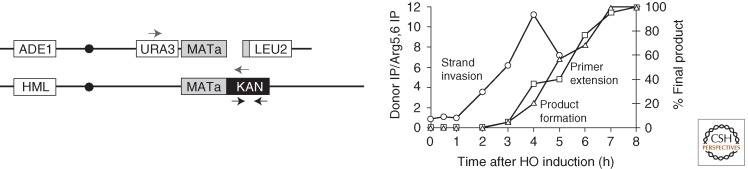
Kinetics of BIR. Schematic representation of a diploid BIR strain used to measure the kinetics of BIR, where there is only homology to the left of the DSB (left). Black arrows represent the position of primers used for ChIP analysis. Gray arrows represent the position of primers used for primer extension assay. The graph (right) shows the kinetics of strand invasion (circles), initiation of new DNA synthesis (squares), and product formation (triangles). (Figure modified from Jain et al. 2009.)
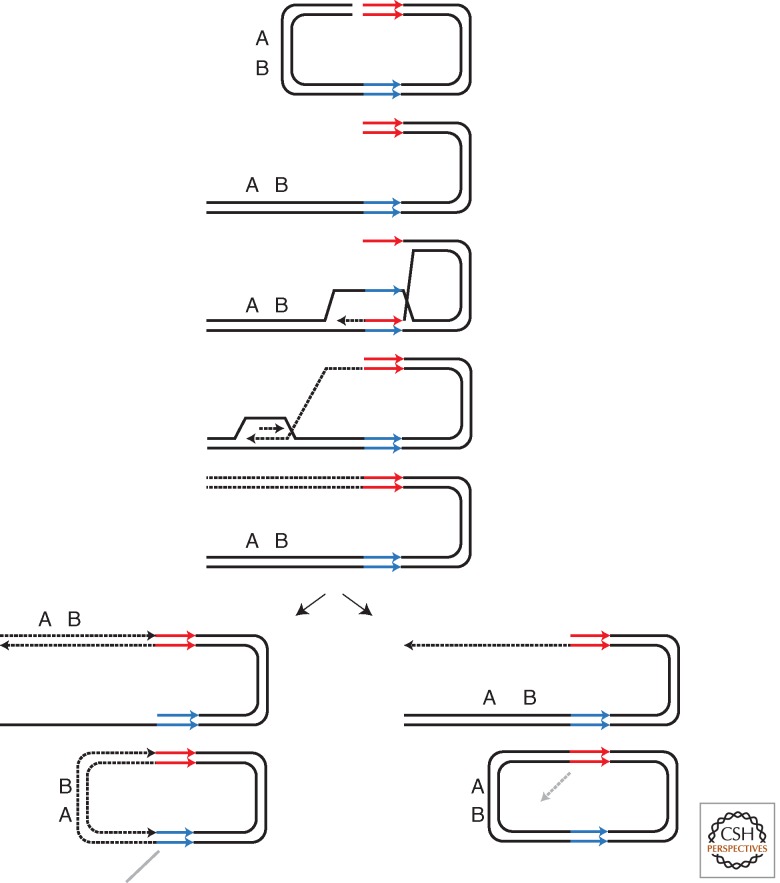
Schematic of events that involve a combination of BIR and SSA. Inverted repeats are shown as blue and red arrows, respectively, which are separated by marker AB. DSB at one of the inverted repeats is followed by resection and invasion into the other (homologous) inverted repeat. DNA synthesis (dashed line) proceeds until the end of the break. Depending on which strand gets resected, SSA results in different orientation of the marker (AB). (Figure adapted from Bartsch et al. 2000.)
References
Publication types
MeSH terms
Substances
Grants and funding
- R01 GM076020/GM/NIGMS NIH HHS/United States
- GM20056/GM/NIGMS NIH HHS/United States
- R01 GM051753/GM/NIGMS NIH HHS/United States
- F32 GM096690/GM/NIGMS NIH HHS/United States
- R01 GM061766/GM/NIGMS NIH HHS/United States
- R37 GM020056/GM/NIGMS NIH HHS/United States
- T32 GM007122/GM/NIGMS NIH HHS/United States
- GM51753/GM/NIGMS NIH HHS/United States
- 2T32GM007122/GM/NIGMS NIH HHS/United States
- GM76020/GM/NIGMS NIH HHS/United States
- GM61766/GM/NIGMS NIH HHS/United States
- R01 GM020056/GM/NIGMS NIH HHS/United States
- 1F32GM096690-01/GM/NIGMS NIH HHS/United States
LinkOut - more resources
Full Text Sources
Other Literature Sources