


Socio-demographic and behavioural correlates of physical activity perception in individuals with recently diagnosed diabetes: results from a cross-sectional study
- PMID: 23883169
- PMCID: PMC3729669
- DOI: 10.1186/1471-2458-13-678
Socio-demographic and behavioural correlates of physical activity perception in individuals with recently diagnosed diabetes: results from a cross-sectional study
Abstract
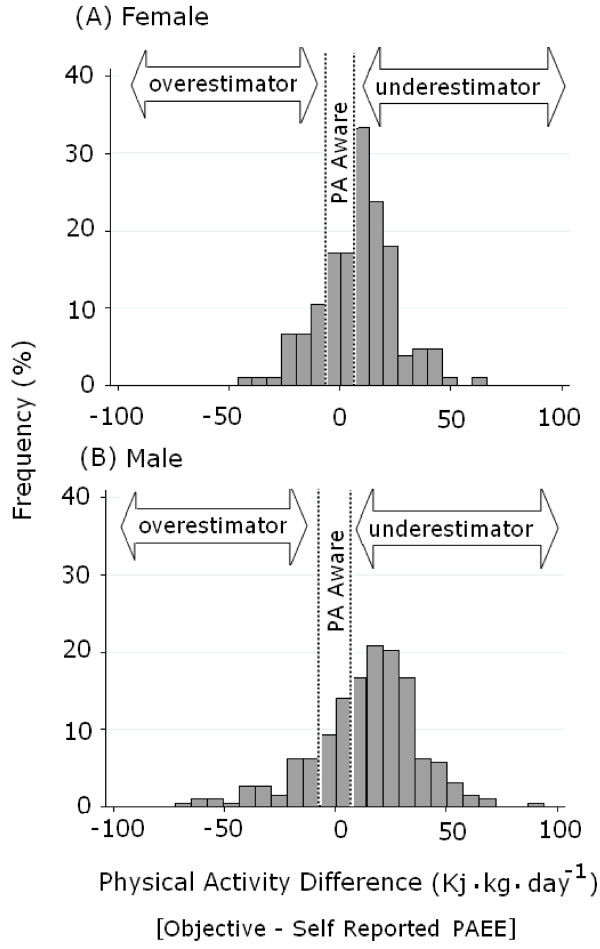
Background: Physical activity (PA) levels in type 2 diabetes mellitus (T2DM) patients are generally low. Poor PA perception may impede healthy behaviour change in this high risk group. We describe (i) objective PA levels, (ii) the difference between objective and self-reported PA ('PA disparity') and the correlates of (iii) PA disparity and (iv) overestimation in recently diagnosed T2DM patients.
Methods: Cross-sectional analysis of 425 recently diagnosed T2DM patients aged 42 to 71, participating in the ADDITION-Plus study in Eastern England, UK. We define 'PA disparity' as the non-negative value of the difference (in mathematical terms the absolute difference) between objective and self-reported physical activity energy expenditure (PAEE in kJ · kg-1 · day-1). 'Overestimators' comprised those whose self-reported- exceeded objective-PAEE by 4.91 kJ · kg-1 · day-1(the equivalent of 30 minutes moderate activity per day). Multivariable linear regression examined the association between PA disparity (continuous) and socio-demographic, clinical, health behaviour, quality of life and psychological characteristics. Logistic regression examined the association between PA overestimation and individual characteristics.
Results: Mean objective and self-reported PAEE levels ± SD were 34.4 ± 17.0 and 22.6 ± 19.4 kJ · kg-1·day-1, respectively (difference in means =11.8; 95% CI=9.7 to 13.9 kJ · kg-1 · day-1). Higher PA disparity was associated with male sex, younger age, lower socio-economic status and lower BMI. PA overestimators comprised 19% (n=80), with those in routine/manual occupations more likely to be overestimators than those in managerial/professional occupations.
Conclusions: T2DM patients with poor physical activity perception are more likely to be male, younger, from a lower socio-economic class and to have a lower BMI. PA overestimators were more likely to be in lower socio-economic categories. Self-monitoring and targeted feedback, particularly to those in lower socio-economic categories, may improve PA perceptions and optimise interventions in T2DM patients. Our findings suggest that strategies for enabling realistic assessment of physical activity levels, through self-monitoring or feedback, warrant further investigation and may help refine and improve physical activity interventions.
Figures
Similar articles
-
Descriptive epidemiology of physical activity energy expenditure in UK adults (The Fenland study).Int J Behav Nutr Phys Act. 2019 Dec 9;16(1):126. doi: 10.1186/s12966-019-0882-6. Int J Behav Nutr Phys Act. 2019. PMID: 31818302 Free PMC article.
-
Levels of physical activity among a nationally representative sample of people in early old age: results of objective and self-reported assessments.Int J Behav Nutr Phys Act. 2014 May 3;11:58. doi: 10.1186/1479-5868-11-58. Int J Behav Nutr Phys Act. 2014. PMID: 24885497 Free PMC article.
-
Awareness of physical activity in healthy middle-aged adults: a cross-sectional study of associations with sociodemographic, biological, behavioural, and psychological factors.BMC Public Health. 2014 May 2;14:421. doi: 10.1186/1471-2458-14-421. BMC Public Health. 2014. PMID: 24886612 Free PMC article.
-
Overestimation of physical activity level is associated with lower BMI: a cross-sectional analysis.Int J Behav Nutr Phys Act. 2010 Sep 20;7:68. doi: 10.1186/1479-5868-7-68. Int J Behav Nutr Phys Act. 2010. PMID: 20854659 Free PMC article.
-
Socio-demographic, medical and social-cognitive correlates of physical activity behavior among older adults (45-70 years): a cross-sectional study.BMC Public Health. 2014 Jun 25;14:647. doi: 10.1186/1471-2458-14-647. BMC Public Health. 2014. PMID: 24965940 Free PMC article.
Cited by
-
Lifestyle interventions for type 2 diabetes prevention in women with prior gestational diabetes: A systematic review and meta-analysis of behavioural, anthropometric and metabolic outcomes.Prev Med Rep. 2015 May 24;2:448-61. doi: 10.1016/j.pmedr.2015.05.009. eCollection 2015. Prev Med Rep. 2015. PMID: 26844102 Free PMC article. Review.
-
Influencing Factors on the Overestimation of Self-Reported Physical Activity: A Cross-Sectional Analysis of Low Back Pain Patients and Healthy Controls.Biomed Res Int. 2016;2016:1497213. doi: 10.1155/2016/1497213. Epub 2016 May 19. Biomed Res Int. 2016. PMID: 27298820 Free PMC article. Clinical Trial.
-
Reasons for non-participation in a primary care-based physical activity trial: a qualitative study.BMJ Open. 2016 May 23;6(5):e011577. doi: 10.1136/bmjopen-2016-011577. BMJ Open. 2016. PMID: 27217288 Free PMC article.
-
Understanding the links between resilience and type-2 diabetes self-management: a qualitative study in South Australia.Arch Public Health. 2017 Sep 21;75:56. doi: 10.1186/s13690-017-0222-8. eCollection 2017. Arch Public Health. 2017. PMID: 28944055 Free PMC article.
-
Using a Socio-Environmental Approach to Explore the Determinants for Meeting the Recommended Physical Activity among Adults at Risk of Diabetes in Rural Indonesia.Healthcare (Basel). 2021 Oct 29;9(11):1467. doi: 10.3390/healthcare9111467. Healthcare (Basel). 2021. PMID: 34828514 Free PMC article.
References
-
- Nathan DM, Buse JB, Davidson MB, Ferrannini E, Holman RR, Sherwin R, Zinman B. Medical management of hyperglycaemia in type 2 diabetes mellitus: a consensus algorithm for the initiation and adjustment of therapy: a consensus statement from the American Diabetes Association and the European Association for the Study of Diabetes. Diabetologia. 2009;52(1):17–30. - PubMed
-
- Department of Health. Start Active, Stay Active: A report on physical activity from the four home countries’ Chief Medical Officers. London: DoH; 2011. http://www.dh.gov.uk/en/Publicationsandstatistics/Publications/Publicati....
-
- Snowling NJ, Hopkins WG. Effects of different modes of exercise training on glucose control and risk factors for complications in type 2 diabetic patients: a meta-analysis. Diabetes Care. 2006;29(11):2518–2527. - PubMed
-
- Boule NG, Haddad E, Kenny GP, Wells GA, Sigal RJ. Effects of exercise on glycemic control and body mass in type 2 diabetes mellitus: a meta-analysis of controlled clinical trials. JAMA. 2001;286(10):1218–1227. - PubMed
Publication types
MeSH terms
Grants and funding
LinkOut - more resources
Full Text Sources
Other Literature Sources
Medical
