


Nestling telomere length does not predict longevity, but covaries with adult body size in wild barn swallows
- PMID: 23883575
- PMCID: PMC3971670
- DOI: 10.1098/rsbl.2013.0340
Nestling telomere length does not predict longevity, but covaries with adult body size in wild barn swallows
Abstract
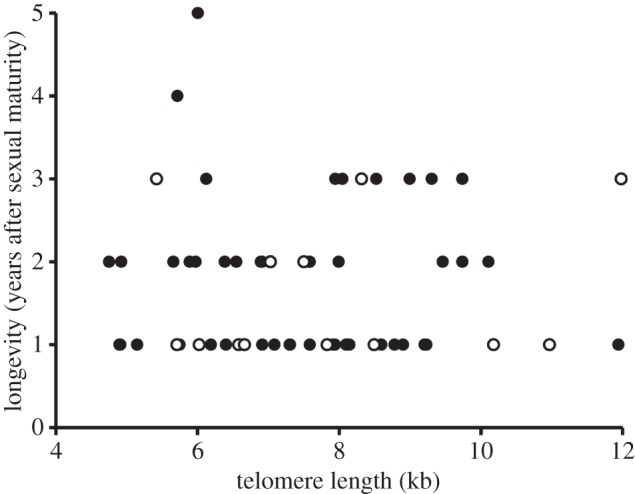
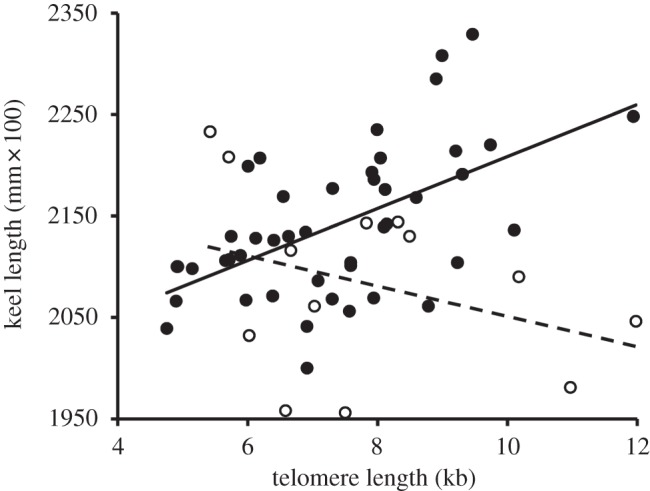
Telomere length and dynamics are increasingly scrutinized as ultimate determinants of performance, including age-dependent mortality and fecundity. Few studies have investigated longevity in relation to telomere length (TL) in the wild and none has analysed longevity in relation to TL soon after hatching, despite the fact that telomere shortening may mostly occur early in life. We show that TL in nestling barn swallows (Hirundo rustica) in the wild does not predict longevity. However, TL positively covaries with body size, suggesting that individuals with large TL can afford to grow larger without paying the cost of reduced TL, and/or that benign rearing conditions ensure both large body size and low rates of telomere shortening. Overall, our study hints at a role of TL in developmental processes, but also indicates a need for further analyses to assess the expectation that TL in young individuals predicts longevity in the wild.
Keywords: body size; longevity; nestlings; sex; telomere length.
Figures
References
-
- Kirkwood TBL, Austad SN. 2000. Why do we age? Nature 408, 233–238 (doi:10.1038/35041682) - DOI - PubMed
-
- Monaghan P, Haussmann M. 2006. Do telomere dynamics link lifestyle and lifespan? Trends Ecol. Evol. 21, 47–53 (doi:10.1016/j.tree.2005.11.007) - DOI - PubMed
-
- Xin H, Liu D, Songyang Z. 2008. The telosome/shelterin complex and its functions. Genome Biol. 9, 232 (doi:10.1186/gb-2008-9-9-232) - DOI - PMC - PubMed
-
- Bolzan AD, Bianchi MS. 2006. Telomeres, interstitial telomeric repeat sequences, and chromosomal aberrations. Mutat. Res. 612, 189–214 (doi:10.1016/j.mrrev.2005.12.003) - DOI - PubMed
-
- von Zglinicki T. 2002. Oxidative stress shortens telomeres. Trends Biochem. Sci. 27, 339–344 (doi:10.1016/S0968-0004(02)02110-2) - DOI - PubMed
MeSH terms
LinkOut - more resources
Full Text Sources
Other Literature Sources
