Review
. 2013 Jul 24;10(87):20130396.
doi: 10.1098/rsif.2013.0396. Print 2013 Oct 6.

Bioavailability of silver nanoparticles and ions: from a chemical and biochemical perspective

Affiliations
Review

Bioavailability of silver nanoparticles and ions: from a chemical and biochemical perspective

Renata Behra et al. J R Soc Interface. .

Abstract

Owing to their antimicrobial properties, silver nanoparticles (NPs) are the most commonly used engineered nanomaterial for use in a wide array of consumer and medical applications. Many discussions are currently ongoing as to whether or not exposure of silver NPs to the ecosystem (i.e. plants and animals) may be conceived as harmful or not. Metallic silver, if released into the environment, can undergo chemical and biochemical conversion which strongly influence its availability towards any biological system. During this process, in the presence of moisture, silver can be oxidized resulting in the release of silver ions. To date, it is still debatable as to whether any biological impact of nanosized silver is relative to either its size, or to its ionic constitution. The aim of this review therefore is to provide a comprehensive, interdisciplinary overview--for biologists, chemists, toxicologists as well as physicists--regarding the production of silver NPs, its (as well as in their ionic form) chemical and biochemical behaviours towards/within a multitude of relative and realistic biological environments and also how such interactions may be correlated across a plethora of different biological organisms.

Keywords: biological impact; silver ions; silver nanoparticles.


Figures
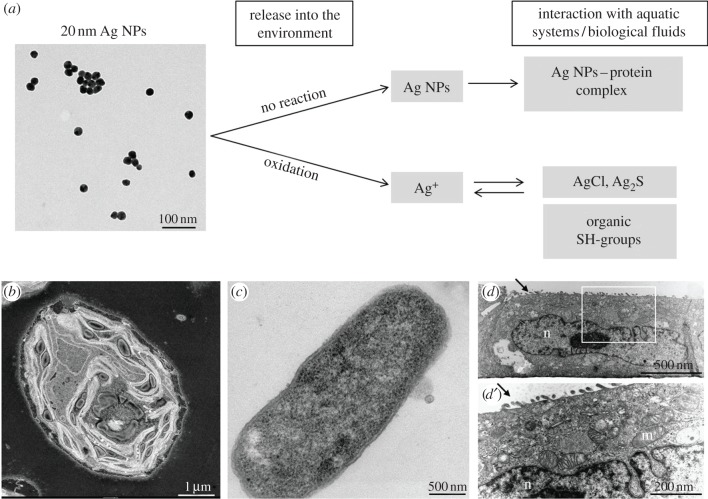
Figure 1.
Figure 1.
Ag NPs released into the environment can either interact with the environment as metallic particles or be oxidized to Ag+. Both species can then undergo further interactions with aquatic and/or biological fluids and interact with proteins or chloride or thiols (a). All Ag species (underlined with a grey box) can then interact with aquatic systems such as (b) algae, (c) bacteria or (d,d’) mammalian cells. (b) Represents a dark field scanning electron microscope (STEM) image of a section through an algae cell Chlamydomonas reinhardtii (courtesy by E. Müller & S. Handschin, EMEZ, ETH Zürich) evidencing the cell wall surrounding the cell. Clearly visible are the photosynthetic thylakoid membranes of the chloroplast which occupy most of the cellular space. For Ag NPs to be effective in inhibiting photosynthesis, particles need to pass through the cell wall, cell membrane and the chloroplast envelope. Conventional transmission electron micrograph image of a bacteria Salmonella typhimurium (c) shows the surrounding of the bacteria with a cell membrane that encloses all essential components of the cytoplasma. Note that bacteria do not have membrane-bound compartments. (d) Represents a TEM picture from an epithelial lung cell in vitro showing the typical polarization of an epithelium with the microvilli's at the apical surface (arrow). At higher magnification (d’) the typical membrane-bound intracellular compartments like cell nucleus (n) and mitochondria (m) can be identified.
Figure 2.
Figure 2.
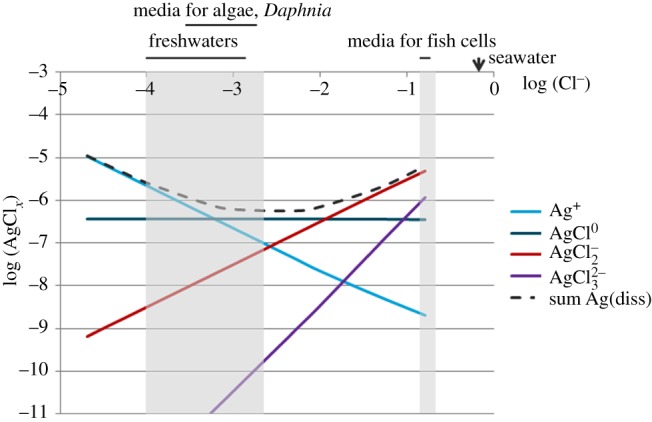
Dissolved Ag-species concentrations (M) at equilibrium with AgCl(s) over a range of (Cl) (M) concentrations (pH 7.5). The dashed line represents the sum of all dissolved species, including Ag+, AgCl0(aq), AgCl2, AgCl32−. The shaded areas represent the chloride concentration ranges of freshwaters and media for freshwater algae and invertebrates, and of media for fish and mammalian cells.
Figure 3.
Figure 3.
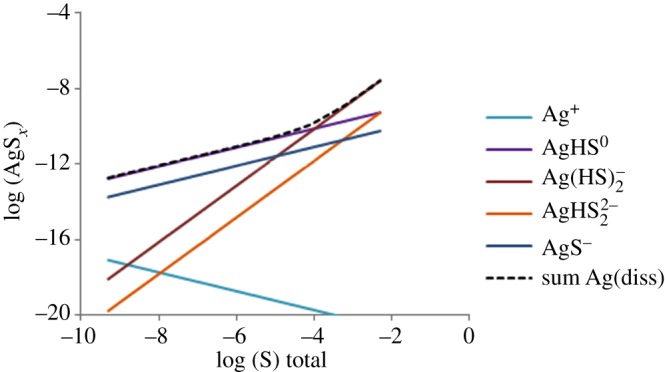
Dissolved Ag-species concentrations (M) at equilibrium with Ag2S(s) over a range of total S(-II) concentrations (M, pH 7.5). The dashed line represents the sum of dissolved Ag-species, including Ag+, AgHS0(aq), Ag(HS)2, AgHS22−, AgS.
Figure 4.
Figure 4.
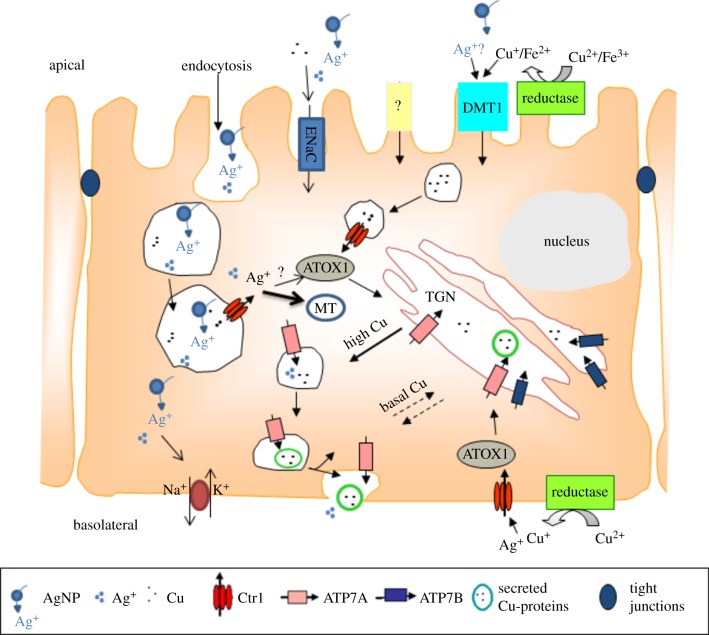
Proposed model for Ag NP uptake and interactions with Cu transporters in a putative gill cell. While Ag NPs might enter the gill cell only through endocytosis, Ag+ dissolving from the particle surface could enter the cell via the sodium channel (ENaC) or an unknown transporter (?) or possibly sharing Cu transporters routes via DMT1 or CTR1. However, CTR1 is more likely to be involved in intracellular transport of Ag from endosomes or other vesicles. Cu enters via CTR1 at the basolateral membrane or via DMT1, endocytosis or other unidentified transporters at the apical membrane in enterocytes. Previous entry via CTR1 and DMT1 Cu is reduced by the metalloreductases. After entry Cu is bound to the chaperone ATOX1 which delivers Cu to the Cu-ATPases located at the trans golgi network (TGN). The Cu-ATPases ATP7A and ATP7B may then deliver Cu to cuproenzymes and secretory Cu-proteins or excrete Cu once Cu levels are high. A possible route of excretion for intracellular Ag+ would be through the same pathway (CTR1-ATOX1-Cu-ATPases), however, this hypothesis remains to be demonstrated. Ag NPs or Ag+ dissolving from their surfaces can also interact and inhibit the Na/K-ATPase located at the basolateral membrane. (Adapted from Minghetti et al. [123].)
Figure 5.
Figure 5.
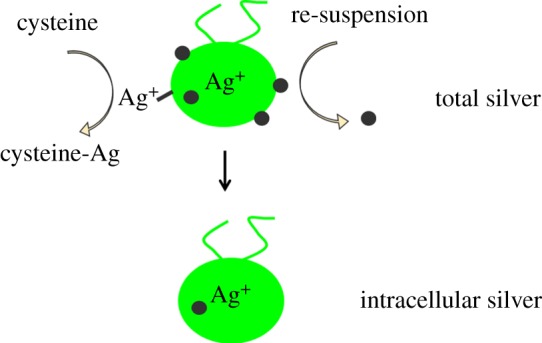
Schematic of Ag distribution in algae after exposure to Ag NPs. Total Ag determined by ICP-MS includes Ag NPs and Ag+ adsorbed to algal surfaces as well as internalized Ag in the form of particles or dissolved Ag. Assessing the intracellular concentration of Ag requires re-suspending algae in an Ag-free medium to remove adsorbed particles and washing with cysteine, which as a strong Ag ligand removes adsorbed Ag+. Black dots represent Ag NPs. (Online version in colour.)

References

    1. Gwinn MR, Vallyathan V. 2006. Nanoparticles: health effects—pros and cons. Environ. Health Perspect. 114, 1818–1825. - PMC - PubMed
    1. Maynard A, Aitken R. 2007. Assessing exposure to airborne nanomaterials: current abilities and future requirements. Nanotoxicology 1, 26–41. ( 10.1080/17435390701314720) - DOI
    1. ISO/TS 27687: 2008.
    1. Edwards-Jones V. 2009. The benefits of silver in hygiene, personal care and healthcare. Lett. Appl. Microbiol. 49, 147–152. ( 10.1111/j.1472-765X.2009.02648.x) - DOI - PubMed
    1. Eckhardt S, et al. 2013. Nanobio silver: its interactions with peptides and bacteria, and its uses in medicine. Chem. Rev. ( 10.1021/cr300288v) - DOI - PubMed

Publication types

LinkOut - more resources