


Comment
doi: 10.1126/scitranslmed.3006850.
When killers become helpers
Affiliations
- PMID: 23884464
- PMCID: PMC3955842
- DOI: 10.1126/scitranslmed.3006850
Item in Clipboard
Comment
When killers become helpers
Sci Transl Med.
.
Abstract
Interplay between a natural killer (NK)-cell receptor, NKp30, and other cells in the salivary glands profoundly affects pathogenesis of the autoimmune disease Sjögren's syndrome (Rusakiewicz et al., this issue).
Conflict of interest statement
Figures
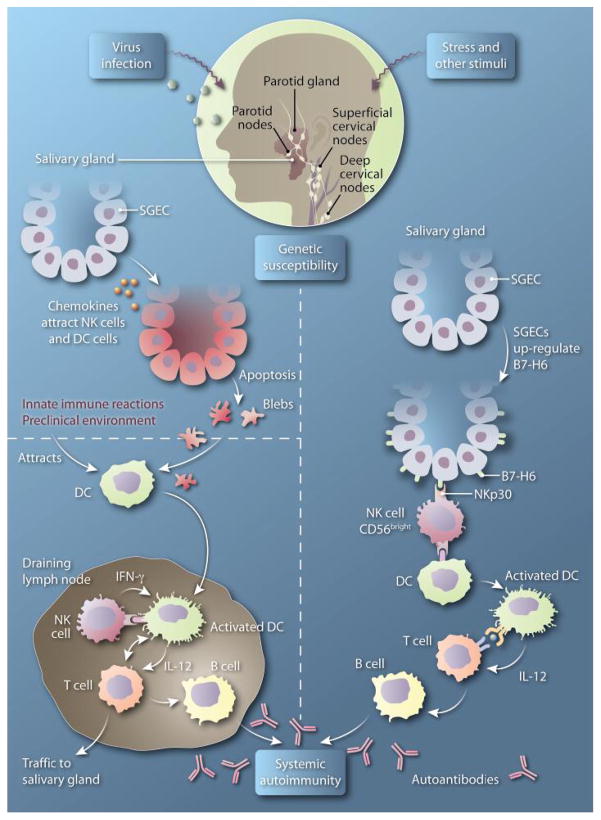
(Left) In lymph nodes that drain the salivary glands, NK cells interact with DCs carrying apoptotic debris from SGECs, resulting in DC maturation. Mature DCs interact with and activate T cells, which then couple with and activate B cells, thus initiating the systemic autoimmune response. (Right) Within the salivary glands, NKp30-expressing NK cells interact with SGECs that express B7-H6. This interaction leads to the production of multiple chemokines, which spurs inflammatory cell infiltration within the salivary gland. NK-activated DCs interact with infiltrating T cells. The resulting activated T cells couple with and activate B cells, which produce autoantibodies and thus initiate and sustain a localized autoimmune response. IL-12, interleukin-12.
Comment on
-
NCR3/NKp30 contributes to pathogenesis in primary Sjogren's syndrome.Sci Transl Med. 2013 Jul 24;5(195):195ra96. doi: 10.1126/scitranslmed.3005727. Sci Transl Med. 2013. PMID: 23884468 Free PMC article.
References
-
- Yao Y, Liu Z, Jallal B, Shen N, Rönnblom L. Type I interferons in Sjögren’s syndrome. Autoimmun Rev. 2013:558–566. - PubMed
-
- Rusakiewicz S, Nocturne G, Lazure T, Semeraro M, Flament C, Caillat-Zucman S, Sène D, Delahaye N, Vivier E, Chaba K, Poirier-Colame V, Nordmark G, Eloranta M-L, Eriksson P, Theander E, Forsblad-d’Elia H, Omdal R, Wahren-Herlenius M, Jonsson R, Rönnblom L, Nititham J, Taylor KE, Lessard CJ, Moser Sivils KL, Gottenberg J-E, Criswell LA, Miceli-Richard C, Zitvogel L, Mariette X. NCR3/NKp30 contributes to pathogenesis in primary Sjögren’s syndrome. Sci Trans Med. 2013:195ra96. - PMC - PubMed
Publication types
MeSH terms
Substances
Grants and funding
LinkOut - more resources
Full Text Sources
Other Literature Sources
Medical
