. 2013 Jul 26:6:294.
doi: 10.1186/1756-0500-6-294.

Role of the Candida albicans MNN1 gene family in cell wall structure and virulence

Affiliations

Role of the Candida albicans MNN1 gene family in cell wall structure and virulence

Steven Bates et al. BMC Res Notes. .

Abstract

Background: The Candida albicans cell wall is the first point of contact with the host, and its outer surface is heavily enriched in mannoproteins modified through the addition of N- and O-mannan. Previous work, using mutants with gross defects in glycosylation, has clearly identified the importance of mannan in the host-pathogen interaction, immune recognition and virulence. Here we report the first analysis of the MNN1 gene family, which contains six members predicted to act as α-1,3 mannosyltransferases in the terminal stages of glycosylation.

Findings: We generated single null mutants in all members of the C. albicans MNN1 gene family, and disruption of MNN14 led to both in vitro and in vivo defects. Null mutants in other members of the family demonstrated no phenotypic defects, suggesting that these members may display functional redundancy. The mnn14Δ null mutant displayed hypersensitivity to agents associated with cell wall and glycosylation defects, suggesting an altered cell wall structure. However, no gross changes in cell wall composition or N-glycosylation were identified in this mutant, although an extension of phosphomannan chain length was apparent. Although the cell wall defects associated with the mnn14Δ mutant were subtle, this mutant displayed a severe attenuation of virulence in a murine infection model.

Conclusion: Mnn14 plays a distinct role from other members of the MNN1 family, demonstrating that specific N-glycan outer chain epitopes are required in the host-pathogen interaction and virulence.


Figures
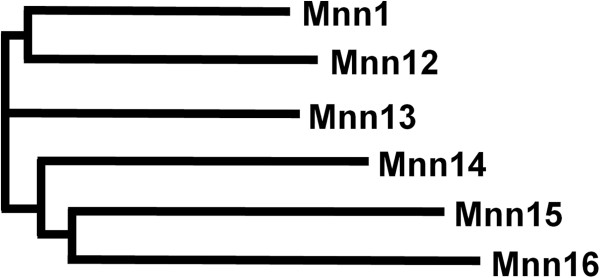
Figure 1
Figure 1
Phylogram of the C. albicans MNN1 gene family. A multiple sequence alignment and phylogram of the six MNN1 orthologues was generated in Clustal Omega (version 1.1.0).
Figure 2
Figure 2
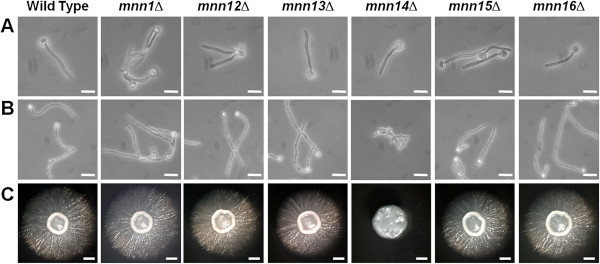
Cell and colony morphology of MNN1 family mutants. Cell morphology after growth at 37°C in 20% serum for 4 h (A) and at 37°C in Lee’s at pH6.5 for 6 h (B). Scale bar, 10 μm. (C) Colony morphology after 6 days growth at 30°C on solid Spider medium. Scale bar, 1 mm.
Figure 3
Figure 3
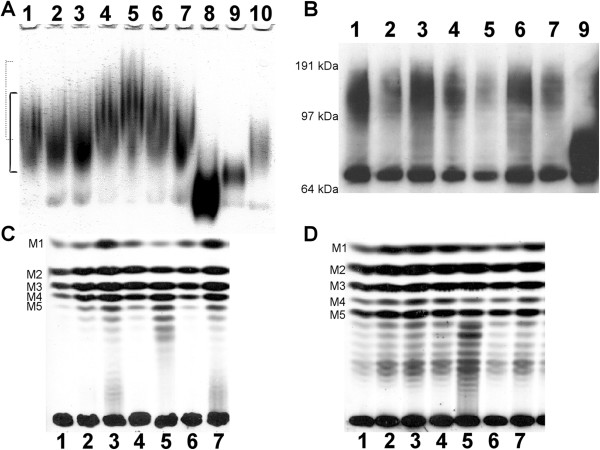
Glycosylation defects in C. albicans MNN1 family null mutants. The extent of N-glycosylation was determined by activity staining of Hex1 (β-N-acetylhexosaminidase) after protein samples were separated by non-denaturing gel electrophoresis (A). The continuous and dotted lines indicate the normal and decreased electrophoretic mobility of Hex1 respectively. The degree of N-glycosylation modification was also determined by western blot analysis of Hex1-V5-6× His tagged strains (B). Hex1-V5-6× His is apparent in both an unmodified (67 kDa) and a heavily glycosylated (~125 kDa) form. Acid-labile phosphomannan (C) and β-eliminated O-mannan (D) were released from [2-3H] mannose-labelled cells and separated by TLC. Samples are as follows: lane 1, wild type; lane 2, mnn1∆; lane 3, mnn12∆; lane 4, mnn13∆; lane 5, mnn14∆; lane 6, mnn15∆; lane 7, mnn16∆; lane 8, och1∆; lane 9, pmr1∆; lane 10, mnt1∆-mnt2∆.
Figure 4
Figure 4
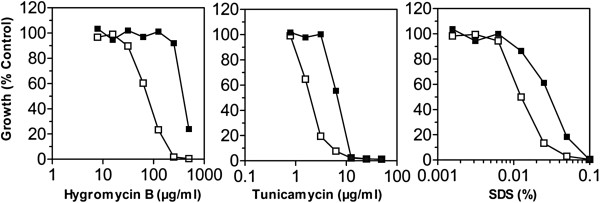
Sensitivity of C. albicans mnn14Δ null mutant to cell wall perturbing agents. The sensitivities of the wild type (closed squares) and Camnn14Δ null mutant (open squares) to cell wall perturbing agents were determined by a broth microdilution method. The agents to which the Camnn14Δ null mutant displayed hypersensitivity are shown (hygromycin B, tunicamycin, and SDS).
Figure 5
Figure 5
Biofilm formation of MNN1 family mutants. Biofilm formation was assessed in 96 well plates using a tetrazolium salt (XTT) reduction assay following growth in SC medium for 24 h (closed bars) and 48 h (open bars).

References

    1. Leroy O, Gangneux JP, Montravers P, Mira JP, Gouin F, Sollet JP, Carlet J, Reynes J, Rosenheim M, Regnier B, Lortholary O. Epidemiology, management, and risk factors for death of invasive Candida infections in critical care: a multicenter, prospective, observational study in France (2005–2006) Crit Care Med. 2009;37:1612–1618. doi: 10.1097/CCM.0b013e31819efac0. - DOI - PubMed
    1. Perlroth J, Choi B, Spellberg B. Nosocomial fungal infections: epidemiology, diagnosis, and treatment. Med Mycol. 2007;45:321–346. doi: 10.1080/13693780701218689. - DOI - PubMed
    1. Pfaller MA, Diekema DJ. Epidemiology of invasive mycoses in North America. Crit Rev Microbiol. 2010;36:1–53. doi: 10.3109/10408410903241444. - DOI - PubMed
    1. Klis FM, de Groot P, Hellingwerf K. Molecular organization of the cell wall of Candida albicans. Med Mycol. 2001;39(Suppl 1):1–8. - PubMed
    1. Mora-Montes HM, Ponce-Noyola P, Villagomez-Castro JC, Gow NA, Flores-Carreon A, Lopez-Romero E. Protein glycosylation in Candida. Future Microbiol. 2009;4:1167–1183. doi: 10.2217/fmb.09.88. - DOI - PubMed

Publication types

Substances