


A qualitative synthesis of trials promoting physical activity behaviour change among post-treatment breast cancer survivors
- PMID: 23888337
- PMCID: PMC3838584
- DOI: 10.1007/s11764-013-0296-4
A qualitative synthesis of trials promoting physical activity behaviour change among post-treatment breast cancer survivors
Abstract
Background: Health outcome trials have provided strong evidence that participating in regular physical activity can improve the quality of life and health of post-treatment breast cancer survivors. Focus is now needed on how to promote changes in physical activity behaviour among this group.
Purpose: This systematic review examines the efficacy of behavioural interventions for promoting physical activity among post-treatment breast cancer survivors.
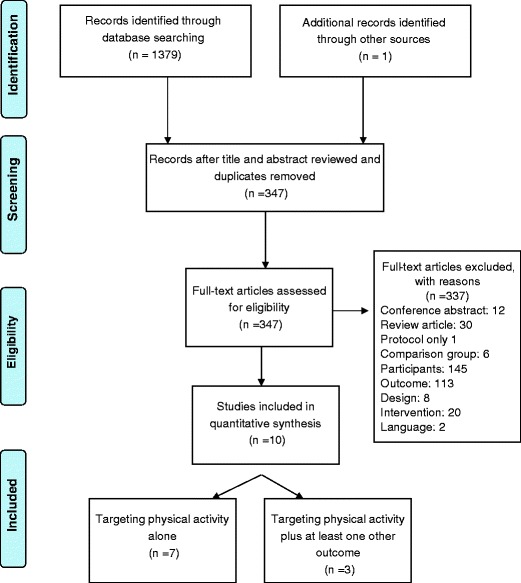
Methods: Behavioural intervention studies published up until July 2012 were identified through a systematic search of two databases: MEDLINE and CINAHL, and by searching reference lists of relevant publications and scanning citation libraries of project staff.
Results: Eight out of the ten identified studies reported positive intervention effects on aerobic physical activity behaviour, ranging from during the intervention period to 6 months post-intervention. Only two studies reported intervention effect sizes. The identification of factors related to efficacy was not possible because of the limited number and heterogeneity of studies included, as well as the lack of effect sizes reported. Nonetheless, an examination of the eight studies that did yield significant intervention effects suggests that 12-week interventions employing behaviour change techniques (e.g., self-monitoring and goal setting) derived from a variety of theories and delivered in a variety of settings (i.e., one-on-one, group or home) can be effective at changing the aerobic physical activity behaviour of breast cancer survivors in the mid- to long terms.
Conclusions: Behavioural interventions do hold promise for effectively changing physical activity behaviour among breast cancer survivors. However, future research is needed to address the lack of studies exploring long-term intervention effects, mediators of intervention effects and interventions promoting resistance-training activity, and to address issues impacting on validity, such as the limited use of objective physical activity measures and the use of convenience samples.
Implications for cancer survivors: Identifying effective ways of assisting breast cancer survivors to adopt and maintain physical activity is important for enhancing the well-being and health outcomes of this group.
Figures
References
-
- Australian Institute of Health and Welfare and National Breast and Ovarian Cancer Centre, Breast cancer in Australia: an overview, 2009, AIHW: Canberra.
-
- Aziz NM. Cancer survivorship research: challenge and opportunity. J Nutr. 2002;132(11):3494S–503. - PubMed
-
- Feuerstein M, Handbook of cancer survivorship . Handbook of cancer survivorship. New York: Springer; 2007. p. 504.
-
- Chlebowski R. Lifestyle change including dietary fat reduction and breast cancer outcome. J Nutr. 2007;137(1):233S–5. - PubMed
Publication types
MeSH terms
LinkOut - more resources
Full Text Sources
Other Literature Sources
Medical
